


Warren Buffett's Successor, Greg Abel, Just Sent a Massive Warning to the Market
Key Points
Berkshire has been a net seller of stocks for much of the current bull market, suggesting the need for caution.
Greg Abel cut his stake in several stocks in the third quarter, including two bank stocks.
Low confidence in bank stocks could imply fear of economic volatility.
- 10 stocks we like better than Berkshire Hathaway ›
Warren Buffett has been a beacon for investors for decades, offering wisdom to the everyday investor looking to replicate his storied investing success.
He's no longer the CEO of the legendary holding company he created, Berkshire Hathaway (NYSE:BRKA)(NYSE:BRKB), but in the months since his chosen successor, Greg Abel, took the helm, he's demonstrated his commitment to the company's values and a savvy approach to the portfolio.
Missed AI’s "Act 1"? Act 2 Could Be 15x Bigger. Most investors think they missed the AI boat because they didn't buy Nvidia in 2005. But according to our analysts, we’re only at the end of "Act 1"—the R&D phase. "Act 2" is the global rollout. Continue »
Buffett and his team have been sending a warning to the market for years already. True to his maxim of being greedy when others are fearful and fearful when others are greedy, Berkshire Hathaway has been a net seller of stocks for most of the current bull market.
However, Abel just issued another warning that investors shouldn't overlook.
A new, concentrated portfolio
Abel has whittled the equity portfolio down to 30 stocks, keeping a promise he made to shareholders that he'd concentrate the company's money in fewer, high-conviction stocks.
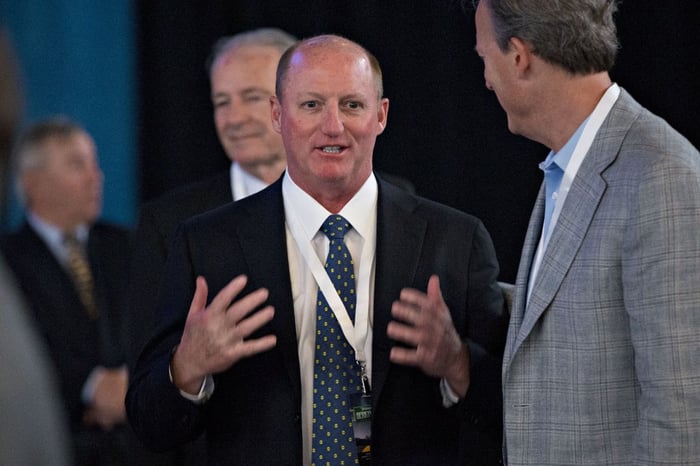
Berkshire Hathaway CEO Greg Abel. Image source: Getty Images.
In the third quarter, he didn't exit any positions, but he started a new position in one stock: Bending Spoons (NASDAQ:BSP). Bending Spoons is an Italian holding company of sorts that buys down-and-out tech companies and builds them up with new resources. He also added to his positions in Lennar (NYSE:LEN), Macy's (NYSE:M), and Delta Air Lines (NYSE:DAL).
Otherwise, Abel cut his positions in several stocks, including 6% of Bank of America and 62% of Capital One Financial (NYSE:COF).
Interest rates are rising
Abel's sales of Bank of America and Capital One are significant amid rising interest rates. BofA remains a large component of the portfolio, accounting for 6.3%, while Capital One accounts for only 0.1%.
These moves come at a moment when the Federal Reserve has already raised interest rates and is expected to raise them again before the year is out. The Fed raised the federal funds rate by a quarter point to 3.75%-4% at the September meeting and kept it steady in October. The broad consensus is that it will raise it again at the December meeting.
High interest rates are a double-edged sword for banks. On the one hand, higher rates mean the bank can earn more net interest income on deposits. On the other, it makes it harder for customers to take out loans and repay them on time. In general, the latter usually outweighs the former.
However, many banks have been flying this year. The economy is still thriving, and the investment banking arms of many banks have been growing rapidly amid a strong bull market and several high-profile initial public offerings (IPO).
What it means for the economy
Abel's bank sales suggest he may be expecting rough terrain ahead for the economy. Lower confidence in banks suggests Abel may be expecting broader economic volatility, not just banking woes.
Higher interest rates restrict economic activity, which is exactly what they're meant to do to combat inflation, and that could lead to a correction or a bear market. Companies don't borrow as much to drive new business when rates are high, and shoppers cut back and save for essentials. They may not have extra to invest, either.
That doesn't mean all hope is lost, but Abel's low buying activity suggests it's still time to be more on the fearful side. If you haven't yet prepared your portfolio for the potential of a further market downturn, take Abel's warning seriously.
Should you buy stock in Berkshire Hathaway right now?
Before you buy stock in Berkshire Hathaway, consider this:
The Motley Fool Stock Advisor analyst team just identified what they believe are the 10 best stocks for investors to buy now… and Berkshire Hathaway wasn’t one of them. The 10 stocks that made the cut could produce monster returns in the coming years.
Consider when Netflix made this list on December 17, 2004... if you invested $1,000 at the time of our recommendation, you’d have $305,941!* Or when Nvidia made this list on April 15, 2005... if you invested $1,000 at the time of our recommendation, you’d have $771,325!*
Now, it’s worth noting Stock Advisor’s total average return is 719% — a market-crushing outperformance compared to 192% for the S&P 500. Don't miss the latest top 10 list, available with Stock Advisor, and join an investing community built by individual investors for individual investors.
See the 10 stocks »
*Stock Advisor returns as of November 23, 2026.
Bank of America is an advertising partner of Motley Fool Money. Jennifer Saibil has no position in any of the stocks mentioned. The Motley Fool has positions in and recommends Berkshire Hathaway and Lennar. The Motley Fool recommends Capital One Financial and Delta Air Lines. The Motley Fool has a disclosure policy.
Recommended Articles


