


Nvidia Stock Jumped on Trump's Call to Rehire Jensen Huang. Don't Count on it Happening.
Key Points
Huang spent years building ties with Trump, and Nvidia's China chip sales got easier along the way.
Nvidia's chairman has said the board unanimously accepted Huang's resignation and doesn't plan to bring him back.
Federal investigations and Huang's Dec. 1 congressional appearance make a quick return hard for directors to justify.
- These 10 stocks could mint the next wave of millionaires ›
Note: Five minutes after I finished this, they reinstated Huang. Things move fast in the market and you can’t predict the future. Watch Fool.com for more articles.
President Donald Trump wants Jensen Huang back at Nvidia (NASDAQ:NVDA), and investors apparently like the idea.
Missed AI’s "Act 1"? Act 2 Could Be 15x Bigger. Most investors think they missed the AI boat because they didn't buy Nvidia in 2005. But according to our analysts, we’re only at the end of "Act 1"—the R&D phase. "Act 2" is the global rollout. Continue »
Nvidia stock jumped 8% in premarket trading Nov. 23 after Trump took to Truth Social to urge the artificial intelligence (AI) chipmaker to reinstate its former CEO, who resigned amid allegations involving extramarital affairs, including one with a woman suspected of having ties to Chinese intelligence.
"I hope the Board of Nvidia rehires Jensen Huang. It would be the best thing for the Company, and also, for the U.S.A.," Trump wrote.
Trump certainly has some influence with Nvidia. Huang spent much of the last two years cultivating a relationship with the president, particularly as Nvidia sought permission to sell its powerful AI processors to China. But the company's board has already said it doesn't intend to bring Huang back. And with congressional investigations and questions about potential violations of U.S. export regulations, I'm not convinced Trump's endorsement will be enough to change its mind.

Image source: Official White House Photo.
Trump and Huang have a history
Huang was a frequent visitor to the White House, and the relationship paid dividends for Nvidia.
In April 2025, Huang attended a $1 million-per-person dinner at Trump's Mar-a-Lago resort. Shortly afterward, the administration temporarily delayed restrictions on Nvidia's H20 chips, although the government subsequently imposed licensing requirements.
By that July, the administration had agreed to resume granting export licenses for H20 sales to China. Trump later said he negotiated a deal with Huang that would allow the company to sell the processors in exchange for the federal government receiving 15% of the revenue. Then in December 2025, Trump approved sales of Nvidia's more powerful H200 processors to China, with the government receiving a 25% share of the proceeds. However, those sales were largely blocked by Beijing, although China allowed limited sales.
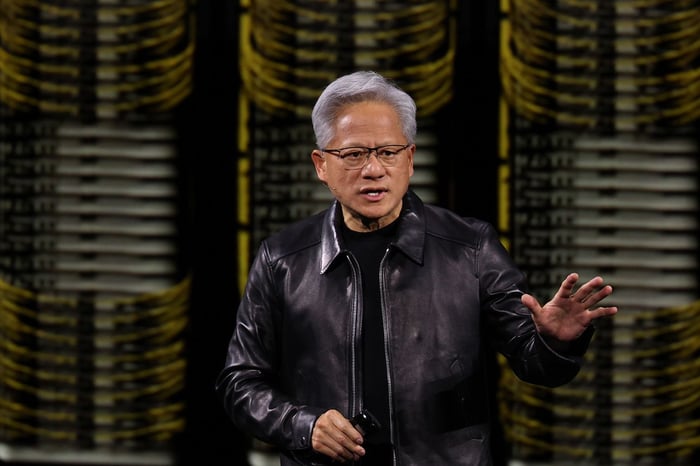
Former Nvidia CEO Jensen Huang. Image source: Getty Images.
Nvidia also donated $25 million toward Trump's White House ballroom project, according to reporting by The Washington Post.
Huang became something of a fixture at presidential events, and Trump regularly praised the Nvidia founder. In March of this year, Huang was named to the President's Council of Advisors on Science and Technology.
So Trump's latest attempt to intervene isn't surprising. He's made it clear more than once that he believes Nvidia would be better off with its founder in charge.
But Nvidia's board has a different responsibility.
Nvidia's problems won't disappear
Nvidia Chairman Harvey Jones told investors during the company's Nov. 17 earnings call that the board unanimously accepted Huang's resignation and doesn't intend to reinstate him.
That was a fairly definitive statement.
And the allegations surrounding Huang have become more complicated. U.S. officials are examining whether advanced Nvidia processors were illegally diverted to China, while federal investigators are looking into the activities of Megaspeed, which employed the businesswoman who had a relationship with Huang and was suspected of being a Chinese spy.
And Huang is not fading from the spotlight. He is scheduled to appear before three House committees on Dec. 1, with additional public testimony expected before the Senate Banking Committee. So, it may be difficult for Nvidia's board to bow to Trump's wishes.
Meanwhile, interim CEO Colette Kress has demonstrated that Nvidia's business can continue performing exceptionally well without Huang at the helm. While the company's fiscal 2027 third-quarter earnings report covers the period while Huang was in charge, it's notable that Nvidia increased its expected fiscal 2028 revenue growth from 70% to 75%.
What should Nvidia investors do?
I understand why investors would welcome Huang's return. He co-founded Nvidia and helped build it into the dominant supplier of processors powering the AI revolution.
Trump's support could eventually help Huang return. But it also puts additional pressure on Nvidia's directors, who must weigh the company's interests against the legal and reputational risks.
Missed AI’s "Act 1"? Act 2 Could Be 14x Bigger
Most investors think they missed the AI boat because they didn't buy Nvidia in 2005.
But according to our analysts, we’re only at the end of "Act 1"—the R&D phase. "Act 2" is the global rollout, a massive technology build-out that Google’s CEO says could be more profound than fire or electricity.
While everyone watches the chip designers, one "backbone" company provides the critical technology that Nvidia and AMD literally cannot function without. We’ve detailed this under-the-radar player in our new AI Playbook.
Continue »
Patrick Sanders has positions in Nvidia. The Motley Fool has positions in and recommends Nvidia. The Motley Fool has a disclosure policy.
Recommended Articles


