


Is Coca-Cola a Millionaire-Maker Stock?
Key Points
Coca-Cola has a track record of outperforming the broader market over the long haul.
Can the company maintain its immense pricing power?
- 10 stocks we like better than Coca-Cola ›
Few businesses exemplify American business success more than Coca-Cola (NYSE: KO). Since its founding in the late 19th century, the multinational beverage maker has expanded globally to serve billions and become one of the world's most recognized brands. Investors have profited substantially along the way, and this shows little sign of stopping.
Over the last 12 months alone, shares have jumped by an impressive 35%, substantially outpacing the S&P 500's return of just 8% over the same time frame. This is a big deal for a company that is already large and mature. Let's dig deeper into the pros and cons of Coca-Cola to decide if the company still has millionaire-maker potential.
Missed AI’s "Act 1"? Act 2 Could Be 15x Bigger. Most investors think they missed the AI boat because they didn't buy Nvidia in 2005. But according to our analysts, we’re only at the end of "Act 1"—the R&D phase. "Act 2" is the global rollout. Continue »
Why Coca-Cola?
To understand Coca-Cola's appeal, it can pay to listen to the philosophy of one of its biggest backers, Warren Buffett. His Berkshire Hathaway portfolio owns a whopping $38.4 billion worth of Coca-Cola stock, making it his third-largest bet behind American Express and Apple.
Buffett likes to invest in companies with simple and easy-to-understand business models that enjoy a strong economic moat. A moat is a competitive advantage that protects a company's market share against competition and allows it to enjoy stable or elevated pricing power. Coca-Cola is arguably the quintessential example of this type of business.
You can walk into a convenience store or restaurant practically anywhere in the world and find Coca-Cola's flagship beverage Coke (or one of its many subbrands like Sprite, Fanta, and a variety of localized options).
The company's ubiquitous shelf space has created unparalleled habit creation among its consumers, which is something new rivals will struggle to disrupt, even if they manage to create better-tasting products. This advantage also makes Coca-Cola's sales remarkably recession-resistant. It has allowed the company to protect its margins amid soaring global inflation in raw materials like aluminum and sugar.
Coca-Cola's gross margins have hovered around 60%, despite the soaring prices for its products. This suggests the company is passing on the vast majority of inflation to consumers, while protecting its own profitability.
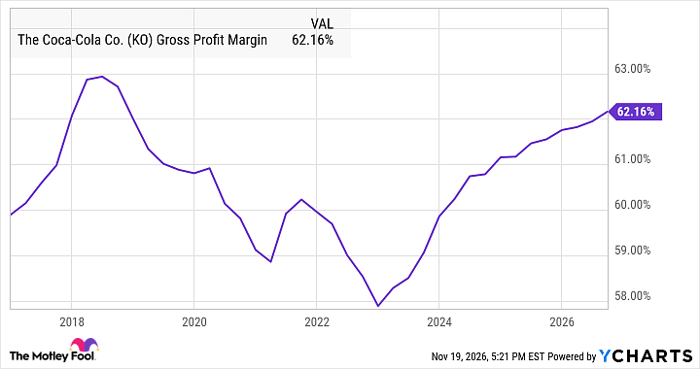
KO Gross Profit Margin data by YCharts.
Are there any risks?
Coca-Cola isn't without some long-term challenges. The company is already a global brand name, and that means there is very little room for organic growth. Management will be increasingly tempted to rely on price increases to juice investor returns. While the company's gross margin of over 60% was easy to justify back when a 12-pack cost $4.00, it is much harder to stomach when prices have doubled, and more American families are struggling to make ends meet.
Soda prices have far exceeded the U.S. inflation rate, despite boasting a disproportionately middle- and lower-income consumer base. It's hard not to wonder if this situation is as sustainable as it may look on the surface.
Over the long term, there could be a generational shift away from brand-name soft drinks as people become more comfortable buying lower-cost store brands from major retailers like Walmart, which offers alternatives like Sam's Cola and Twist Up.
Image source: Getty Images.
Is Coca-Cola a millionaire-maker stock?
Coca-Cola's recent performance is impressive, and its strong moat can help set the company up for more market-beating growth over the long term. That said, with a market cap of $422 billion (in a mature industry with relatively little room for organic growth), Coca-Cola's days of explosive millionaire-making growth are likely behind it. Shares are also somewhat expensive at a forward price-to-earnings (P/E) multiple of 28.
Investors who buy the stock now should look at it as a safer alternative to more speculative opportunities like generative AI. The company's dividend (currently boasting a yield of 2.21%) will likely represent a sizable percentage of its long-term returns.
Should you buy stock in Coca-Cola right now?
Before you buy stock in Coca-Cola, consider this:
The Motley Fool Stock Advisor analyst team just identified what they believe are the 10 best stocks for investors to buy now… and Coca-Cola wasn’t one of them. The 10 stocks that made the cut could produce monster returns in the coming years.
Consider when Netflix made this list on December 17, 2004... if you invested $1,000 at the time of our recommendation, you’d have $315,271!* Or when Nvidia made this list on April 15, 2005... if you invested $1,000 at the time of our recommendation, you’d have $896,981!*
Now, it’s worth noting Stock Advisor’s total average return is 768% — a market-crushing outperformance compared to 198% for the S&P 500. Don't miss the latest top 10 list, available with Stock Advisor, and join an investing community built by individual investors for individual investors.
See the 10 stocks »
*Stock Advisor returns as of November 20, 2026.
American Express is an advertising partner of Motley Fool Money. Will Ebiefung has no position in any of the stocks mentioned. The Motley Fool has positions in and recommends American Express, Apple, and Walmart. The Motley Fool has a disclosure policy.
Recommended Articles


