


Nokia Starts a Critical Week After a 7% Selloff — Can Strong AI Orders Reverse the Trend?
TradingKey - Nokia (NYSE: NOK) sank 6.94% to $13.01 on June 26 amidst significant sector-wide selling pressure on European tech stocks. The stock slump didn’t reflect any company-specific negative news or operational concerns: Nokia’s Q1 2026 results, which were reported April 23, delivered an EPS beat of 31.39%, expanded gross margin 320 basis points to 45.5%, produced €629 million in free cash flow, and grew AI and Cloud customer revenue 49% year-over-year with a book-to-bill of approximately 3 times in this segment.
The stock is at $12.93 on June 29, positioned inside a descending channel on the 2H chart with RSI at 41.78 neutral and consistently seeing lower highs and lower lows. The chart and the business don’t speak the same language, and investors going into the week of June 30 need to know which narrative they should place more confidence in.
AI/Cloud Revenue Up 49% and a 3x Book-to-Bill — The Fundamental Case the Chart Is Ignoring
Nokia’s Q1 2026 results contain plenty of detail that is easy to miss when the stock is stuck in a descending channel and the wider tech sector is selling off. AI and Cloud customer net sales are up 49% year-over-year, and added over €1 billion in new orders during a single quarter. The AI and Cloud book-to-bill was noted to be approximately 3 times during the Q1 earnings call Q&A, translating to €3 of orders that Nokia collected for every €1 that the company booked for revenue in that segment.
That’s not just a slightly bullish leading indicator. A book-to-bill of 3x represents clear confirmation of demand vastly outpacing the ability for Nokia to meet it. Nokia CEO Justin Hotard mentioned that demand in both the AI and Cloud segments has remained strong and that Nokia is running above the middle of its guidance range for comparable operating profit of €2.0 to €2.5 billion.
This demand is being driven by Nokia’s optical networking arm, namely its IP Networks and Optical Networks, which are key for data centre interconnect and networking infrastructure for AI. AI models require training and inference on massive clusters of compute nodes, all of which need massive low-latency fibre transport for connectivity. Nokia provides the primary infrastructure layer for the IP routing and dense wavelength division multiplexing (DWDM) optics systems required for this connectivity.
Nokia hiked its 2026 guidance for Network Infrastructure to growth of 12 to 14% and for Optical plus IP Networks to growth of 18 to 20%. This is a reflection of the demand pull that is now coming from AI infrastructure investment on behalf of the hyperscalers. Finally, Nokia’s Infinera acquisition, finalized in late 2024, brought optical networking scale and capability that was expected to provide strong synergies, per Q1 management commentary. To address supply shortages on the optical side, Nokia is building a new manufacturing plant in San Jose using indium phosphide technology that is expected to begin ramp in late 2026.
Why the June 26 Selloff Was Sentiment, Not Fundamentals
The 6.94% drop June 26 happened when European tech stocks were generally selling into profits and tech globally was weak. Nokia issued no bad news on June 26, no lower guidance, no bad news on operations or other announcements, and no analyst downgrades. The stock had gained about 108% YTD and 154% for the year after trading from a 52-week low of $4.00 to a high of $17.45. It is common to see sector rotation selling on a stock move of that size if overall sentiment for the tech sector is not supportive of the broader market. The declining channel since the high of $17.45 reflects how the stock has been traded as institutional holders look to sell into rallies near the top of the channel after accumulating at lower prices, even though the order book and revenue growth have remained positive.
For the trade setup, the key question is whether this is a stock that is selling on deteriorating fundamentals or a stock that was ahead of itself and is selling off to a more defensible valuation. Nokia at $12.93 trades at about 10x forward earnings, below the telecom equipment median valuation and a long way below where Nokia is trading if the market values Nokia at a growth rate based on the 49% AI/Cloud growth rate and a 3x book-to-bill ratio. JPMorgan raised its target for NOK significantly in June citing the expansion of its optical business and expects order acceleration in 2026 and then again into 2027. The Q2 2026 consensus estimate of €4.825B in revenue and €0.051 EPS is the next event that will determine if the Q1 earnings beat and raised guidance were sustainable.
NOK Technical Setup — Descending Channel, RSI 41.78, Short Targeting $12.17
On the 2H chart, Nokia is trading at $12.93 in a descending black channel below the broken $13.75 support with lower highs and lower lows. The 41.78 RSI is still neutral with room to continue lower or reverse higher, without clear divergence, implying that bearish momentum is intact without oversold extremes. The channel projects further downside toward $12.17 to $11.59 if the decline resumes.
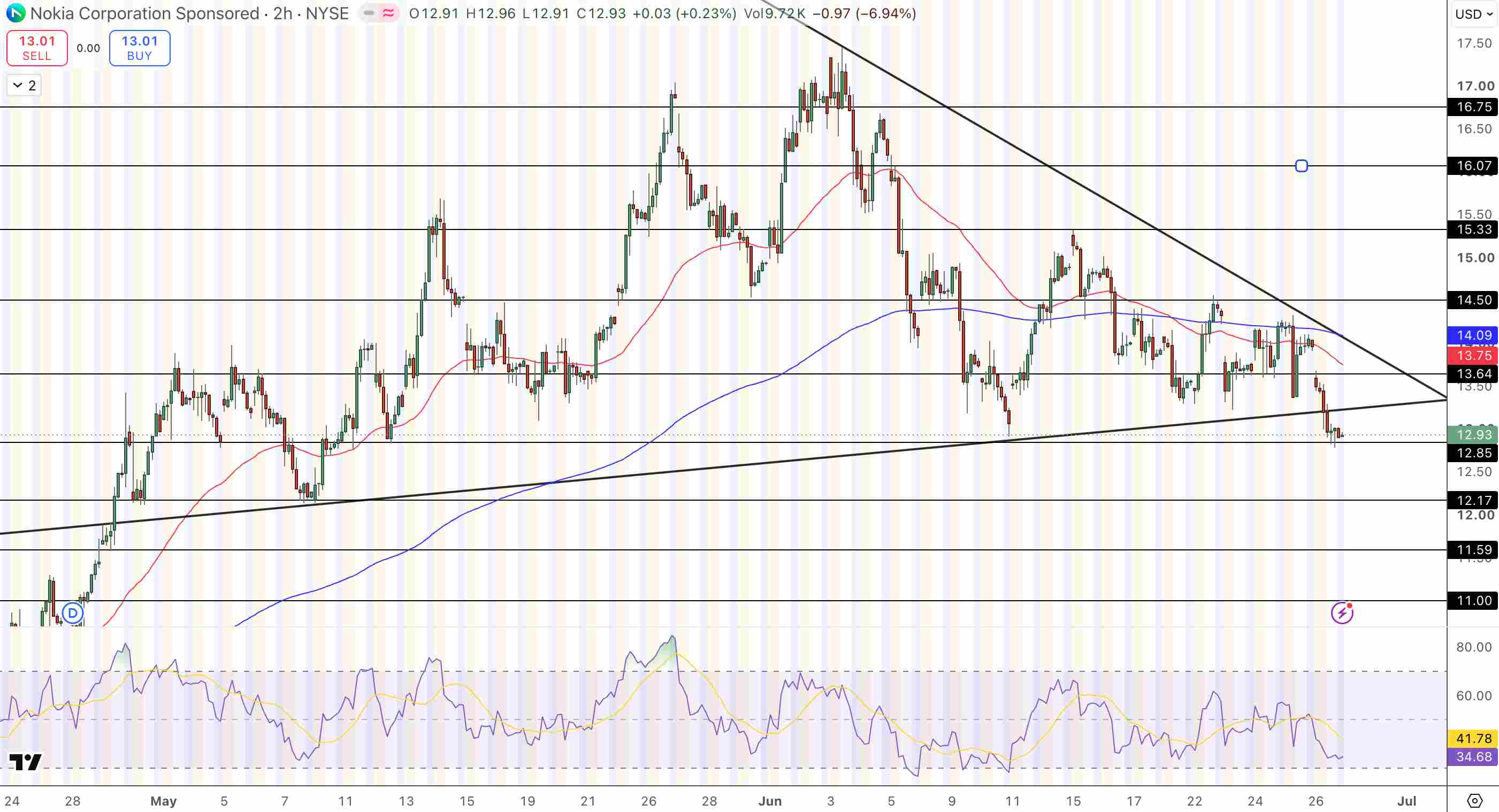
Nokia Price Chart - Source: Tradingview
The horizontal support below the channel from $12.85 to $12.17 is the next major level. The technical short below $12.93 targets $12.17 with a stop above $13.75. A close back above $13.75 (broken support which becomes resistance) would begin to invalidate the descending channel structure and shift the technical bias.
- Short entry: Below $12.93 — descending channel continuation
- Target: $12.17 — horizontal support cluster
- Stop Loss: Close above $13.75 — broken support reclaimed
- AI/Cloud revenue: +49% YoY, €1B+ new orders in Q1, book-to-bill ~3x
- Next earnings: Q2 2026 — expected late July 2026
- Q2 consensus: €4.825B revenue, EPS €0.051
The Bottom Line
To sum up Nokia’s June 26 decline: 7% with no company specific news, just sector-wide contagion following a 108% year-to-date run. The first quarter fundamentals were clearly solid: the acceleration of AI/Cloud revenue +49% YoY, book-to-bill of roughly 3X, gross margin was 45.5% (+320 bps), EPS surprise 31.39%, and the company raised Q1 network infrastructure full year guidance to 12-14% with the optical/IP network subsegment guidance to 18-20% growth.
The bear case continues to hold in a technical context, the descending channel remains intact at $12.93, RSI was at 41.78 neutral with an end target of $12.17 if the price remains below $13.75 stop; I think if the stock is able to reclaim $13.75 broken support, the bear case will change. The upcoming second quarter earnings report in late July will be another inflection point for Nokia and it will test the extent to which the Q1 AI/Cloud order acceleration is being translated into revenue in-line with guidance.
Recommended Articles


