


This Artificial Intelligence (AI) Cloud Stock Has Crushed Amazon, Microsoft, and Google in 2026. It Can Continue Skyrocketing After 184% Gains
Key Points
DigitalOcean's AI-focused cloud computing offerings are in healthy demand from customers.
The company is now anticipating much stronger growth in 2026 and 2027.
DigitalOcean stock could deliver significant upside over the next five years due to the booming demand for AI inference solutions.
- 10 stocks we like better than DigitalOcean ›
Amazon, Microsoft, and Alphabet's Google have been experiencing strong demand for their artificial intelligence (AI)-focused cloud computing offerings, leading to significant increases in their backlogs and remaining performance obligations (RPO).
The three tech giants, which are members of the Magnificent Seven, were sitting on a combined order backlog of $1.45 trillion in the first quarter of 2026. This clearly indicates an incredible demand for running AI workloads in data centers. However, shares of Amazon, Microsoft, and Alphabet have struggled despite the massive contractual backlogs they carry.
Missed Nvidia in 2009? This Rare Signal Is Flashing Again. In 2009, a "Double Down" signal flashed for a little-known chipmaker called Nvidia. For the first time in years, that same "Total Conviction" signal is flashing for a company 1/100th the size of Nvidia. Continue »
While Amazon and Alphabet have gained 3% and 6% this year, Microsoft's stock has retreated 21%. However, there's another cloud computing company that's witnessed a parabolic jump in its stock price this year. Shares of DigitalOcean (NYSE: DOCN) are up by an incredible 184%.
Let's see why that's the case and check why this high-flying stock isn't done soaring yet.

Image source: The Motley Fool.
DigitalOcean's business model is driving an acceleration in growth
Like its larger peers, DigitalOcean provides an on-demand cloud computing platform. However, the key difference in its business model from those of Amazon, Microsoft, and Alphabet is that its offerings are tailored for small and medium businesses, start-ups, and developers. Of course, the three tech giants I am comparing DigitalOcean with account for 62% share of the cloud computing market, but the smaller company is carving out a niche for itself.
That's because DigitalOcean claims to offer a simple platform with predictable, flat pricing to customers, which is ideal for small and medium-sized companies that want to avoid complexity and keep costs in check while deploying AI solutions. Specifically, DigitalOcean offers 30 core products as compared to the hundreds of offerings available on the cloud computing platforms of its bigger competitors. It offers all its products on a single platform, making it easier to build, deploy, and scale AI applications.
Also, the simplified nature of its cloud offerings means that smaller businesses are likely to get better support and attention. Most importantly, DigitalOcean claims that it can reduce total costs by up to 80% compared with traditional hyperscalers. This probably explains why customers have started spending aggressively on its cloud computing platform, especially for running AI workloads.
The company noted that its AI-focused annual recurring revenue (ARR) in Q1 jumped by 221% year over year to $170 million. That was significantly higher than the 22% increase in its overall ARR to just over $1 billion. More importantly, DigitalOcean customers are not just renting the company's AI hardware but also running inference services on its platform.
Specifically, DigitalOcean's ARR from its inference services increased by a whopping 487% year over year in Q1, accounting for 64% of its AI ARR. The company estimates that AI inference workloads will account for 80% of the computing power in AI data centers in 2030, up from around 50% last year. So, it won't be surprising to see more customers flocking toward DigitalOcean's platform to run inference workloads in the future.
The good news is that DigitalOcean's growing prominence in AI cloud infrastructure is poised to translate into stronger growth for the company, as evidenced by the substantial upgrade to its guidance. DigitalOcean anticipates a 26% increase in revenue in 2026, followed by a significantly stronger jump of more than 50% in 2027. Even better, analysts anticipate its solid momentum will continue beyond next year.
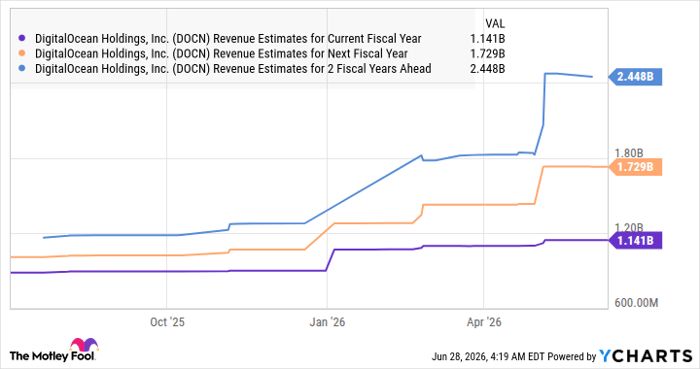
Data by YCharts
But is the stock still worth buying?
Investors may be wondering whether buying this AI stock is a good idea after its stunning 2026 rally. After all, DigitalOcean is now trading at almost 16 times sales, well above the tech-laden Nasdaq Composite index's price-to-sales ratio of 5.2.
However, the acceleration in DigitalOcean's growth justifies the premium valuation, especially considering that it is at the beginning of a terrific growth curve. The cloud computing provider can sustain its solid growth beyond the next couple of years, driven by the growing demand for AI inference. Assuming it can clock even 20% revenue growth in 2029 and 2030, DigitalOcean's top line could reach $3.53 billion by the end of the decade.
If the stock trades at even 10 times sales at that time, its market cap could reach $35 billion, implying 141% upside from current levels. So, it isn't too late for investors to buy this growth stock as it still has terrific upside potential.
Should you buy stock in DigitalOcean right now?
Before you buy stock in DigitalOcean, consider this:
The Motley Fool Stock Advisor analyst team just identified what they believe are the 10 best stocks for investors to buy now… and DigitalOcean wasn’t one of them. The 10 stocks that made the cut could produce monster returns in the coming years.
Consider when Netflix made this list on December 17, 2004... if you invested $1,000 at the time of our recommendation, you’d have $398,052!* Or when Nvidia made this list on April 15, 2005... if you invested $1,000 at the time of our recommendation, you’d have $1,181,688!*
Now, it’s worth noting Stock Advisor’s total average return is 892% — a market-crushing outperformance compared to 205% for the S&P 500. Don't miss the latest top 10 list, available with Stock Advisor, and join an investing community built by individual investors for individual investors.
See the 10 stocks »
*Stock Advisor returns as of June 28, 2026.
Harsh Chauhan has no position in any of the stocks mentioned. The Motley Fool has positions in and recommends Alphabet, Amazon, DigitalOcean, and Microsoft. The Motley Fool has a disclosure policy.
Recommended Articles


