


Millions of Investors Are About to Own SpaceX Stock Indirectly -- Whether They Want to or Not
Key Points
SpaceX joined the Russell 1000 this month under a new fast-track rule, just weeks after the largest IPO in history.
The space and AI company will also be added to the Nasdaq-100 before the market opens on July 7.
The S&P 500, the index most retirement money tracks, is keeping SpaceX out because it isn't profitable.
- 10 stocks we like better than Space Exploration Technologies ›
For the first time, anyone who owns an index fund is about to own a piece of SpaceX (NASDAQ: SPCX). The rocket and satellite company went public on June 12 in the largest initial public offering (IPO) in history, and barely two weeks later it is being pulled into the funds that sit inside millions of 401(k)s and brokerage accounts.
On Friday, SpaceX was added to the Russell 1000 under a new rule that fast-tracks the biggest new listings into the index. And before the market opens on July 7, it will join the Nasdaq-100 through a similar process. Likely millions of people who have never placed a direct order for the stock are about to pick up a sliver (albeit indirectly) through funds they already hold.
Missed Nvidia in 2009? This Rare Signal Is Flashing Again. In 2009, a "Double Down" signal flashed for a little-known chipmaker called Nvidia. For the first time in years, that same "Total Conviction" signal is flashing for a company 1/100th the size of Nvidia. Continue »
Fortunately, the buying comes as the shares have cooled. SpaceX trades at about $153 as of this writing, down about a third from the post-IPO high of about $226 it reached on June 16.
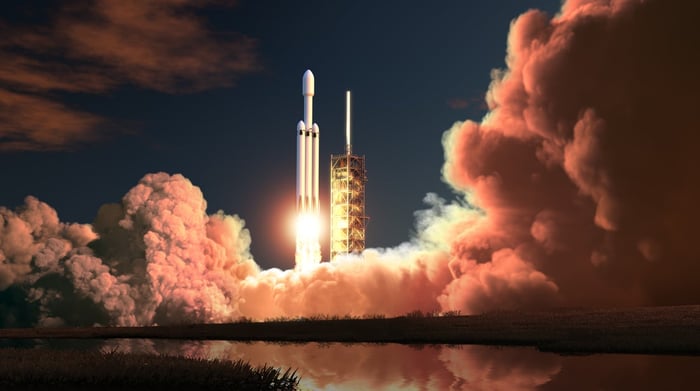
Image source: Getty Images.
Why the funds have to buy
When a company enters an index, every fund built to track that index has to buy the stock -- regardless of the price, the valuation, or whether the business turns a profit. The buying is automatic, and for a company SpaceX's size, it is large.
Estimates vary, but the sums are big. The Russell 1000 move alone could force over $4 billion of buying, by some estimates, and the Nasdaq-100 addition is expected to drive about $4 billion more as well. Add in the other funds that track related benchmarks, and the total climbs higher still.
These additions are happening fast because the index providers changed their rules. FTSE Russell, which runs the Russell indexes, now lets the largest new stocks in after just five trading days rather than waiting for its next scheduled reconstitution. Nasdaq adopted its own fast-entry route this year, clearing the way for some big new listings after 15 trading days.
None of that buying reflects a view on whether SpaceX is a good investment. Index funds don't analyze stocks the way an investor would, weighing growth, profits, and valuation. They buy because the rules tell them to.
What the buying doesn't tell you
You can see that distinction in the one major index sitting this out: the S&P 500, the benchmark most retirement dollars actually follow.
S&P Global's S&P Dow Jones Indices declined to loosen its standards for SpaceX and kept its profitability screen in place. To qualify, a company needs four straight quarters of positive earnings under generally accepted accounting principles (GAAP) -- and SpaceX doesn't meet the test. It lost about $4.9 billion in 2025 and posted another loss in the first quarter of 2026.
So the index designed to screen for steady profits is keeping SpaceX out, while the rules that ignore profits are forcing funds to buy.
Underneath, the company leans primarily on one segment in terms of its profit drivers today: Starlink, its satellite-internet service, generated about $11.4 billion in revenue in 2025 -- around 61% of the company total -- and grew close to 50% from a year earlier. The launch business, by comparison, is smaller and grew about 8%. All told, SpaceX brought in about $18.7 billion in 2025.
SpaceX makes money providing Starlink service but lost money overall, weighed down by spending on its Starship rocket and the absorption of Elon Musk's AI start-up, xAI, which it folded in earlier this year.
The valuation leaves little doubt about how much optimism is already built in. At a market capitalization of about $2 trillion, SpaceX trades at more than 100 times its annual revenue. And with no profit, there is no price-to-earnings ratio to anchor it.
The forced index buying doesn't change any of that.
So, for many investors who own the Russell 1000 or the Nasdaq-100, get used to being a SpaceX shareholder -- whether you wanted it or not. But note that being added to an index is not the same as being worth owning. Whether SpaceX deserves more than the sliver the index hands you comes down to Starlink's growth and the company's path to profits -- not which index it just joined.
Should you buy stock in Space Exploration Technologies right now?
Before you buy stock in Space Exploration Technologies, consider this:
The Motley Fool Stock Advisor analyst team just identified what they believe are the 10 best stocks for investors to buy now… and Space Exploration Technologies wasn’t one of them. The 10 stocks that made the cut could produce monster returns in the coming years.
Consider when Netflix made this list on December 17, 2004... if you invested $1,000 at the time of our recommendation, you’d have $398,052!* Or when Nvidia made this list on April 15, 2005... if you invested $1,000 at the time of our recommendation, you’d have $1,181,688!*
Now, it’s worth noting Stock Advisor’s total average return is 892% — a market-crushing outperformance compared to 205% for the S&P 500. Don't miss the latest top 10 list, available with Stock Advisor, and join an investing community built by individual investors for individual investors.
See the 10 stocks »
*Stock Advisor returns as of June 27, 2026.
Daniel Sparks and his clients have no position in any of the stocks mentioned. The Motley Fool has positions in and recommends S&P Global. The Motley Fool has a disclosure policy.
Recommended Articles


