


SpaceX's Out-of-This-World Plan Has Flaws. That Bodes Well for This Terrestial Stock.
Key Points
SpaceX wants to launch orbital AI data centers to dominate the AI market.
Orbital data centers would cost three times as much as terrestrial ones in the near term.
Meanwhile, electricity demand from terrestrial centers will grow, benefiting a different company.
- 10 stocks we like better than Space Exploration Technologies ›
Whether you think Space Exploration Technologies Corp. (NASDAQ: SPCX), commonly known as SpaceX, is fairly valued at $2 trillion or not, there's no denying its plans are ambitious.
SpaceX plans to dominate the AI computing market by putting data centers into outer space. Admittedly, this would solve a bunch of problems. Unfortunately, it would also likely cause a whole host of new ones.
Where to invest $1,000 right now? Our analyst team just revealed what they believe are the 10 best stocks to buy right now, when you join Stock Advisor. See the stocks »
If SpaceX is unable to pull it off, one sector is likely to be a big winner. Here are the flaws in SpaceX's "out-of-this-world" plan, and the surprising "down-to-earth" company likely to benefit.
Keeping it cool
AI spending is continuing to grow, and one of the biggest expenditures is on building new AI data centers.
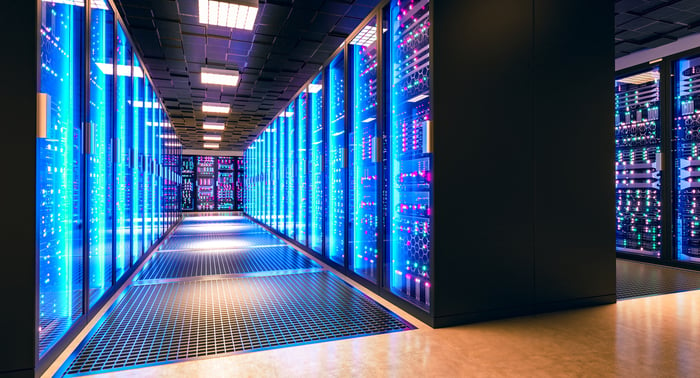
Image source: Getty Images.
These facilities require lots of electricity. A recent report by the International Energy Agency found that a ChatGPT query consumes 10 times as much electricity as a Google search.
All that electricity use cranks out a lot of heat, so AI data centers also require massive cooling systems to prevent overheating. Air-cooled systems require even more electricity to operate, while liquid-cooled systems require massive amounts of water.
Recently, the AI data center buildout has run into a new snag. Across the country, concerned residents have successfully petitioned local zoning boards and other elected officials to prevent the construction of proposed AI data centers in their communities, citing environmental concerns and the impact on local electricity and water supplies.
SpaceX's plan sounds like a simple solution to this problem: Instead of battling locals over your energy-intensive data center, just put it into orbit instead.
In space, no one can see you sweat
Outer space is extremely cold under most circumstances, with a temperature of about -455 degrees Fahrenheit. Logically, with a base temperature that cold, your orbital data center wouldn't need a cooling system, which would lower your computing costs.
As for the huge power requirements, SpaceX points out that solar power is actually more concentrated in space, making solar panels more efficient. By attaching solar panels to the orbital center and aiming them at the sun, you could inexpensively generate enough power to operate the data center, further lowering costs.
When it comes to communicating queries to and from the AI, SpaceX would simply utilize and expand its existing Starlink satellite network.
It all sounds so simple, you have to wonder why nobody's tried it before.

Image source: Getty Images.
The obvious flaws with SpaceX's plan
Well, nobody's tried it because of the obvious, glaring flaws in the plan.
First of all, the cold environment in space isn't necessarily a good thing. Most electrical equipment can't function at temperatures below about -340 degrees Fahrenheit, because electrons lose the thermal energy required to move and stop flowing. There are ways around this issue, but they require costlier materials, components, and designs. A recent report by Wood Mackenzie estimates that a 1-gigawatt orbital data center would cost about $170 billion, more than three times that of an equivalent terrestrial facility.
Meanwhile, AI data centers and solar arrays contain thousands of small, interconnected components, such as circuit boards, wires, and fuses. If one of those components fails in a terrestrial facility, a technician can quickly walk over and fix the problem. Not in outer space! Although launch costs have come down in recent years, it's unlikely to ever get so cheap as to justify the cost of launching and performing a spacewalk to swap out a fuse.
Who will win?
Wood Mackenzie estimates that the cost of an orbital data center would need to drop by 70% to be competitive. That could happen by 2040 or so if launch costs continue to drop exponentially, but in the meantime, we'll still have to use terrestrial data centers and absorb their massive electricity requirements.
And that's where electric utility stocks stand to benefit. One of the likeliest beneficiaries is American Electric Power (NASDAQ: AEP), which operates the largest electricity transmission network in the U.S., and operates in regions that have been historically friendly to large-scale energy development, including Texas, Oklahoma, Louisiana, and Appalachia. It also has a near-monopoly on 765-kilovolt power transmission infrastructure.
Recently, AEP instituted a "Data Center Tariff" in Ohio, prompting data center developers to sign binding contracts for 5.6 gigawatts of data center load. This insulates the utility from the financial repercussions if a data center project doesn't use its projected capacity or gets canceled altogether.
With a 2.8% dividend yield and huge expansion prospects, AEP will likely pay off for investors long before SpaceX's orbital data centers even get off the ground (literally).
Should you buy stock in Space Exploration Technologies right now?
Before you buy stock in Space Exploration Technologies, consider this:
The Motley Fool Stock Advisor analyst team just identified what they believe are the 10 best stocks for investors to buy now… and Space Exploration Technologies wasn’t one of them. The 10 stocks that made the cut could produce monster returns in the coming years.
Consider when Netflix made this list on December 17, 2004... if you invested $1,000 at the time of our recommendation, you’d have $398,052!* Or when Nvidia made this list on April 15, 2005... if you invested $1,000 at the time of our recommendation, you’d have $1,181,688!*
Now, it’s worth noting Stock Advisor’s total average return is 892% — a market-crushing outperformance compared to 205% for the S&P 500. Don't miss the latest top 10 list, available with Stock Advisor, and join an investing community built by individual investors for individual investors.
See the 10 stocks »
*Stock Advisor returns as of June 27, 2026.
John Bromels has positions in Alphabet. The Motley Fool has positions in and recommends Alphabet. The Motley Fool has a disclosure policy.
Recommended Articles


