


Kevin Warsh Just Suggested the Fed May Bring Down the Hammer on Inflation. Could It Spell Trouble for Wall Street?
Key Points
Newly minted Fed Chair Kevin Warsh stated the Federal Reserve "will deliver price stability."
Analysts believe this virtually guarantees at least one interest rate hike this year.
A hike in interest rates could be bad for small-cap growth stocks but a boon for banks.
- These 10 stocks could mint the next wave of millionaires ›
When a new CEO takes the reins at a company, they sometimes try to make an immediate high-impact statement, like Elon Musk carrying a porcelain sink into Twitter's headquarters in 2022 and tweeting, "Entering Twitter HQ-let that sink in!"
And while new Federal Reserve Chair Kevin Warsh's first move wasn't quite as flashy as Musk's, he certainly made a big splash at his first Federal Open Market Committee meeting. He left no doubt that he wasn't interested in "business as usual." Instead, he clearly signaled his intention to bring down the hammer on inflation.
Where to invest $1,000 right now? Our analyst team just revealed what they believe are the 10 best stocks to buy right now, when you join Stock Advisor. See the stocks »
Here's what Warsh said and why it could spell trouble for Wall Street.

Image source: Getty Images.
Outside the range
Sixteen years ago, the Fed officially established its long-term inflation target as a modest 2% per year. That number had been unofficial since 1996, but it wasn't made public until 2012. For almost a decade after that announcement, the Fed largely kept inflation below that 2% target.
Unfortunately, that hasn't been the case in recent years. The inflation rate, as measured by the Consumer Price Index (CPI), hasn't been below 2% since February 2021, during the height of the COVID-19 pandemic. In June 2022, it peaked at 9% before dropping sharply. It's been hovering between 2.3% and 3.8% since July 2023.
That is, until last month, when it shot up to 4.2%, the highest level in 18 months. And the big question was what the new Fed Chair, Kevin Warsh, was going to do about it.
The hammer is dropping
The Fed's primary tool for curbing inflation is raising its benchmark federal funds interest rate, which currently sits between 3.5% and 3.75%. Warsh's critics worried that he would acquiesce to President Donald Trump's clear desire for the Fed to lower interest rates to stimulate economic growth, despite the risk of higher inflation.
But Warsh made clear he had no intention of doing that. "The Committee will deliver price stability," the FOMC said in a unanimous statement last week. That seems to guarantee at least one interest rate hike before the end of the year, but Bank of America thought it was emphatic enough to suggest three rate hikes before 2027 rolls around. The market didn't like that idea much: The S&P 500 dropped 1.2% on the news.
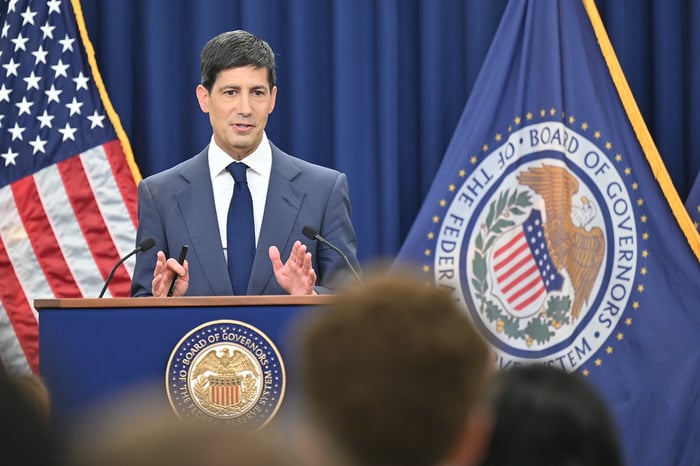
Chairman Warsh answers reporters' questions at the FOMC press conference on June 17, 2026. Image source: Official Federal Reserve Photo.
The Fed raised interest rates to 5.3% between August 2023 and August 2024, but inflation still stayed stubbornly above the Fed's 2% target. If Warsh is serious about getting inflation back down to 2% -- and he certainly sounds serious -- the Fed might have to push rates even higher than that.
Higher rates tend to benefit banks and insurance companies, which benefit from the higher fees they can charge on loans. But growth stocks, especially smaller ones that rely on debt to finance expansion, will likely struggle to maintain robust growth as borrowing becomes more expensive. Similarly, companies that have committed to big AI capital expenditures may end up delaying those projects, which could cause their stocks -- and those of AI infrastructure providers -- to falter.
Investors will want to make sure their portfolio is balanced moving forward, and if high-growth stocks have grown to outsize positions in their portfolio, it may be wise to think about rebalancing.
Where to invest $1,000 right now
When our analyst team has a stock tip, it can pay to listen. After all, Stock Advisor’s total average return is 883%* — a market-crushing outperformance compared to 205% for the S&P 500.
They just revealed what they believe are the 10 best stocks for investors to buy right now, available when you join Stock Advisor.
See the stocks »
*Stock Advisor returns as of June 27, 2026.
Bank of America is an advertising partner of Motley Fool Money. John Bromels has no position in any of the stocks mentioned. The Motley Fool has no position in any of the stocks mentioned. The Motley Fool has a disclosure policy.
Recommended Articles


