


Is SpaceX Overvalued Right Now?
Key Points
SpaceX has a market cap of about $2 trillion as of June 24.
It's trading at about 109 times sales, a massive valuation that's extremely difficult to maintain.
In addition, lockup expirations could be a headwind throughout 2026.
- 10 stocks we like better than Space Exploration Technologies ›
The Space Exploration Technologies (NASDAQ: SPCX) IPO was the biggest, and arguably the most divisive, in history. It raised about $75 billion, and for a brief period on June 16, it surpassed Microsoft and Amazon -- two companies with much stronger balance sheets -- in market cap.
SpaceX has been extremely volatile in its first weeks on the market. Since peaking at $226, it has declined to about $155 at market close on June 24. Does the pullback make for a better buying opportunity, or is the leading space company still overvalued?
Where to invest $1,000 right now? Our analyst team just revealed what they believe are the 10 best stocks to buy right now, when you join Stock Advisor. See the stocks »
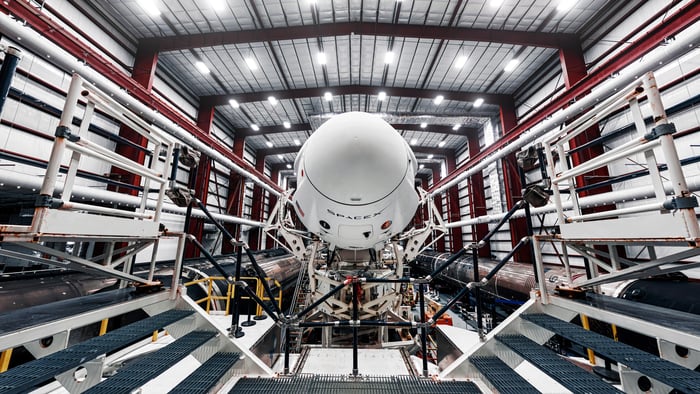
Image source: Getty Images.
The valuation is still astronomical
The most common criticism in the lead-up to SpaceX going public was the valuation. SpaceX is trading higher than its IPO price of $135 at the time of this writing, so the valuation concerns haven't gone away.
SpaceX isn't profitable, reporting a net loss of $4.9 billion in 2025. Revenue that year was $18.7 billion. At a market cap of just over $2 trillion, SpaceX trades at 109 times last year's sales, making it the most expensive megacap stock. Palantir Technologies (NASDAQ: PLTR), previously the poster child for high valuations, is trading at 65 times annual sales.
Palantir used to be far more expensive, but it has lost 45% of its value since reaching an all-time high of $208 last November. That's what tends to happen with stocks trading at these kinds of premiums, because such high valuations are rarely sustainable.
The lockup expiration could create significant selling pressure
Another risk of buying SpaceX stock now is that the stock is still in its lockup period, during which insiders can't sell their shares. While most companies set a fixed lockup period, typically 180 days, SpaceX handles this very differently.
It's taking a staggered approach, where selling windows for a percentage of insider holdings open gradually. The first selling window opens on the second trading day after the company's second-quarter 2026 earnings release, and insiders will be able to sell up to 20% of their shares. If the stock trades 30% above its IPO price (which would be $175.50) for at least five of the 10 trading days leading up to the earnings release, then insiders can sell up to an additional 10%.
Selling windows will continue to open through Dec. 8, 2026, which is when the lockup period ends. However, CEO Elon Musk has said that he and "certain significant investors" have agreed to a 366-day lockup period.
The SpaceX IPO could reportedly turn more than 4,400 current and former employees into millionaires. It's a safe bet that many of them will want to sell at least some of their shares, both to lock in gains and because SpaceX stock has been volatile. SpaceX's selling windows will act as a headwind, and performance is likely to be rocky for at least the first 180 days.
The bottom line on SpaceX
There are plenty of reasons to be excited about SpaceX as a business. It has a dominant share of the U.S. commercial launch market, conducting 80% of launches in 2025. Starlink has also been a winner, accounting for $11.4 billion in revenue. The jury's still out on the AI side of the company.
But based on the valuation and the lockup period, SpaceX is better to put on your watch list than to buy right now. That's what I'm doing, as I expect much better buying opportunities later in the year.
Should you buy stock in Space Exploration Technologies right now?
Before you buy stock in Space Exploration Technologies, consider this:
The Motley Fool Stock Advisor analyst team just identified what they believe are the 10 best stocks for investors to buy now… and Space Exploration Technologies wasn’t one of them. The 10 stocks that made the cut could produce monster returns in the coming years.
Consider when Netflix made this list on December 17, 2004... if you invested $1,000 at the time of our recommendation, you’d have $382,359!* Or when Nvidia made this list on April 15, 2005... if you invested $1,000 at the time of our recommendation, you’d have $1,201,390!*
Now, it’s worth noting Stock Advisor’s total average return is 883% — a market-crushing outperformance compared to 205% for the S&P 500. Don't miss the latest top 10 list, available with Stock Advisor, and join an investing community built by individual investors for individual investors.
See the 10 stocks »
*Stock Advisor returns as of June 26, 2026.
Lyle Daly has no position in any of the stocks mentioned. The Motley Fool has positions in and recommends Amazon, Microsoft, and Palantir Technologies. The Motley Fool has a disclosure policy.
Recommended Articles


