


Apple (AAPL) Falls 6% as Memory Crisis Forces Price Hikes Across Macs and iPads
TradingKey - On June 25, Apple (NASDAQ: AAPL) shares dropped 6.12% to settle at $275.15. The decline came after the company disclosed it is hiking prices on various Mac and iPad models as it navigates a worldwide shortage of memory and storage chips. Apple has increased the prices of the MacBook Neo to $699 (up from $599), the MacBook Air to $1,299 (up from $1,099), and the MacBook Pro 14-inch to $1,999 (up from $1,699), as well as the iPad Air to $749 (up from $599). Apple has not raised iPhone prices.
There were at least four factors weighing on the stock today: Apple already guided down gross margin to between 47.5% and 48.5% for the June quarter from 49.3% in March; news of an Apple-Intel manufacturing deal on social media posted by President Trump on June 18 (which is unconfirmed and which the market believes won't have any short-term benefit for Apple); a new multi billion-pound UK class action lawsuit that was filed on Apple over iCloud pricing; and reports that Apple insiders have been selling over $111 million of the company’s stock over the past three months.
From a daily chart perspective, AAPL is approaching the 0.618 Fibonacci level of $272.96, above the 200-EMA at $267.79; the RSI is at 32.20 and sitting in oversold territory, forming a positive divergence.
The Memory Crisis Is the Same Story From Two Sides — What AAPL and MU Tell Each Other
One of the clearest expressions of this market’s dynamics so far this year came on yesterday’s session, which was Micron’s 15.98% post-earnings climb after the memory company reported that it had pulled in $41.46 billion in revenue during the third quarter of 2026, up 346% from year-ago, with gross margin hitting 84.6% and a $50 billion run rate in the fourth quarter guided for 86% gross margin.
The other side of that same story, in today’s AAPL post, was the 6.12% stock dip as the company revealed that it was being forced to pass those same costs through to its customer base, which confirms to all market participants that DRAM and NAND price increases are not only real but have the staying power to force Apple, the world’s most dominant consumer electronics brand, and the manufacturer that holds the most leverage in a supply chain, into passing them onto consumers instead of absorbing them on its own end of the equation.
With DRAM and NAND prices projected to jump 58-63% and 70-75%, respectively, on a sequential-quarter basis because of a supply shortage in memory chips as vendors divert their capacity to AI datacenter chips, Apple books memory as cost of goods sold, which means that these price increases will show up straight to the bottom line on gross margin.
One uncomfortable truth Apple didn’t disclose is that it did not raise iPhone prices, but it did raise prices for its Mac, iPad, Apple TV, HomePod, and Vision Pro products. As JPMorgan points out, the firm expects iPhone 18 price increases of only about $50, which is fairly modest given the memory cost hike, meaning Apple is likely to absorb more of the memory cost increase through iPhone and pass those price increases through more aggressively on Mac and iPad instead to try to preserve iPhone demand elasticity. Deutsche Bank sees this tightness continuing well into 2028. If that is the case, Apple’s gross margin is not just a short-term headwind that it will wait out in one or two quarters but rather a structural cost environment that will impact Apple’s profitability for the iPhone 18 cycle.
Four Simultaneous Headwinds — Separating Structural From Transient
There are four distinct headwinds pushing Apple's share price down from its high of $317 to its current level at $275, each of which must be evaluated differently. The only issue with any fundamental bearing on the company's bottom line, and which constitutes a structural issue for as long as the AI buildout continues to consume capacity, is the higher memory prices.
The Apple UK "iCloud" class action suit represents a legal risk that could unfold in the next year, but it will most likely be resolved over a multi-year timeframe, and will have zero immediate impact on current operations. Apple-Intel "manufacturing," which was announced by Trump on social media on June 18, but has not been verified by either party (Apple or Intel), would require a minimum of 2–3 years to yield products under Apple's guidance, and might involve the 14A process which Intel won't likely deliver until 2028–2029. The risk is real but the news has zero impact on the business in the short term, and thus, should not significantly impact the share price by itself.
The insider selling is the only one of these headwinds that seems worth investigating on its own merits. Insider selling at the company has come to a level that is worth a closer look at $111 million over a three-month period. Insiders might be selling shares for reasons unrelated to their confidence in the business, namely due to a scheduled liquidation plan, tax purposes, or, as some might be quick to point out in light of recent insider selling, due to their lack of confidence at present share prices.
With the recent selloff off of the June 25, this comes after the stock had traded ~+25% over its March lows, and is now trading at a ~10.1x trailing price-to-sales multiple (the highest ever for Apple per Yahoo Finance AlphaSpace), diversification is a fair reading here. However, it is worth investigating whether this level of insider selling is a reflection of the fact that management and directors do not know something about iPhone 18 demand dynamics or AI trajectory.
AAPL Technical Setup — 0.618 Fib at $272.96, RSI 32.20, EMA200 $267.79, Target $300.40
AAPL is trading around the 0.618 Fibonacci retrace at $272.96, which is approaching to a $267.79 EMA200 (a boundary on the upward sloping blue channel). The RSI is at 32.20 (oversold) with strong positive divergence in play with lower price lows. Additionally, we see several long wicks under the recent candle prints for the down moves. Trading volume was light on the downside, which we'd expect for the profit taking we discussed in the above paragraph.
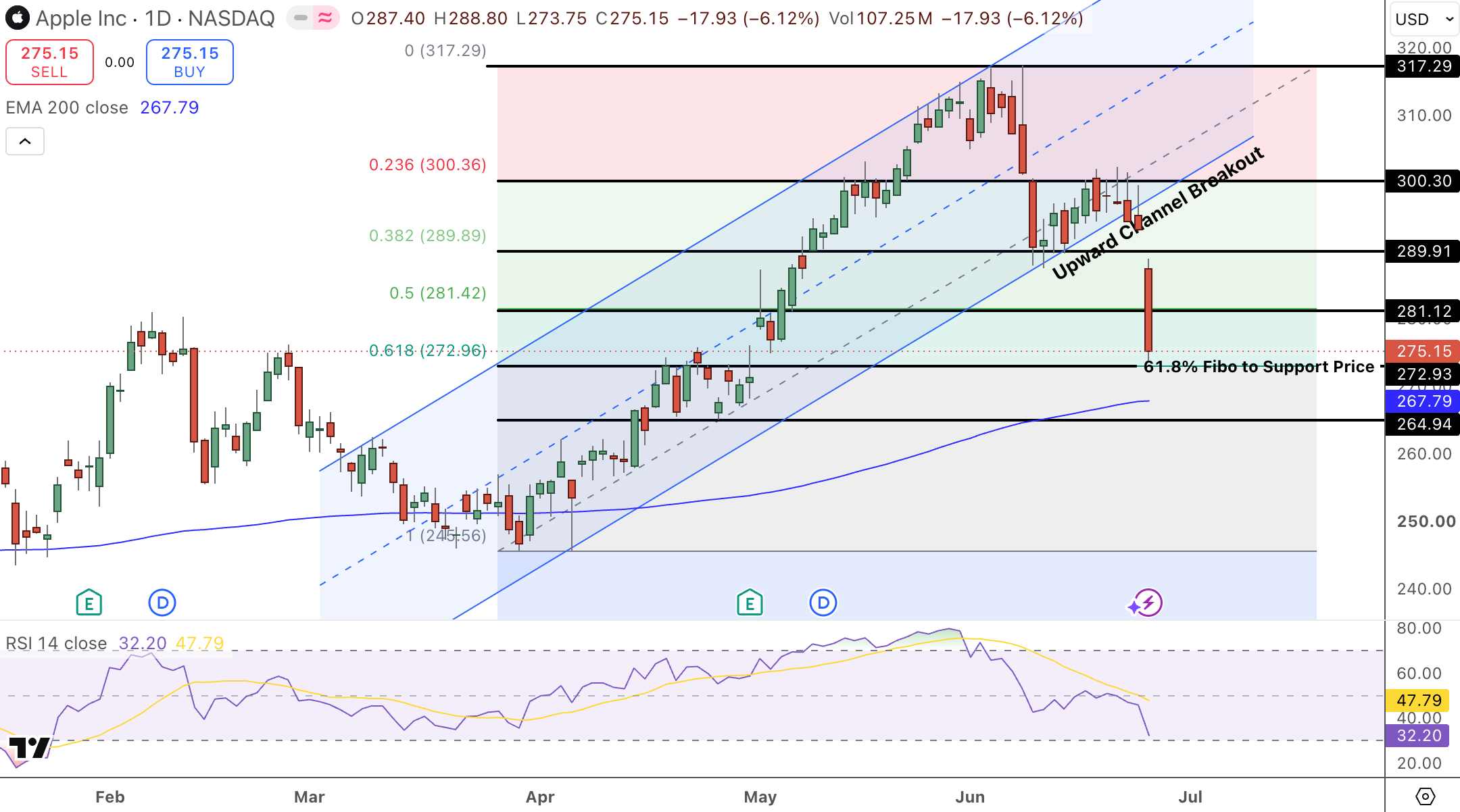
Apple (AAPL) Price Chart - Source: Tradingview
If we have confirmation of price holding above $281.40, a trade in the long direction has the potential to test $300.40, which is the 0.236 Fibonacci retrace. If it recovers fully (or exceeds) the recent highs at $317.29 that would represent a "0" level, meaning the move would be completely invalidated, as far as the retrace goes (i.e., the high would become a lower low, not a higher low).
A tight stop would be closing below the 200 day EMA moving average at $267.80 (a break in the upward sloping channel).
- Entry: Long above $281.40 — 0.5 Fib resistance cleared
- Target 1: $300.40 — 0.236 Fib retracement
- Target 2: $317.29 — prior high, 0 Fib level
- Stop Loss: Close below $267.80 — EMA200 and channel lower boundary fails
- Memory cost: DRAM +58–63% QoQ, NAND +70–75% QoQ — gross margin guided 47.5–48.5%
- iPhone: Price unchanged — iPhone 18 increase expected ~$50 per JPMorgan
Bottom Line
Apple’s 6.12% decline on June 25 and the 15.98% pop in Micron the same day are merely two sides to the same trade, in that the global memory crisis is enriching semiconductor manufacturers and increasing costs for consumer devices companies that purchase memory as an input. Apple has raised the prices of its Macs and iPads, while keeping the iPhone price steady, a calculated bet on demand elasticity heading into the iPhone 18 cycle.
The key question remains: for how long does the memory tightness continue? Deutsche Bank’s “well into 2028” prediction is the bearish case, while Micron’s $50 billion Q4 guidance, plus Sandisk NBM agreements, would indicate that more memory is not being provided quickly enough to reduce the tightness. Apple stock is supported at $275.15 (0.618 Fib at $272.96, and EMA200 at $267.79). A buy above $281.40 targets $300.40, with a $267.80 stop. The September iPhone 18 launch remains the primary fundamental event.
Recommended Articles


