


Qualcomm Backed by Meta, Microsoft, Shares Jump 12% After Hours, AI Inference Chips May Support Stock Past $300
TradingKey - On June 24, Eastern Time, Qualcomm ( QCOM) sent a powerful signal at its Investor Day: the company expects its data center chip sales to reach over $15 billion by 2029, and noted that revenue from this business is projected to hit $5 billion by fiscal year 2027. Meanwhile, Meta ( META) will adopt its Dragonfly C1000 data center CPU, and Microsoft ( MSFT) will also deploy its HBC chips, marking Qualcomm's official entry into the AI data center market. Following the news, Qualcomm's shares jumped over 12% after hours.
Why is Qualcomm entering the AI data center market?
For many years, Qualcomm's core identity has been associated with mobile SoCs, basebands, and mobile communication patents. For the market, this business model offers stable cash flow but limited growth potential, especially against the backdrop of a maturing global smartphone market and expectations of Apple ( AAPL) developing its own baseband repeatedly shaking investor confidence, which has left the market concerned about Qualcomm's lack of long-term growth room.
Analysts believe that AI data centers present a re-rating opportunity for Qualcomm. Compared to training chips, Qualcomm's entry point is focused more on AI inference. As large models transition from the training phase to practical application, inference demands will grow rapidly. Enterprises require not just raw computing power, but also lower power consumption, lower costs, and higher energy efficiency—strengths that align perfectly with Qualcomm's low-power computing expertise accumulated during the mobile chip era.
From an industry perspective, AI inference is likely to be one of the fastest-growing chip markets in the coming years. While the training phase is dominated by a few GPU giants, inference use cases are far more fragmented, spanning search, ad recommendations, smart assistants, enterprise AI applications, edge cloud, and AI agent workflows. Qualcomm has long emphasized its 'device-to-cloud' AI layout. If it can successfully connect smartphones, PCs, automotive, edge devices, and data centers, its valuation narrative will transition away from being tied solely to the smartphone cycle.
Wall Street institutions are generally bullish on Qualcomm's entry into the AI inference market. Wells Fargo believes the AI inference market could exceed $100 billion, noting that Qualcomm's opportunity in this space has yet to be fully priced in. JPMorgan also turned markedly optimistic ahead of Qualcomm's investor day, raising its price target from $160 to $265, and projecting that the company's data center revenue could top $3 billion by fiscal 2027 and potentially reach $35 billion by fiscal 2031.
Endorsements from Meta and Microsoft bolster Qualcomm's confidence in entering the AI data center market.
The most significant signal from this Qualcomm Investor Day is that its AI data center products are beginning to gain validation from leading cloud providers. Among them, Meta's endorsement is the most representative. According to a joint official statement released by Qualcomm and Meta, the two parties have established a "multi-generation roadmap" collaboration, and Qualcomm will become one of Meta's data center CPU suppliers, with its first-generation Dragonfly C1000 CPU scheduled for production in the second half of 2028 to support Meta's expanding computing infrastructure.
Meta CEO Mark Zuckerberg also stated in the announcement that Meta will continue to collaborate with Qualcomm to design next-generation data center CPUs; he also mentioned that Meta is rapidly building the infrastructure required to achieve "personal superintelligence." This means Meta is incorporating Qualcomm's chips as part of its future AI infrastructure expansion. For a new entrant in the data center CPU market, securing a spot on Meta's next-generation server roadmap is in itself a significant validation.
Regarding Microsoft, Seeking Alpha reported that Qualcomm revealed during its Investor Day that Meta and Microsoft are early customers of its data center technology infrastructure, with Microsoft set to adopt Qualcomm's HBC-related solutions. HBC (High Bandwidth Compute) is a near-memory computing architecture proposed by Qualcomm, aimed at alleviating memory bandwidth bottlenecks in AI inference while reducing energy consumption per token and total cost of ownership (TCO). For hyperscalers like Microsoft, AI inference costs, energy efficiency, and memory bandwidth are becoming critical constraints. Therefore, if Qualcomm's HBC can be successfully implemented, it theoretically has the potential to offer a lower-power complementary solution alongside Nvidia GPUs.
Business transformation could support Qualcomm's stock price in breaking through $300.
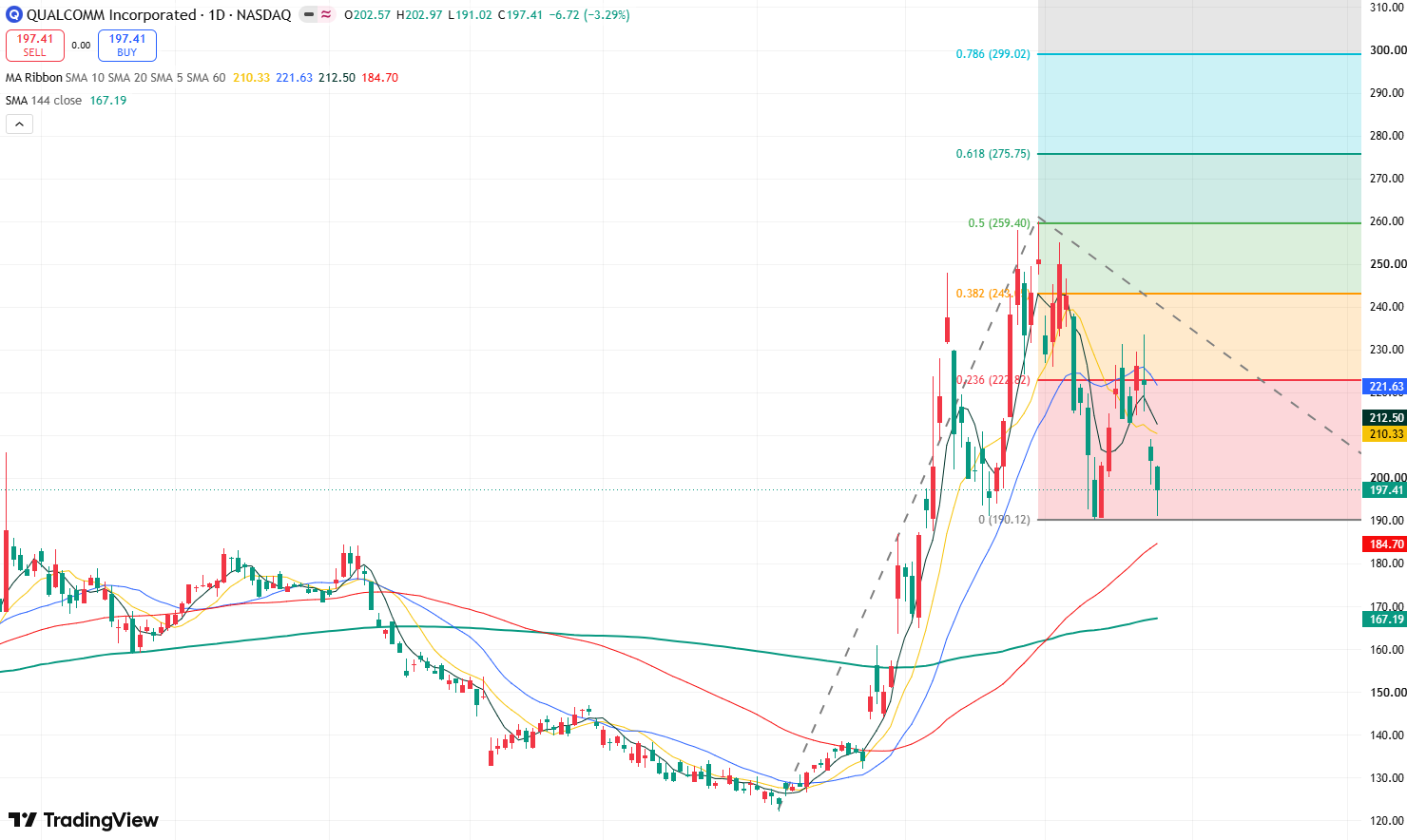
Qualcomm daily stock price chart, Source: TradingView
According to Qualcomm's daily chart, the stock has recently maintained its corrective momentum, dragged down by a broader pullback in the market's AI sector. Having touched $190 three consecutive times without breaking below, this level represents robust support. In the short term, the stock may initiate a technical rebound, with the primary target testing the June 22 rebound high of $233.44.
If the stock can decisively break and hold above the resistance level at $233.44, it will open up upside potential toward its all-time high of $259.92. A further breakout above that level would clear the path toward the Fibonacci 0.786 extension level of $300.
On the downside, if the stock falls below the $190 support level, it will likely slide to test support in the $180 to $184.50 range.
Recommended Articles


