


Worried About Stagflation? You Might Want to Own These 3 ETFs.
Key Points
“Stagflation” is a painful economic condition that combines stagnant growth with high inflation.
Investing in broadly diversified index funds of U.S. stocks, bonds, and international stocks could offer protection from stagflation.
The Vanguard Total Bond Market ETF outperformed U.S. stocks for several years after the global financial crisis.
- These 10 stocks could mint the next wave of millionaires ›
Americans are feeling bad about the economy. According to May data from the University of Michigan's Surveys of Consumers, consumer sentiment has reached a new record low. People are feeling the pain of higher gas prices from the Iran war and lingering inflation. It's clear that higher prices are bad for people's pocketbooks. But what if the economy got worse?
Some investors might be worried that the U.S. economy is at risk of "stagflation" -- which is a combination of slow economic growth, high unemployment, and high inflation. If the job market stays sluggish and prices stay higher for longer, the American economy might stay stuck in neutral instead of growing strongly.
Where to invest $1,000 right now? Our analyst team just revealed what they believe are the 10 best stocks to buy right now, when you join Stock Advisor. See the stocks »
The last period of serious stagflation in the U.S. occurred in the mid-1970s, when America suffered inflation rates of 12% or higher and a 9% unemployment rate. Something like that could happen again. People who are afraid of losing their jobs and feeling burned out on high prices might cut back on spending. Company profits could shrink. Less consumer demand could lead to fewer jobs being created. That would feel uncomfortably close to stagflation.

Image source: Getty Images.
If America's economy faces another battle with stagflation, how should you invest? Let's look at three exchange-traded funds (ETFs) that offer diversification and defensive characteristics that might help protect your money from higher inflation and slower growth.
1. Schwab U.S. Broad Market ETF (SCHB): 2,409 stocks, 16 years of 14.5% annualized returns
The Schwab U.S. Broad Market ETF (NYSEMKT: SCHB) made the list of the best low-cost index funds. And for good reason, as this fund offers diversified exposure to the Dow Jones U.S. Broad Stock Market Index. This Schwab fund holds 2,409 stocks and charges an ultra-low expense ratio of 0.03%. Since its inception in November 2009, it has delivered average annual returns of 14.5%.
No one knows for sure which stocks or sectors will perform better during a stagflationary economy. But the Schwab U.S. Broad Market ETF could be a good choice because it's so diversified. This fund's top five sectors are:
- Information technology: 31.06% of the fund
- Financials: 12.9%
- Industrials: 10.3%
- Healthcare: 9.94%
- Consumer discretionary: 9.87%
No matter what happens next with the U.S. economy, stocks tend to outperform inflation over time. (For example, even if inflation climbs to 5%-6%, the average U.S. stock market return is about 10% per year.) This Schwab index fund lets you own thousands of stocks and is a solid "set it and forget it" piece of a portfolio for long-term investors.
2. Vanguard Total Bond Market ETF (BND): 11,455 bonds, 19 years of 3.08% annualized returns
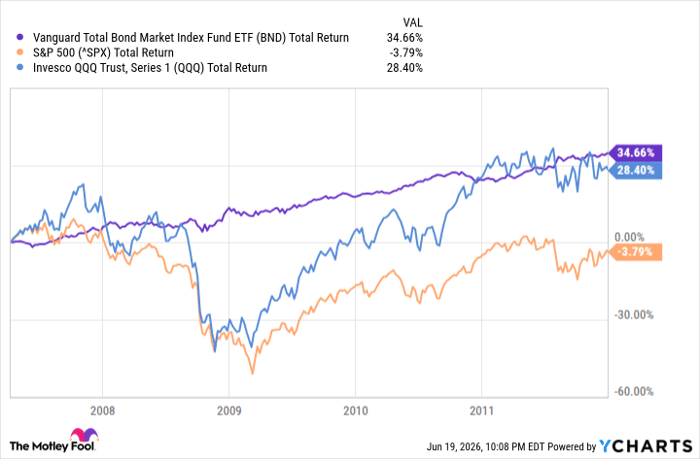
When the economy is going through a time of slow growth or recession, bonds often outperform stocks. The Vanguard Total Bond Market ETF (NASDAQ: BND) is one of the easiest, lowest-cost ways to invest in bonds. It offers a broadly diversified portfolio of 11,455 U.S. bonds, including government bonds and corporate bonds. Like the Schwab fund, it charges an ultra-low-cost expense ratio of 0.03%. And since the fund's inception in April 2007, this bond ETF has delivered average annual returns of 3.08%.
Returns of 3.08% might not sound exciting compared to the recent strong returns from U.S. growth stocks. But keep in mind that stocks sometimes go through extended bear markets that last for years. From April 2007 to January 2012, the Vanguard Total Bond Market ETF outperformed the S&P 500 index and the tech-heavy Invesco QQQ Trust ETF (NASDAQ: QQQ).
BND Total Return Level data by YCharts
If the U.S. economy goes through another long-term slowdown, owning bonds can help your money keep growing -- or at least reduce your risk of loss.
3. Vanguard International High Dividend Yield ETF (VYMI): 1,578 stocks, 10 years of 11.4% annualized returns
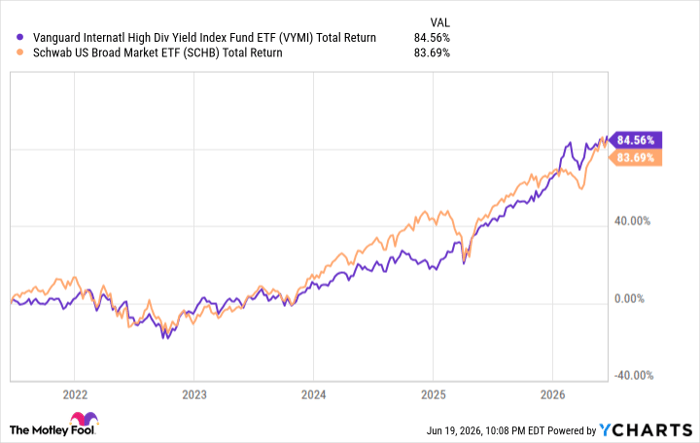
Even if the U.S. economy suffers stagflation, other countries might keep growing. Buying international stocks can help diversify your portfolio by investing in other parts of the world, away from the U.S. economy and the U.S. dollar. The Vanguard International High Dividend Yield ETF (NASDAQ: VYMI) has outperformed the Schwab U.S. Broad Market ETF for the past five years.
VYMI Total Return Level data by YCharts
The Vanguard International High Dividend Yield ETF could be a good choice for stagflationary conditions. It holds a broad portfolio of 1,578 international stocks from 45 countries. The fund owns companies that tend to be consistently profitable, financially strong, and able to pay high dividends. Since its inception in February 2016, this fund has delivered average annual returns of 11.4%.
The U.S. economy might avoid the worst-case scenarios. And even if the economy takes a turn for the worse, no one knows for sure which investments will do better (or worse) in times of stagflation. But if you're concerned about the risks of higher-for-longer inflation and slower-than-expected economic growth, these ETFs could be worth adding to your portfolio. Diversification across U.S. stocks, bonds, and international stocks could potentially protect your money -- and keep your investments growing for years to come.
Where to invest $1,000 right now
When our analyst team has a stock tip, it can pay to listen. After all, Stock Advisor’s total average return is 936%* — a market-crushing outperformance compared to 209% for the S&P 500.
They just revealed what they believe are the 10 best stocks for investors to buy right now, available when you join Stock Advisor.
See the stocks »
*Stock Advisor returns as of June 23, 2026.
Ben Gran has positions in Vanguard Total Bond Market ETF. The Motley Fool has positions in and recommends Vanguard Total Bond Market ETF. The Motley Fool has a disclosure policy.
Recommended Articles


