

US President Trump: Iran broke the ceasefire with Hormuz drone strike

Source Fxstreet

Recently, the US President Donald Trump posted on his Truth Social network that Iran violated the ceasefire, after launching drones at ships in the Strait of Hormuz, with one of them hitting the upper deck of a large cargo-carrying ship.

Key highlights:
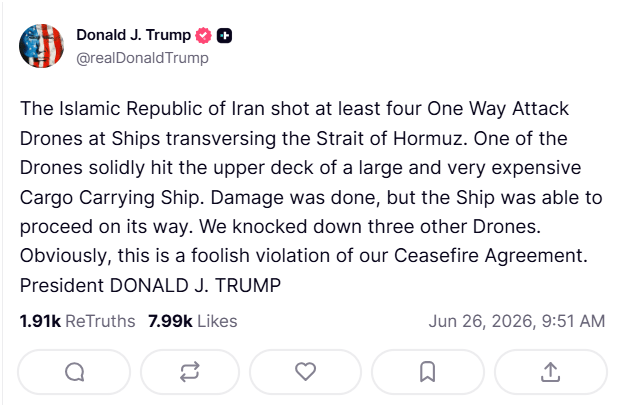
Source: Truth Social

Markets' reaction to Trump’s post

  • WTI prices bounced off the daily low of $68.56 and reclaimed $69.00, but it remains trading with losses of 3.54% in the day.
  • Gold prices shot up towards a two-day high of $4,096, yet it remains shy of clearing the psychological $4,100 figure.

Risk sentiment FAQs

In the world of financial jargon the two widely used terms “risk-on” and “risk off'' refer to the level of risk that investors are willing to stomach during the period referenced. In a “risk-on” market, investors are optimistic about the future and more willing to buy risky assets. In a “risk-off” market investors start to ‘play it safe’ because they are worried about the future, and therefore buy less risky assets that are more certain of bringing a return, even if it is relatively modest.

Typically, during periods of “risk-on”, stock markets will rise, most commodities – except Gold – will also gain in value, since they benefit from a positive growth outlook. The currencies of nations that are heavy commodity exporters strengthen because of increased demand, and Cryptocurrencies rise. In a “risk-off” market, Bonds go up – especially major government Bonds – Gold shines, and safe-haven currencies such as the Japanese Yen, Swiss Franc and US Dollar all benefit.

The Australian Dollar (AUD), the Canadian Dollar (CAD), the New Zealand Dollar (NZD) and minor FX like the Ruble (RUB) and the South African Rand (ZAR), all tend to rise in markets that are “risk-on”. This is because the economies of these currencies are heavily reliant on commodity exports for growth, and commodities tend to rise in price during risk-on periods. This is because investors foresee greater demand for raw materials in the future due to heightened economic activity.

The major currencies that tend to rise during periods of “risk-off” are the US Dollar (USD), the Japanese Yen (JPY) and the Swiss Franc (CHF). The US Dollar, because it is the world’s reserve currency, and because in times of crisis investors buy US government debt, which is seen as safe because the largest economy in the world is unlikely to default. The Yen, from increased demand for Japanese government bonds, because a high proportion are held by domestic investors who are unlikely to dump them – even in a crisis. The Swiss Franc, because strict Swiss banking laws offer investors enhanced capital protection.

Disclaimer: For information purposes only. Past performance is not indicative of future results.
placeholder
Gold Price Analysis (XAU/USD): Gold Falls to 6-Month Low as Inflation Fuels Rate Hike Bets, A Buying Opportunity or a Falling Knife? Gold hit a 6-month low on Fed rate hike bets. However, strong central bank buying and technical indicators suggest potential tactical bounces and long-term accumulation windows.
Author  Mitrade Team
6 Month 12 Day Fri
Gold hit a 6-month low on Fed rate hike bets. However, strong central bank buying and technical indicators suggest potential tactical bounces and long-term accumulation windows.
placeholder
15 Days After SpaceX Listing, Index Funds Will Take 30% of Floating Shares, What It Means for Retail Investors?TradingKey - SpaceX (SPCX.US) is set to debut on Nasdaq on June 12, targeting a valuation of $1.75 trillion. At that time, only about 3% to 4% of total shares will be freely tradable; with founder sha
Author  Mitrade Team
6 Month 10 Day Wed
TradingKey - SpaceX (SPCX.US) is set to debut on Nasdaq on June 12, targeting a valuation of $1.75 trillion. At that time, only about 3% to 4% of total shares will be freely tradable; with founder sha
placeholder
WTI steadies around $87.50 despite renewed supply concernsWest Texas Intermediate (WTI) oil price experiences volatility after registering over 2.5% losses in the previous day, trading around $87.40 per barrel during the Asian hours on Wednesday.
Author  Mitrade Team
6 Month 10 Day Wed
West Texas Intermediate (WTI) oil price experiences volatility after registering over 2.5% losses in the previous day, trading around $87.40 per barrel during the Asian hours on Wednesday.
placeholder
Lincoln National vs. MetLife: Which Financial Stock Is a Better Buy in 2026?Key PointsLincoln National offers a specialized focus on U.S. retirement and life insurance markets.MetLife provides massive global diversification across forty international marke
Author  Mitrade Team
6 Month 10 Day Wed
Key PointsLincoln National offers a specialized focus on U.S. retirement and life insurance markets.MetLife provides massive global diversification across forty international marke
placeholder
US Attacks Iran Amid the “Ceasefire”: Bitcoin, Gold, and Oil ReactThe United States launched strikes against Iran on Tuesday after a US Apache helicopter was downed over the Strait of Hormuz, breaking the fragile ceasefire previously announced by President Donald Tr
Author  Mitrade Team
6 Month 10 Day Wed
The United States launched strikes against Iran on Tuesday after a US Apache helicopter was downed over the Strait of Hormuz, breaking the fragile ceasefire previously announced by President Donald Tr
Related Instrument
goTop
quote