


Silver Price Forecast: XAG/USD slides to fresh 14-month low near $40.50, US PCE data eyed
- Silver price slumps to near $40.50 on Wednesday, the lowest level seen in over 14 months.
- Investors keenly await the US PCE Inflation data for October.
- The CME FedWatch tool shows traders are confident about Fed interest rate hike in the December meeting.
Silver price (XAG/USD) posts a fresh 14-month low at $40.52 in the Asian trade on Wednesday. The white metal faces selling pressure ahead of the United States (US) Personal Consumption Expenditure (PCE) Price Index data for October, which will be published at 13:30 GMT.
Commerzbank expects the data to underscore persistent price pressures, with “the inflation rate… expected to rise to 3.8% in October, and even without food and energy prices, the inflation rate is expected to be too high at 3.2%.”
The inflation data is expected to have a significant impact on the Federal Reserve’s (Fed) monetary policy outlook.
Latest remarks from several Fed policymakers have indicated that they are highly concerned that inflation is moving in a wrong direction and more interest rate hikes are warranted to contain the same.
Williams flags more work on inflation, keeping Dollar sentiment firmly hawkish
Fed’s Williams delivers a speech that scores 6.2 on the FXS Speechtracker, broadly in line relative to the historical average and signaling a steady, not extreme, hawkish tone. The emphasis that the U.S. central bank “still has work to do” to get inflation back to the 2% target, alongside projections of 3.5% inflation in 2026 and risks skewed to the upside, reinforces a message of ongoing policy vigilance even as Williams notes a strong, resilient economy and stable job market. Forward guidance that inflation only returns to 2% by 2028, with solid growth around 2.75%, suggests a prolonged period of restrictive policy expectations that should underpin the Dollar on balance.
The FXS Fed Sentiment Index rises by 0.35 points to 152.49, confirming that the speech nudged overall Fed rhetoric deeper into hawkish territory according to the FXS Speechtracker. With the index far above the neutral 100 mark, markets are likely to interpret Williams’ comments as supportive of higher-for-longer rate pricing, a backdrop that typically favors the Dollar against lower-yielding peers.
According to the CME FedWatch tool, the Fed is almost certain to hike interest rates in the December policy meeting.
Theoretically, higher Fed interest rates bode poorly for non-yielding assets, such as Silver.
Silver Technical Analysis
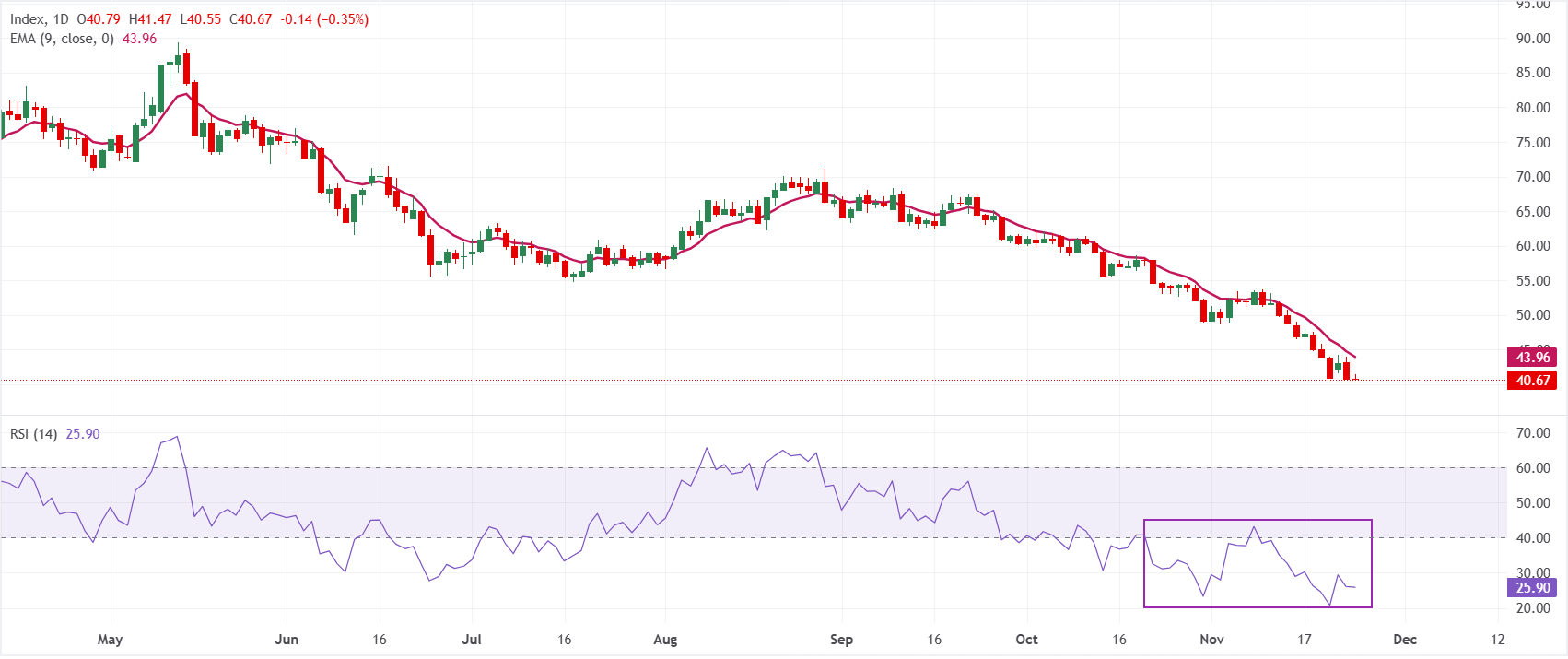
In the daily chart, XAG/USD trades at $40.67, keeping a bearish near-term bias as price remains below the 9-day exponential moving average (EMA) at $43.96. The metal has been sliding away from the mid-$50s area seen earlier in the month, and the proximity of the 9-day EMA just overhead hints that rallies are likely to be capped while below this dynamic resistance. The Relative Strength Index (14) at 25.90 sits in oversold territory, suggesting that while downside pressure dominates, the pace of the recent sell-off could start to moderate.
On the topside, initial resistance is located at the 9-day EMA at $43.96, which marks the first hurdle for any recovery attempt and would need to be reclaimed to ease the current bearish tone. With no clear nearby structural supports below the market in this dataset, traders may continue to focus on intraday price action and oversold signals from the RSI for signs of a potential stabilization or corrective bounce, while respecting the prevailing downtrend as long as XAG/USD trades under the short-term EMA.
(The technical analysis of this story was written with the help of an AI tool. Know more.)
Silver FAQs
Silver is a precious metal highly traded among investors. It has been historically used as a store of value and a medium of exchange. Although less popular than Gold, traders may turn to Silver to diversify their investment portfolio, for its intrinsic value or as a potential hedge during high-inflation periods. Investors can buy physical Silver, in coins or in bars, or trade it through vehicles such as Exchange Traded Funds, which track its price on international markets.
Silver prices can move due to a wide range of factors. Geopolitical instability or fears of a deep recession can make Silver price escalate due to its safe-haven status, although to a lesser extent than Gold's. As a yieldless asset, Silver tends to rise with lower interest rates. Its moves also depend on how the US Dollar (USD) behaves as the asset is priced in dollars (XAG/USD). A strong Dollar tends to keep the price of Silver at bay, whereas a weaker Dollar is likely to propel prices up. Other factors such as investment demand, mining supply – Silver is much more abundant than Gold – and recycling rates can also affect prices.
Silver is widely used in industry, particularly in sectors such as electronics or solar energy, as it has one of the highest electric conductivity of all metals – more than Copper and Gold. A surge in demand can increase prices, while a decline tends to lower them. Dynamics in the US, Chinese and Indian economies can also contribute to price swings: for the US and particularly China, their big industrial sectors use Silver in various processes; in India, consumers’ demand for the precious metal for jewellery also plays a key role in setting prices.
Silver prices tend to follow Gold's moves. When Gold prices rise, Silver typically follows suit, as their status as safe-haven assets is similar. The Gold/Silver ratio, which shows the number of ounces of Silver needed to equal the value of one ounce of Gold, may help to determine the relative valuation between both metals. Some investors may consider a high ratio as an indicator that Silver is undervalued, or Gold is overvalued. On the contrary, a low ratio might suggest that Gold is undervalued relative to Silver.
Recommended Articles


