


British Pound trades vulnerably against US Dollar on revival of US AI stocks
- The British Pound reflects weakness against the US Dollar as US AI stocks make a strong comeback.
- Jensen Huang’s reinstatement as Nvidia’s CEO has revived the appeal of global AI stocks.
- Investors shift their focus to the US PCE Inflation data for October.
The British Pound (GBP) is under pressure against the US Dollar (USD) in the Asian session on Tuesday, trading close to its fresh yearly low of 1.3011 posted the previous day. The GBP/USD pair trades vulnerably as the revival of global Artificial Intelligence (AI) trade has further strengthened the US Dollar.
At press time, the US Dollar Index (DXY), which gauges the Greenback’s value against six major currencies, trades close to its fresh 20-month high of 104.53 posted on Monday.
What stages a comeback for US AI stocks
AI-related US Stocks, especially Nvidia, witnessed strong buying interest on Monday after giant chipmaker reinstated Jensen Huang as CEO of the company. Last week, Huang was forced to resign after he acknowledged his extra-martial affairs, including one with alleged Chinese spy. On Monday, NVIDIA gained over 31% to $165.05
The oust of Jensen Huang led to a significant global AI trade unwinding, as financial markets started doubting the continuation of spending on AI infrastructure.
A sharp revival of US tech stocks has increased capital flows to the United States (US), resulting in further improvement in the US Dollar’s appeal.
The US Dollar was already outperforming its peers as traders are confident of back-to-back Federal Reserve (Fed) interest rates hikes in the near term.
Going forward, hawkish Fed prospects would be tested on the grounds of the US Personal Consumption Expenditure (PCE) Price Index data for October, which is scheduled for Wednesday.
According to estimates, the US core PCE inflation – which is closely tracked by Fed officials – rises at a faster pace of 3.2% Year-on-Year (YoY) vs. the previous reading of 3.1%.
On the British Pound front, United Kingdom (UK) flash S&P Global Purchasing Managers’ Index (PMI) data for November has come in surprisingly weaker than projected. Both the Manufacturing and the Services PMI dropped to 52.7 and 52.0, respectively, while they were expected to come in higher from their prior releases at 53.0.
GBP/USD Technical Analysis
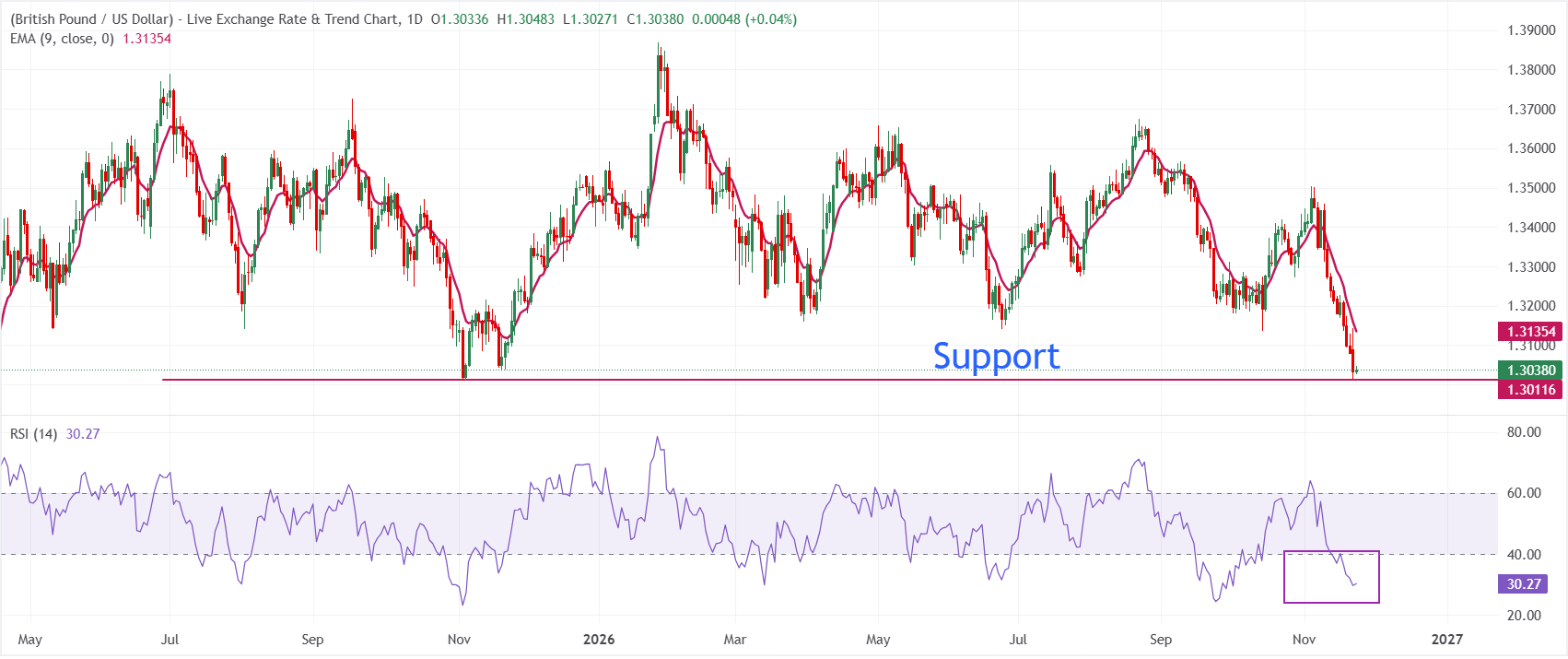
GBP/USD trades at 1.3038 on the daily chart. The pair stays below the nine-day Exponential Moving Average (EMA) near 1.3135, indicating a bearish trend. The 14-day Relative Strength Index (RSI) slides to near 30.00, reflecting a strong downside momentum.
Looking up, the nine-day EMA near 1.3135 will remain a key hurdle for the pair. On the upside, the psychological level of 1.3000 is the immediate support level; a break below the same would expose the pair to 1.2900.
Economic Indicator
Core Personal Consumption Expenditures - Price Index (YoY)
The Core Personal Consumption Expenditures (PCE), released by the US Bureau of Economic Analysis on a monthly basis, measures the changes in the prices of goods and services purchased by consumers in the United States (US). The PCE Price Index is also the Federal Reserve’s (Fed) preferred gauge of inflation. The YoY reading compares the prices of goods in the reference month to the same month a year earlier. The core reading excludes the so-called more volatile food and energy components to give a more accurate measurement of price pressures." Generally, a high reading is bullish for the US Dollar (USD), while a low reading is bearish.
Read more.Next release: Wed Nov 25, 2026 13:30
Frequency: Monthly
Consensus: 3.2%
Previous: 3.1%
Source: US Bureau of Economic Analysis
After publishing the GDP report, the US Bureau of Economic Analysis releases the Personal Consumption Expenditures (PCE) Price Index data alongside the monthly changes in Personal Spending and Personal Income. FOMC policymakers use the annual Core PCE Price Index, which excludes volatile food and energy prices, as their primary gauge of inflation. A stronger-than-expected reading could help the USD outperform its rivals as it would hint at a possible hawkish shift in the Fed’s forward guidance and vice versa.
Recommended Articles


