


Treasury yields near 24-year high as Pimco warns of 6%
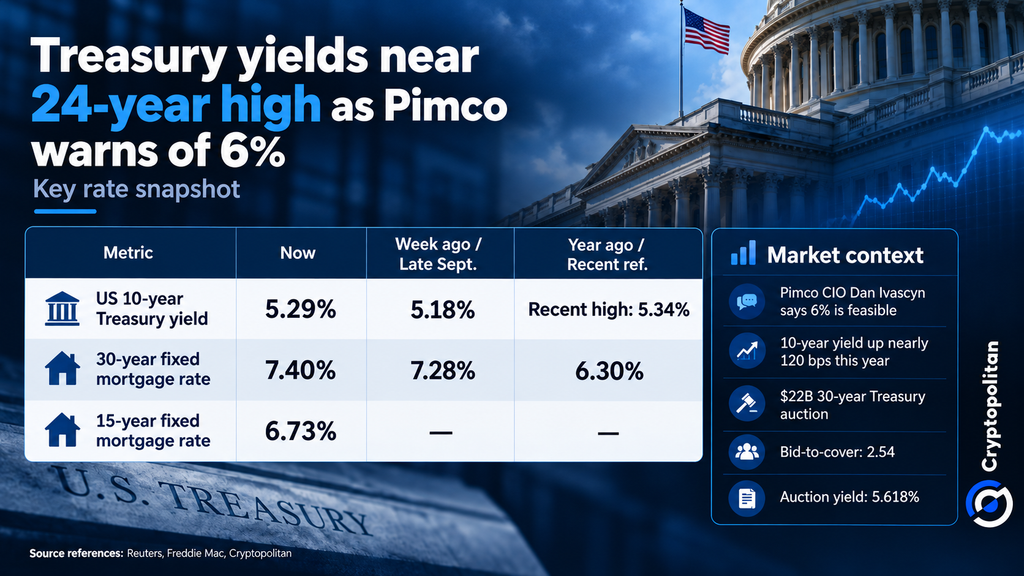
The US 10-year Treasury yield hovered near 5.29% on Friday, just below its recent 5.34% peak. That was its highest level since April 2002, when it reached 5.36% on April 2, according to Federal Reserve data.
Pimco’s chief investment officer Dan Ivascyn says 6% is a possibility, which raises fears of high borrowing rates, stocks and corporate credit across the globe.
Why Pimco calls 6% “feasible”
Ivascyn has called another sharp jump “feasible,” while cautioning that leveraged hedge funds can speed up the selloff as they unwind losing positions.
As reported by Reuters, higher oil prices, ongoing inflation, and increased debt faced by the United States were all part of Ivascyn’s arguments.
This year, the yield on 10-year bonds has increased by about 120 basis points, marking the largest quarterly increase of this century in July to September.
Ivascyn cautioned that a rise in the yields above 5.5% might spur “some decent weakness in risk markets, both credit and equity.”
Cryptocurrencies may also experience difficulties due to the tendency of investors to move toward higher-yielding Treasuries.
More than 70% of the move is real rates
It is not only the Federal Reserve that is responsible for rising yields.
According to Russell Investments, more than 70% of the increase since the end of February has been attributed to higher expected real rates and also the widening of the real term premium.
In its review published in September, the Bank of International Settlement reported that investors continue to buy riskier assets, including emerging-market investments, in spite of increasing yields.
However, the International Monetary Fund cautioned that sudden changes in market sentiment might lead to outflow of capital from weakened economies.
The plumbing is flashing warning signs
Several actions may be exerting pressure that could worsen the bond selloff.
An analysis by Reuters has revealed that investors who acquired long-term bonds sold by AI firms are now selling Treasury futures to protect themselves from climbing interest rates. Goldman Sachs predicts that hyperscalers would borrow $420 billion in debt next year, which may also add onto the pressure.
Investors are also becoming increasingly wary about keeping long-term government bonds. The difference between 10-year and 30-year Treasury bonds has climbed to around 37 basis points, indicating that investors feel that they need more compensation for the risks associated with such long-term investments.
Mortgage markets can make the situation worse. Rising interest rates mean that homeowners will be less inclined to refinance, thereby prolonging the time when mortgage-backed securities are outstanding. Investors react by selling Treasury futures to hedge their risk, which increases the pressure on bond prices.
The feelings of anxiety are reflected in the options markets as well. The price of shielding oneself from the risk of a 200 basis point increase in interest rates has risen to its highest level since March 2023. With several forces causing the market to be put under pressure at the same time, even a small market movement could cause a chain reaction.
Households already feel it at 7.40%
Higher mortgage rates are making home ownership even harder for Americans.
Freddie Mac reported that the 30-year fixed mortgage rate climbed to 7.40% on October 8, compared to 7.28% the week prior, whereas the rate stood at 6.30% in 2025. Meanwhile, the 15-year rate rose to 6.73%.
This increase confirms the trend reported by Cryptopolitan in September, when rising Treasury yields pushed mortgage rates higher.
What strong demand can and cannot fix
On October 8, investors were still present for the $22 billion 30-year Treasury bond auction.
The auction’s clearing yield was 5.618% and had a bid-to-cover ratio of 2.54.
Even though there was enough interest in bonds on the market, it doesn’t mean that the borrowing is going to be cheap as buyers are looking for higher return. If yields linger around 6%, pressure will be put on stocks, corporate credit, and cryptocurrencies and not only on Treasury bonds despite their strong demand.
Don’t just read crypto news. Understand it. Subscribe to our newsletter. It's free.
บทความแนะนำ


