


Aave moves to wind down Scroll, zkSync and Aptos in reserve cull
Aave’s founder Stani Kulechov named Scroll, zkSync and Aptos among the smaller deployments that the project plans to fully retire in part of a sweeping proposal to deprecate another 50 low-adoption asset reserves in a governance push announced on Thursday.
According to the governance forum filing drafted by risk provider LlamaRisk, the two-part plan is supposed to remove about $98.1 million in supplied assets and $15.6 million in outstanding debt from these so-called low-adoption asset reserves.
That total is a combination of:
- Individual reserve removals across 11 Aave V3 deployments, covering 50 reserves and another 21 matured Pendle Principal Tokens. Altogether, those come up to $85.3 million in supply and $11.5 million in debt.
- Another 25 reserves could be taken offline via six whole-market shutdowns worth $12.8 million in supply and $4.1 million in debt.
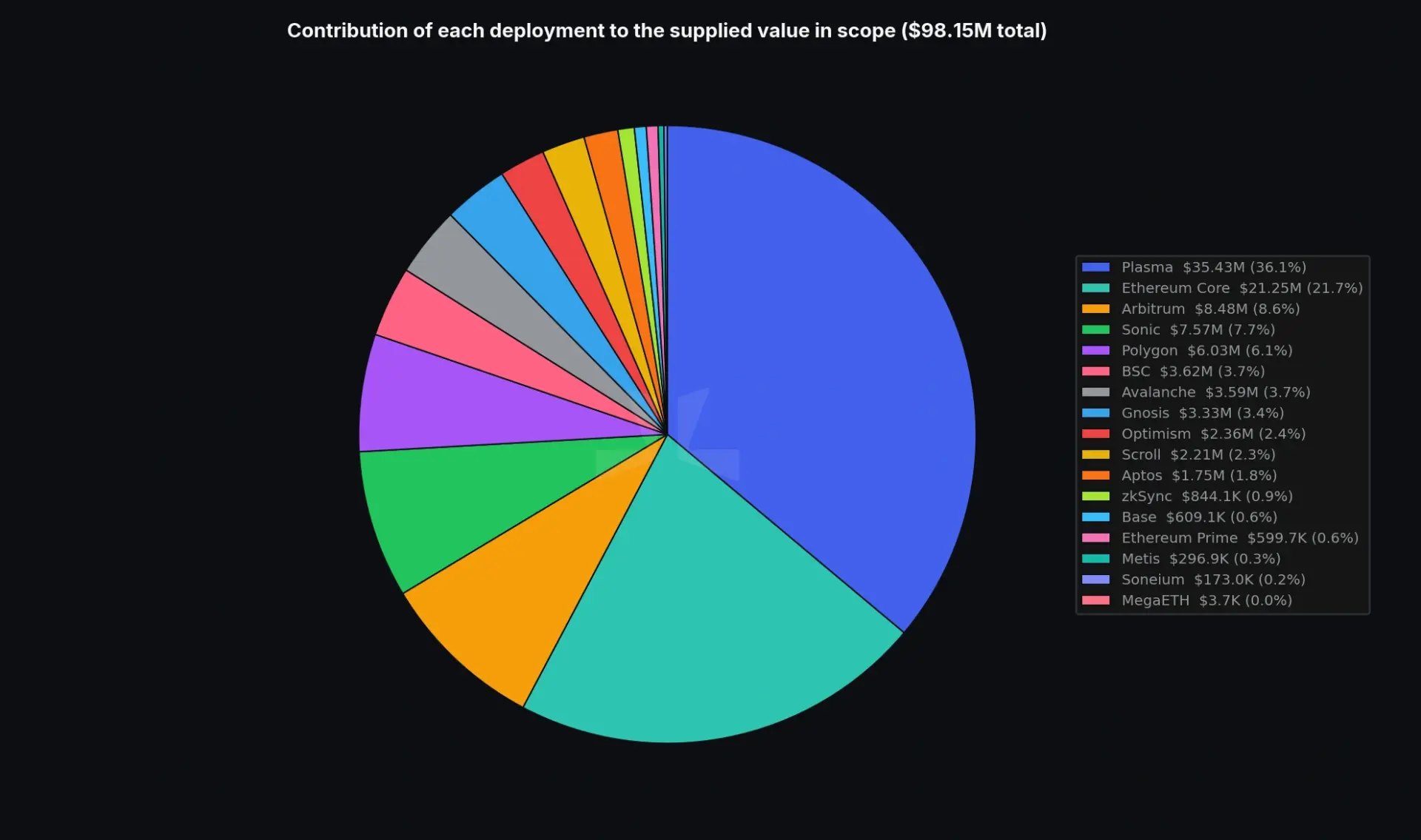 Contribution of each deployment to the supplied value on Aave. Source: LlamaRisk
Which chains will Aave deprecate whole markets on?
Kulechov confirmed that the governance filing is proposing an “orderly winding down” of entire markets on six chains (Sonic, Scroll, zkSync, Metis, Soneium and Aptos) instead of doing a reserve-by-reserve review.
| Chain | Supplied Balance |
| Sonic | $7.6 million |
| Scroll | $2.2 million |
| Aptos | $1.7 million |
| zkSync | $0.8 million |
| Metis | $0.3 million |
| Soneium | $0.2 million |
DefiLlama data backs up LlamaRisk’s rationale for pushing to completely take the selected networks off Aave. The $1.81 million in total value locked on Scroll and roughly $873,000 on Aptos barely show up on the balance sheet for Aave, which holds $14.47 billion across all chains.
An important bit of context to note is that these proposals are pending a governance vote . Holders still have to approve the wind-downs before any freezes and rate changes take effect.
Why is Aave taking down markets?
Regardless of size, the operating cost on every listed reserve stays at a standard rate. Those costs often include oracle costs, risk parameter monitoring, and maintenance of liquidation paths,
According to LlamaRisk, the cuts are simply portfolio maintenance moves to deployments that no longer made fiscal sense, rather than any one big blowup or response to a catastrophic event.
In short, if a reserve’s activity cannot cover the overhead to maintain it, it’s time to wind it down. And according to LlamaRisk, Aave is now paying more to support the markets on Sonic, Scroll, zkSync, Metis, Soneium and Aptos than the revenue they generate.
The review runs against Aave’s proposed Risk Framework, a four-layer standard that LlamaRisk introduced to govern listings, quarterly due-diligence refreshes, and deprecation decisions across V3, V4 and Aave Horizon.
Aave floated the standard in June after the roughly $292 million KelpDAO bridge exploit, which routed stolen rsETH into Aave markets as collateral and left the protocol facing potential bad debt.
A companion proposal targets shaky price feeds
Running in parallel is a second LlamaRisk proposal aimed at long-tail reserves flagged for Chainlink price-feed risk. Chainlink has tagged the feeds behind these assets as high or very high operational risk because the underlying tokens lost liquidity, leaving too little trading to price them reliably.
That set spans 10 deployments with $6.76 million in supply and $4.29 million in debt. Because live positions remain open, the feeds cannot simply be switched off.
Instead, each reserve gets frozen, its caps cut to one, and its live oracle swapped for a fixed-price adapter, so remaining loans can unwind without a manipulable feed. SCR on Scroll and USDm on Celo appear in both proposals, LlamaRisk noted.
The trims sit against a growing V4
The housekeeping arrives while Aave’s newer plumbing expands. On July 29, the protocol said V4 deposits had nearly doubled over the prior month, and that deposit and borrow caps had been raised for the eleventh time, per its account on X.
The two moves fit Kulechov’s stated “revenue-led protocol strategy,” under which reserves that no longer earn their keep are pruned, and capital is pushed toward institutional and real-world-asset markets.

Aave holds around $116.6 million in annualized revenue and $14.47 billion in TVL, according to DefiLlama, still the largest lending protocol by both measures. AAVE traded at $95.52 on Thursday, down 2.75% over 24 hours.
If you're reading this, you’re already ahead. Stay there with our newsletter.
บทความแนะนำ


