




US Dollar Index: More upside likely amid 20 and 50-day EMAs bullish crossover
- The US Dollar Index falls to near 99.20 amid uncertainty ahead of the long weekend in the US.
- Fed’s Schmid and Bostic argued in favor of a modestly restrictive monetary policy stance.
- The DXY could extend gains if the RSI (14) breaks above 60.00.
The US Dollar Index (DXY), which tracks the Greenback’s value against six major currencies, trades 0.15% lower to near 99.20 during the European trading session on Friday, ahead of an extended weekend in the United States (US), correcting from its six-week high of 99.50 posted the previous day.
On Thursday, the US Dollar (USD) gained sharply after a few Federal Reserve (Fed) officials: Fed officials: Kansas Fed Bank President Jeffrey Schmid and Atlanta Fed Bank President Raphael Bostic, stressed the need to adopt a restrictive monetary policy stance, citing upside inflation risks.
“Monetary policy needs to be modestly restrictive as inflation is too hot,” Schmid said at the Economic Club of Kansas City, warning that more interest rate cuts could worsen the inflation situation.
This week, the US Consumer Price Index (CPI) data for December showed that price pressures remained steady.
US Dollar Index technical analysis
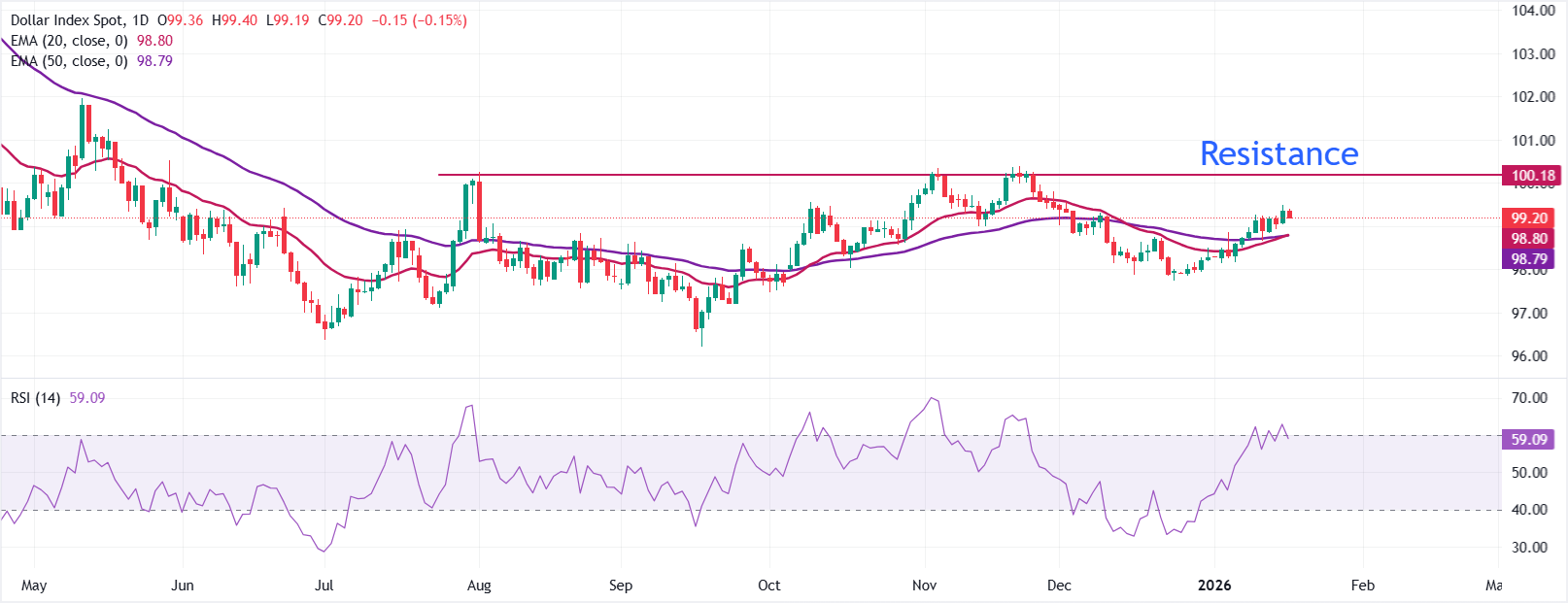
In the daily chart, the Dollar Index Spot trades at 99.20. Price holds above the rising 20-Exponential Moving Average (EMA) at 98.80 and the 50-EMA at 98.79, with these averages acting as immediate supports. The 20-EMA rises marginally above the 50-EMA, reinforcing a positive near-term bias.
The 14-day Relative Strength Index (RSI) at 59 (neutral-bullish) stays above 50, backing the recovery in momentum.
Momentum would stay positive while the index holds above the 20-EMA, and a pullback could test the 50-EMA as first support. RSI eased from 62.92 to 59.10 but remains above the midline, keeping the backdrop supportive. Continued acceptance above the EMA cluster could extend the move, whereas a close below the short-term average would open the way toward the medium-term baseline.
(The technical analysis of this story was written with the help of an AI tool.)
US Dollar FAQs
The US Dollar (USD) is the official currency of the United States of America, and the ‘de facto’ currency of a significant number of other countries where it is found in circulation alongside local notes. It is the most heavily traded currency in the world, accounting for over 88% of all global foreign exchange turnover, or an average of $6.6 trillion in transactions per day, according to data from 2022. Following the second world war, the USD took over from the British Pound as the world’s reserve currency. For most of its history, the US Dollar was backed by Gold, until the Bretton Woods Agreement in 1971 when the Gold Standard went away.
The most important single factor impacting on the value of the US Dollar is monetary policy, which is shaped by the Federal Reserve (Fed). The Fed has two mandates: to achieve price stability (control inflation) and foster full employment. Its primary tool to achieve these two goals is by adjusting interest rates. When prices are rising too quickly and inflation is above the Fed’s 2% target, the Fed will raise rates, which helps the USD value. When inflation falls below 2% or the Unemployment Rate is too high, the Fed may lower interest rates, which weighs on the Greenback.
In extreme situations, the Federal Reserve can also print more Dollars and enact quantitative easing (QE). QE is the process by which the Fed substantially increases the flow of credit in a stuck financial system. It is a non-standard policy measure used when credit has dried up because banks will not lend to each other (out of the fear of counterparty default). It is a last resort when simply lowering interest rates is unlikely to achieve the necessary result. It was the Fed’s weapon of choice to combat the credit crunch that occurred during the Great Financial Crisis in 2008. It involves the Fed printing more Dollars and using them to buy US government bonds predominantly from financial institutions. QE usually leads to a weaker US Dollar.
Quantitative tightening (QT) is the reverse process whereby the Federal Reserve stops buying bonds from financial institutions and does not reinvest the principal from the bonds it holds maturing in new purchases. It is usually positive for the US Dollar.
Artigos Recomendados


