


Mexican Peso tumbles as Consumer Confidence deteriorates, US recession fears
- Mexican Peso snaps four-day winning streak as risk sentiment sours.
- Dismal Mexican Consumer Confidence adds pressure to the Peso as outlook worsens for next year.
- US recession fears escalate as Trump avoids questions on economic slowdown.
- Despite USD weakness, safe-haven flows hurt EM currencies like the Peso.
The Mexican Peso depreciates against the US Dollar on Monday, snapping four days of consecutive losses against the emerging market currency as investors eye the release of crucial inflation figures in the United States (US). Meanwhile, the deterioration of Mexican Consumer Confidence weighed on the Peso, which is up 2.60% against the Greenback so far in 2025. The USD/MXN trades at 20.31, up 0.31%.
A dismal market mood drives the USD/MXN exchange rate higher on fears of a US recession. President Donald Trump's controversial trade policies sent the US stock market into a tailspin, while he dodged a question about a possible recession.
Across the south of the border, Consumer Confidence revealed by the Instituto Nacional de Estadistica Geografia e Informatica (INEGI) showed that consumers continued to get pessimistic about the current economic situation and about the outlook of the country in the 12 months from now.
In the meantime, fears that the US economy could be tipped into a recession or a stagflationary scenario keep investors leaning into safe-have currencies to the detriment of Emerging Market (EM) currencies like the Peso.
Despite this, the Greenback extended its losses against most G10 FX currencies. The US Dollar Index (DXY) tracks the buck's performance against a basket of six other currencies, down 0.14% to 103.76.
This week, Mexico’s economic docket will feature Industrial Production data. In the US, the schedule would reveal the JOLTs Job Openings data on Tuesday, followed by the Consumer Price Index (CPI) release on Wednesday.
Daily digest market movers: Mexican Peso pressured by US trade rhetoric
- Mexico’s Consumer Confidence dropped from 46.6 to 46.3, revealed INEGI.
- This data alongside with the ongoing disinflation process in Mexico, despite the recent uptick on headline and core prices, suggests Banco de Mexico (Banxico) could cut interest rates at the upcoming March 27 meeting.
- Banxico’s private economist survey showed that headline inflation is forecast to end at 3.71%, while core CPI is expected to finish at 3.75%. The USD/MXN exchange rate is projected to end at 20.85 in 2025, slightly lower than the 20.90 projection in the previous survey. However, for 2026, they anticipate a sharper depreciation of the Peso, well beyond the 21.30 level expected in January’s poll.
- The New York Fed Consumer Sentiment Survey revealed that inflation expectations for one year in February increased from 3% to 3.1%. For the three and five-year periods, they remained unchanged at 3%. Americans expect price increases in gas, rent and food.
- A Reuters poll showed that 70 out of 74 economists say the risk of recession has risen in the US, Canada and Mexico.
- Expectations that the Federal Reserve would ease policy had risen due to recession fears. Market participants estimate 80 basis points of easing toward year-end, revealed data from the Chicago Board of Trade.
- In the boiler room, trade disputes between the US and Mexico remain front and center. If the countries could agree, it would pave the way for a recovery of the Mexican currency. Otherwise, further USD/MXN upside is seen as US tariffs could trigger a recession in Mexico.
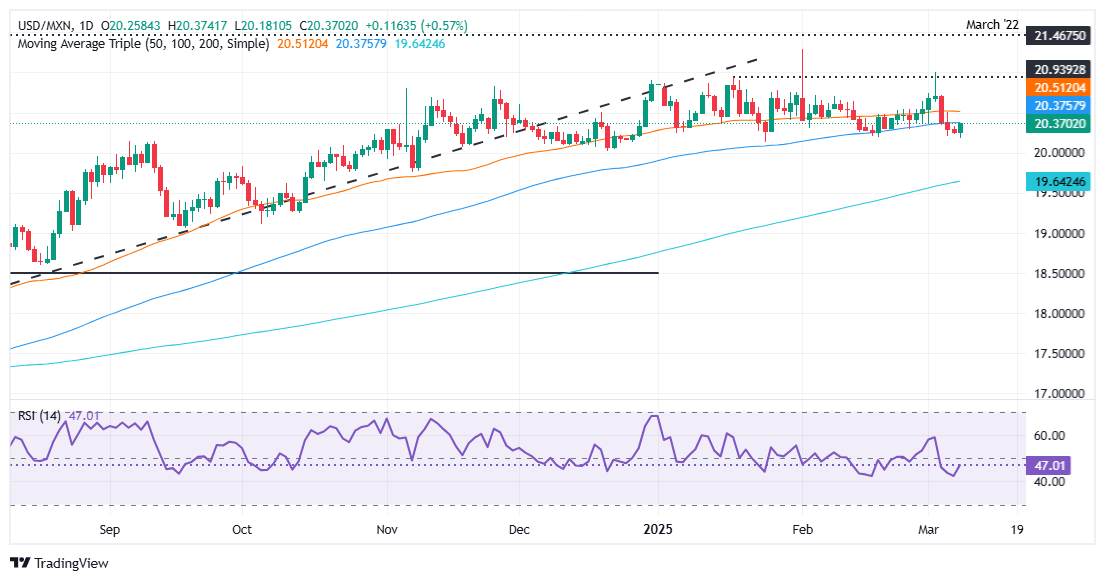
USD/MXN technical outlook: Mexican Peso weakens as USD/MXN climbs past 20.30
The USD/MXN trades sideways, unable to break the 20.20-21.00 figure range for the latest five weeks. However, as of writing, traders are testing the 100-day Simple Moving Average (SMA) at 20.34, which if broken would pave the way to test the 20.50. If surpassed, the next key resistance levels would be the March 4 peak at 20.99 and the year-to-date (YTD) peak of 21.28.
Conversely, if USD/MXN hurdles the 20.20 support, the next floor would be the 20.00 figure, ahead of challenging the 200-day SMA at 19.59.
Mexican Peso FAQs
The Mexican Peso (MXN) is the most traded currency among its Latin American peers. Its value is broadly determined by the performance of the Mexican economy, the country’s central bank’s policy, the amount of foreign investment in the country and even the levels of remittances sent by Mexicans who live abroad, particularly in the United States. Geopolitical trends can also move MXN: for example, the process of nearshoring – or the decision by some firms to relocate manufacturing capacity and supply chains closer to their home countries – is also seen as a catalyst for the Mexican currency as the country is considered a key manufacturing hub in the American continent. Another catalyst for MXN is Oil prices as Mexico is a key exporter of the commodity.
The main objective of Mexico’s central bank, also known as Banxico, is to maintain inflation at low and stable levels (at or close to its target of 3%, the midpoint in a tolerance band of between 2% and 4%). To this end, the bank sets an appropriate level of interest rates. When inflation is too high, Banxico will attempt to tame it by raising interest rates, making it more expensive for households and businesses to borrow money, thus cooling demand and the overall economy. Higher interest rates are generally positive for the Mexican Peso (MXN) as they lead to higher yields, making the country a more attractive place for investors. On the contrary, lower interest rates tend to weaken MXN.
Macroeconomic data releases are key to assess the state of the economy and can have an impact on the Mexican Peso (MXN) valuation. A strong Mexican economy, based on high economic growth, low unemployment and high confidence is good for MXN. Not only does it attract more foreign investment but it may encourage the Bank of Mexico (Banxico) to increase interest rates, particularly if this strength comes together with elevated inflation. However, if economic data is weak, MXN is likely to depreciate.
As an emerging-market currency, the Mexican Peso (MXN) tends to strive during risk-on periods, or when investors perceive that broader market risks are low and thus are eager to engage with investments that carry a higher risk. Conversely, MXN tends to weaken at times of market turbulence or economic uncertainty as investors tend to sell higher-risk assets and flee to the more-stable safe havens.
추천 기사


