


EUR/USD soars above 1.1800 as Yen intervention rumors slam Dollar
- EUR/USD jumps over 0.70% as intervention rumors trigger aggressive US Dollar selling.
- DXY sinks to September 2025 lows after reports of Fed-linked rate checks fuel market speculation.
- Focus shifts to ECB speakers, Eurozone GDP, and the upcoming FOMC meeting for direction.
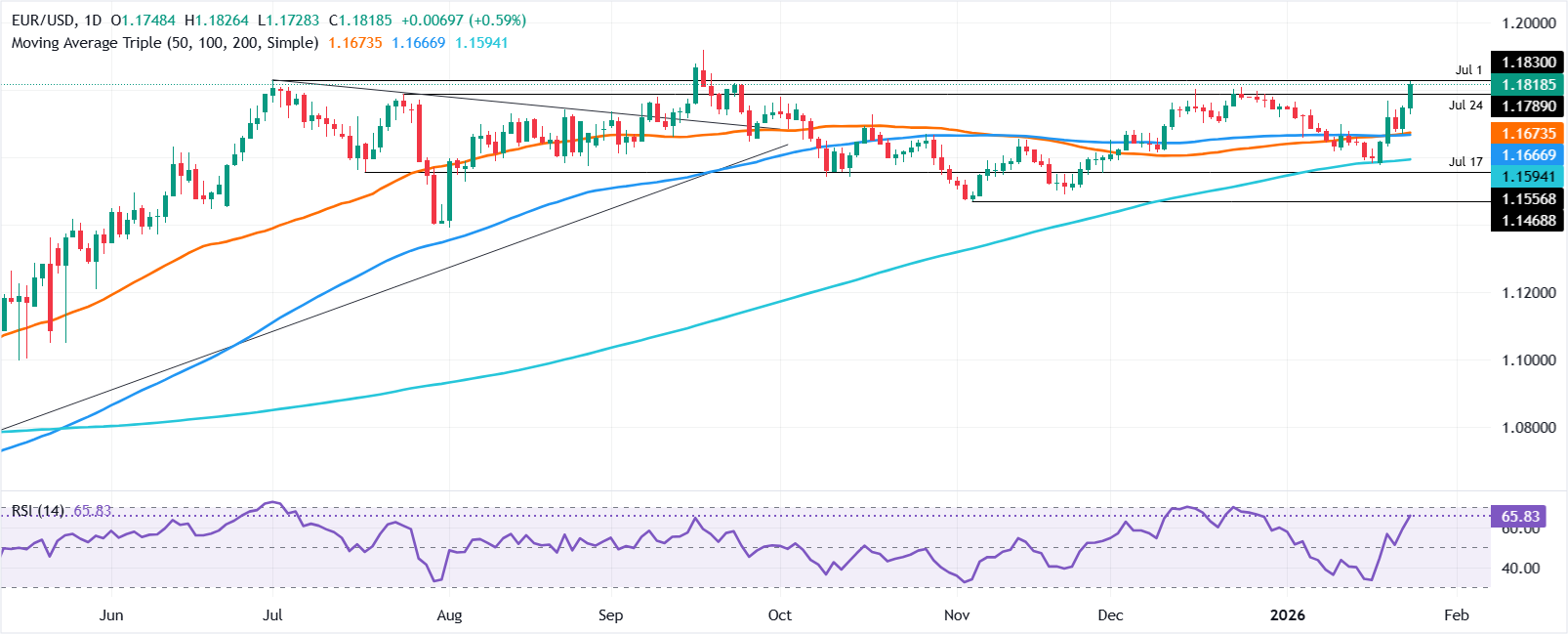
EUR/USD registers solid gains late in the North American session on Friday after rumors of an intervention in the FX markets to boost the Japanese Yen sent the US Dollar (USD) sliding, with losses of over 0.70%, according to the US Dollar Index (DXY). This, despite the economic data being moderately positive on Friday. At the time of writing, the pair trades at 1.1811 after hitting a four-month high of 1.1826 earlier during the day.
Euro rallies sharply as speculation of FX intervention sends the Dollar to multi-month lows
A Bloomberg headline, “Yen jumps most since August as risk of intervention ramps up,” broke late during the session amid speculation that Japanese authorities could be preparing to intervene in the markets.
The Bloomberg story mentions “traders reported that the Federal Reserve Bank of New York had conducted a so-called rate check with major banks to ask for indicative exchange rates — a move that was seen as an indication it may be preparing to assist with another intervention.“
Consequently, DXY, which measures the US currency value against other six, extended its losses to levels last seen in September 2025, down from 98.33, and lies at 97.53.
US economic data revealed that American consumer sentiment improved, according to a poll of the University of Michigan. Regarding business activity, S&P Global Flash Purchasing Managers Indices revealed signs of strength in the economy, yet S&P Chief Economist stated that economic growth for Q1 2026 in the US could decelerate further.
In Europe, HCOB Flash PMIs for the bloc were mixed, with the Composite and Services PMI dipping below estimates, while the Manufacturing PMI shows signs of a slight expansion.
Economic data for the next week
The schedule in Europe will feature Germany’s Business Climate and GfK Consumer. Gross Domestic Product (GDP) figures will be revealed for the bloc, Germany, Spain and France. Also, traders will eye speeches by European Central Bank (ECB) officials like Nagel, Lagarde, Elderson and Schnabel.
In the US, traders will focus on Durable Goods Orders, ADP Employment Change four-week average, the Federal Open Market Committee policy decision, and the subsequent press conference by Fed Chair Jerome Powell.
Daily digest market movers: Euro appreciates as the Dollar collapses
- The Consumer Sentiment of the University of Michigan on its final reading in December exceeded forecasts of 54, coming at 56.4. Joanne Hsu, the economist in charge, revealed that households remain pressured on purchasing power and are concerned about elevated prices and a weaker job market.
- The survey revealed that inflation expectations have eased. One-year expectations slipped to 4.0% from 4.2%, while five-year expectations fell to 3.3% from 3.4%.
- The S&P Global Composite PMI showed a modest uptick in December, rising to 52.8 from 52.7. However, Chris Williamson, Chief Business Economist at S&P Global Market Intelligence, warned that subdued new business growth across both manufacturing and services increases the risk that first-quarter growth could disappoint.
- Eurozone flash PMI data showed a weak services sector in January, with the index declining to 51.9, below both December’s reading and market expectations. Earlier releases from Germany surprised to the upside, with the Services PMI exceeding estimates in expansionary territory, while the Manufacturing PMI showed improvements, but remains below the expansion/contraction level.
Euro Price This week
The table below shows the percentage change of Euro (EUR) against listed major currencies this week. Euro was the strongest against the US Dollar.
| USD | EUR | GBP | JPY | CAD | AUD | NZD | CHF | |
|---|---|---|---|---|---|---|---|---|
| USD | -1.97% | -2.01% | -1.20% | -1.50% | -3.18% | -3.37% | -2.28% | |
| EUR | 1.97% | -0.05% | 0.76% | 0.47% | -1.25% | -1.44% | -0.33% | |
| GBP | 2.01% | 0.05% | 0.57% | 0.52% | -1.19% | -1.40% | -0.28% | |
| JPY | 1.20% | -0.76% | -0.57% | -0.28% | -1.98% | -2.17% | -1.07% | |
| CAD | 1.50% | -0.47% | -0.52% | 0.28% | -1.68% | -1.89% | -0.80% | |
| AUD | 3.18% | 1.25% | 1.19% | 1.98% | 1.68% | -0.19% | 0.94% | |
| NZD | 3.37% | 1.44% | 1.40% | 2.17% | 1.89% | 0.19% | 1.13% | |
| CHF | 2.28% | 0.33% | 0.28% | 1.07% | 0.80% | -0.94% | -1.13% |
The heat map shows percentage changes of major currencies against each other. The base currency is picked from the left column, while the quote currency is picked from the top row. For example, if you pick the Euro from the left column and move along the horizontal line to the US Dollar, the percentage change displayed in the box will represent EUR (base)/USD (quote).
Technical outlook: EUR/USD breaks 1.1800, sight on 1.200
EUR/USD technical picture shows a breakout of a downslope trendline drawn from the daily highs of September and December, which was cleared at around 1.1775, pushing the pair past the 1.1800 figure to reach yearly highs of 1.1826.
Momentum as measured by the Relative Strength Index (RSI) indicates that buyers are in charge. Also, the clear break above the December 24 swing high of 1.1807 shifted the trend from sideways to upwards.
For a bullish continuation, traders must clear 1.1850 with eyes set on the 2025 yearly peak at 1.1918. A breach of the latter opens the discussions to test 1.2000.
Downwards, the first key support is 1.1750, which could clear the way towards 1.1700.
Euro FAQs
The Euro is the currency for the 20 European Union countries that belong to the Eurozone. It is the second most heavily traded currency in the world behind the US Dollar. In 2022, it accounted for 31% of all foreign exchange transactions, with an average daily turnover of over $2.2 trillion a day. EUR/USD is the most heavily traded currency pair in the world, accounting for an estimated 30% off all transactions, followed by EUR/JPY (4%), EUR/GBP (3%) and EUR/AUD (2%).
The European Central Bank (ECB) in Frankfurt, Germany, is the reserve bank for the Eurozone. The ECB sets interest rates and manages monetary policy. The ECB’s primary mandate is to maintain price stability, which means either controlling inflation or stimulating growth. Its primary tool is the raising or lowering of interest rates. Relatively high interest rates – or the expectation of higher rates – will usually benefit the Euro and vice versa. The ECB Governing Council makes monetary policy decisions at meetings held eight times a year. Decisions are made by heads of the Eurozone national banks and six permanent members, including the President of the ECB, Christine Lagarde.
Eurozone inflation data, measured by the Harmonized Index of Consumer Prices (HICP), is an important econometric for the Euro. If inflation rises more than expected, especially if above the ECB’s 2% target, it obliges the ECB to raise interest rates to bring it back under control. Relatively high interest rates compared to its counterparts will usually benefit the Euro, as it makes the region more attractive as a place for global investors to park their money.
Data releases gauge the health of the economy and can impact on the Euro. Indicators such as GDP, Manufacturing and Services PMIs, employment, and consumer sentiment surveys can all influence the direction of the single currency. A strong economy is good for the Euro. Not only does it attract more foreign investment but it may encourage the ECB to put up interest rates, which will directly strengthen the Euro. Otherwise, if economic data is weak, the Euro is likely to fall. Economic data for the four largest economies in the euro area (Germany, France, Italy and Spain) are especially significant, as they account for 75% of the Eurozone’s economy.
Another significant data release for the Euro is the Trade Balance. This indicator measures the difference between what a country earns from its exports and what it spends on imports over a given period. If a country produces highly sought after exports then its currency will gain in value purely from the extra demand created from foreign buyers seeking to purchase these goods. Therefore, a positive net Trade Balance strengthens a currency and vice versa for a negative balance.
추천 기사


