


Dow Jones Industrial Average climbs back above 49,000 as Oil eases, earnings beat
- The DJIA is recovering most of Monday's losses to trade above 49,000, supported by softer Oil prices and another wave of earnings beats.
- The S&P 500 is up around 0.7% while the Nasdaq Composite has set a fresh intraday record above 25K, led by tech and chip names.
- WTI crude is off 3% even as Iran continues to harass shipping in the Strait of Hormuz, raising questions about how much of the disruption equity markets are actually pricing in.
- Markets now look ahead to Friday's Nonfarm Payrolls (NFP) print, with consensus expecting a sharp slowdown in headline job creation.
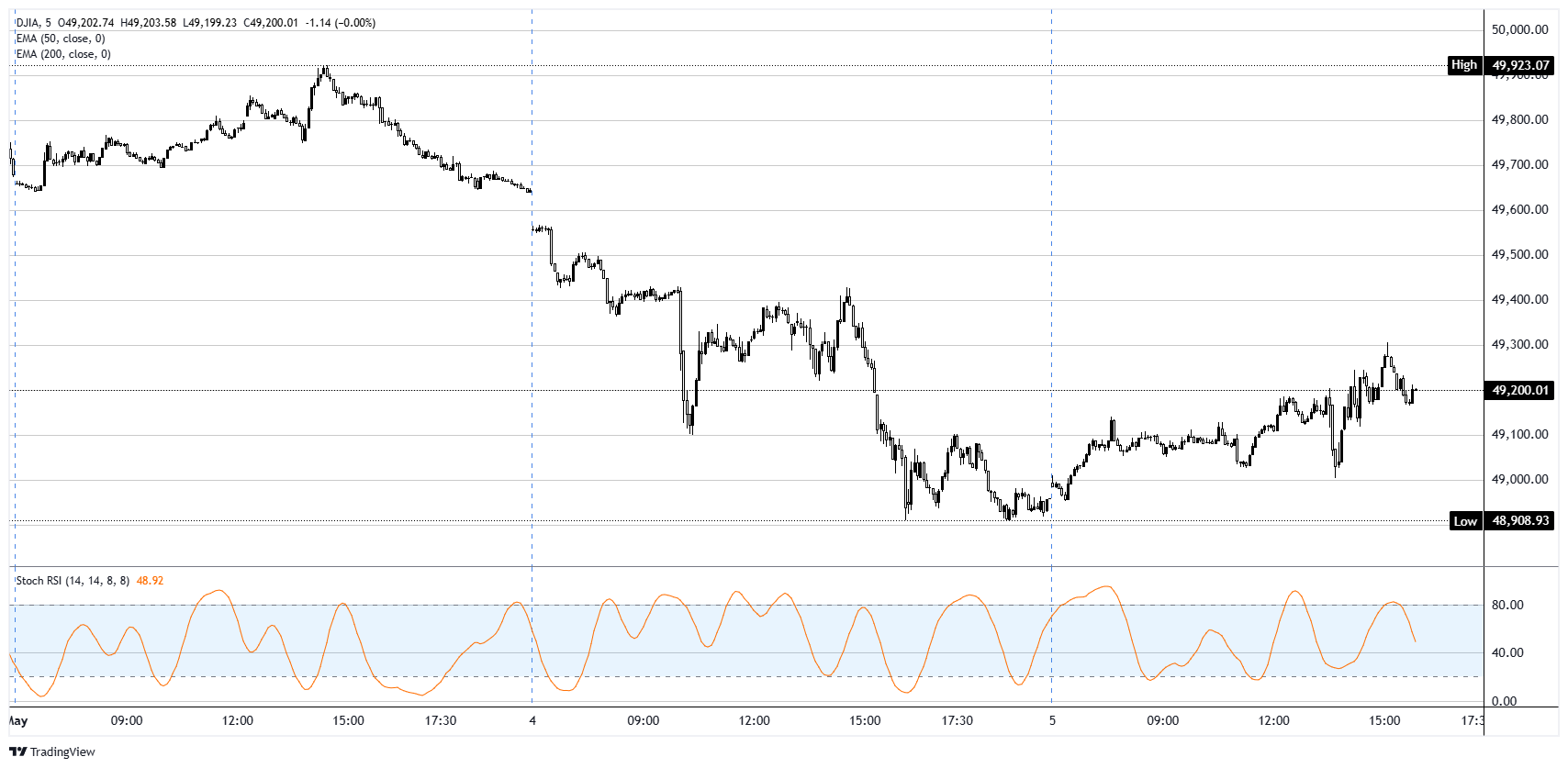
US equities are trading higher on Tuesday as crude prices ease and a wave of stronger-than-expected first-quarter earnings reinforces the thesis that profits, not policy, are doing the heavy lifting in this market. The Dow Jones Industrial Average (DJIA) is up around 0.3% and back above 49,000, recovering most of Monday's 1.1% drop. The S&P 500 is gaining close to 0.7%, while the Nasdaq Composite is up about 1% after setting a new intraday all-time high above 25K. The session is unfolding against a notably sanguine read on the US-Iran ceasefire, even as fresh attacks in the Strait of Hormuz suggest the situation on the ground is anything but stable.
Markets shrug off ongoing Strait of Hormuz disruption
The energy complex is unwinding a chunk of Monday's spike. West Texas Intermediate (WTI) crude futures are down 3% at above $102 per barrel, while Brent crude is off 2% at above $111 per barrel. The pullback is happening despite a continued drumbeat of Iranian harassment in the Strait of Hormuz, where Tehran has reportedly attacked vessels nine times since the ceasefire was first announced. Joint Chiefs Chair Dan Caine flagged on Tuesday that around 22.5K mariners remain unable to transit the chokepoint, with hundreds of ships queued and waiting on US naval cover. Defense Secretary Pete Hegseth's line that the ceasefire "certainly holds" is doing a lot of work in those circumstances. The market response suggests investors are treating the US escort regime as a permanent feature rather than a fragile workaround. That is a notable read, and one worth flagging: equities are pricing the Strait as effectively reopened, while the underlying conflict shows no signs of de-escalating. Oil-sensitive cyclicals are catching a bid on that interpretation, with industrials and transports leading the rebound off Monday's lows.
Earnings keep doing the heavy lifting
Tuesday's reaction set is a straightforward win for the bulls. Pfizer (PFE) is up around 2% after its first-quarter earnings and revenue topped consensus, with the pharmaceuticals giant reaffirming its full-year 2026 outlook. Anheuser-Busch InBev (BUD) is up roughly 8%, posting its first quarterly beer volume growth in three years and beating both top and bottom lines. Intel (INTC) is the standout single-stock move, surging around 10% after Bloomberg reported that Apple (AAPL) is in early-stage talks with the chipmaker about US-based chip manufacturing. Micron (MU) is up another 5% as analysts continue to lift price targets on AI-driven high-bandwidth memory demand. The cumulative message is one the market has been hearing all earnings season: revenue and EPS surprises are running well ahead of historical averages, and that has been enough to absorb most of the macro noise.
Palantir slips despite a blowout
Not every earnings winner is trading like one. Palantir (PLTR) shares are down roughly 3% even after the data analytics firm posted record Q1 revenue, beat consensus on EPS, and raised full-year guidance. Q1 sales grew 85% YoY against a Wall Street expectation closer to 75%. The reaction is the cleanest read in the market on a question that keeps getting louder: how much of future growth is already in the multiple? Shares are still down close to 20% year-to-date, and a guidance raise that would have been celebrated at almost any other AI name has been met with profit-taking. It is implication territory, not a thesis, but the price action suggests valuation discipline is starting to show up where it has been notably absent.
Services data softens, all eyes on Friday's NFP
Today's data is supportive of risk on balance but contains a few wrinkles. The Institute for Supply Management (ISM) Services Purchasing Managers Index (PMI) printed at 53.6, marginally below the 53.7 consensus, while the S&P Global Composite PMI came in at 51.7 versus 52 expected. The Job Openings and Labor Turnover Survey (JOLTS) for March registered 6.87 million openings, slightly above expectations, and the Bureau of Labor Statistics (BLS) flagged a sharp uptick in the hiring rate to 3.5%. None of this is enough on its own to shift Federal Reserve (Fed) expectations, particularly with multiple hawkish dissents at the last meeting still fresh in mind. The bigger event sits at the end of the week: Friday's NFP release, where consensus calls for headline job growth of just 60K versus 178K prior. With ADP on Wednesday, weekly jobless claims on Thursday, and a heavy slate of Fed speakers including Williams, Goolsbee, Hammack, and Kashkari, the next 72 hours will likely set the tone for the May rate path conversation.
Dow Jones 5-minute chart
Futures FAQs
The futures market is an exchange-based auction in which participants buy and sell contracts of an underlying asset at a predetermined future date and price. The set price is agreed upon today and is derived from the underlying asset. Futures contracts can be based on a wide range of assets, with commodities among the most popular, although currencies and indices are other common underlying assets. Futures prices depend on their underlying asset and act as a mechanism for firms, institutions, and large-position traders to manage risks through hedging.
Futures can be traded in different ways. The most common ways are via a regulated exchange or via Contracts For Difference (CFDs). In the former, liquidity is high and pricing is more transparent, with the broker serving only as an intermediary between you and the market. Still, it generally requires more capital. The largest futures exchanges are the Chicago Mercantile Exchange (CME) and the New York Mercantile Exchange (NYME). As for CFDs, these require less capital and thus trading is more flexible, but at the cost of less transparency.
The E-mini S&P 500 index, Crude Oil (Brent, WTI), Natural Gas, Gold, Silver, Copper, and soft commodities such as grains are among the most actively traded contracts. These offer strong liquidity and are closely followed by traders worldwide. Futures market volume consistently exceeds spot market volume, often significantly. This dominance is driven by leverage, hedging, and higher liquidity on exchanges.
Yes. Future gauges, particularly equity index futures such as those of the S&P 500 or the Nasdaq, are widely considered key gauges of market sentiment because they reflect investors’ expectations for the next session’s opening price. When equity futures drop, it is a sign of risk-aversion, signaling bearish market sentiment. On the contrary, rising equity futures suggest markets are risk on.
As a futures contract approaches its maturity date, the futures price converges upon the spot price, becoming almost identical at expiration. However, prices can diverge significantly before the contract ends. A market is in contango when future prices are higher than spot prices, while the mirror image is called backwardation (when current prices are higher than future prices). For commodities, the normal state of the market is contango because holding the asset over time incurs costs such as storage or insurance fees. When markets turn from contango to backwardation – or vice versa – it signals a shift in the trend: a change from contango to backwardation is taken as a bullish sign, while going from backwardation to contango is generally considered bearish.
추천 기사


