


Dow Jones Industrial Average slides as Trump nominates Warsh for Fed chair
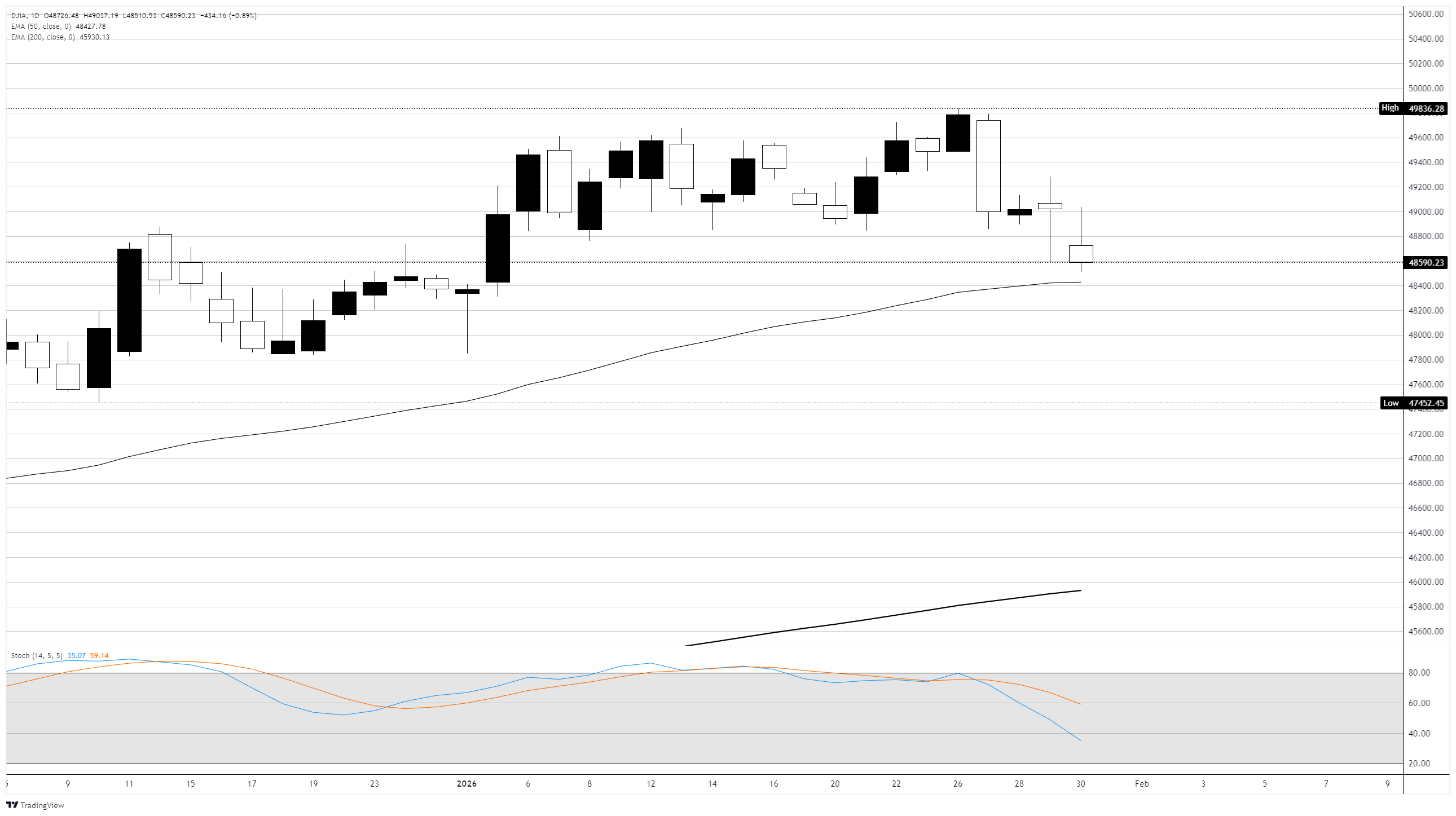
- The Dow Jones fell around 0.9% on Friday as markets digest Trump's Fed chair nomination.
- President Trump named Kevin Warsh to succeed Jerome Powell, ending a prolonged search for the Fed's next leader.
- Despite Friday's losses, all three major indexes are set to close January with solid gains.
The Dow Jones Industrial Average (DJIA) declined sharply on Friday after President Donald Trump announced his nomination of former Fed Governor Kevin Warsh to succeed Jerome Powell as Federal Reserve (Fed) Chair. The S&P 500 (SP500) slid around 0.5%, while the tech-heavy Nasdaq Composite fell 0.6%. The blue-chip Dow dropped approximately 0.9%, or around 400 points, weighed down by notable declines in American Express (AXP), Visa (V), and IBM. Despite Friday's pullback, all three major indexes remain on pace to post gains for the month, with the S&P 500 up 1.8%, the Dow advancing 2.1%, and the Nasdaq gaining 1.9% for January.
Trump's Fed nomination roils markets
Trump announced on Truth Social that he would nominate Warsh, 55, a former Fed governor who served from 2006 to 2011 during the financial crisis. While Warsh is historically known as a monetary policy hawk who favored higher interest rates to combat inflation, he has recently voiced support for rate cuts. Markets view Warsh as a relatively steady pick who is unlikely to always follow Trump's aggressive rate-cutting preferences, helping ease concerns about Fed independence. The US Dollar rose on the announcement while Treasury yields held steady, signaling investor confidence in the nomination. Warsh still faces a challenging Senate confirmation process, with Republican Senator Thom Tillis threatening to block any Fed nominees until the Justice Department resolves its investigation of current Chair Powell.
Earnings season delivers mixed results
A heavy slate of corporate earnings added volatility to Friday's session. Apple (AAPL) reported record-breaking fiscal first-quarter results after Thursday's close, with revenue surging 16% year over year to $143.8B, driven by unprecedented iPhone demand. However, shares slipped about 1% on Friday despite the strong results as CEO Tim Cook warned about memory cost pressures hitting margins in the coming quarters. Verizon (VZ) was a bright spot, surging over 6% after posting its highest quarterly subscriber additions since 2019 and setting guidance for 2026 profit above expectations. Energy giants ExxonMobil (XOM) and Chevron (CVX) both beat estimates despite lower oil prices, with Chevron signaling potential upside from expanded operations in Venezuela. American Express (MA) tumbled over 3% after missing earnings expectations, while Visa and Mastercard both delivered strong quarterly results but saw their shares decline.
Looking ahead: January wraps with monthly gains
Despite Friday's weakness, equity markets are closing January on a positive note following a volatile month marked by tech sector rotation and policy uncertainty. The Fed's December rate cut and ongoing economic resilience have supported investor sentiment, even as markets grapple with elevated Treasury yields and persistent inflation concerns. Attention now turns to Warsh's confirmation process and whether he can navigate the politically charged environment surrounding Fed policy. With Powell's term expiring in May, markets will closely watch for signals about the future direction of monetary policy under new leadership.
Dow Jones daily chart
Dow Jones FAQs
The Dow Jones Industrial Average, one of the oldest stock market indices in the world, is compiled of the 30 most traded stocks in the US. The index is price-weighted rather than weighted by capitalization. It is calculated by summing the prices of the constituent stocks and dividing them by a factor, currently 0.152. The index was founded by Charles Dow, who also founded the Wall Street Journal. In later years it has been criticized for not being broadly representative enough because it only tracks 30 conglomerates, unlike broader indices such as the S&P 500.
Many different factors drive the Dow Jones Industrial Average (DJIA). The aggregate performance of the component companies revealed in quarterly company earnings reports is the main one. US and global macroeconomic data also contributes as it impacts on investor sentiment. The level of interest rates, set by the Federal Reserve (Fed), also influences the DJIA as it affects the cost of credit, on which many corporations are heavily reliant. Therefore, inflation can be a major driver as well as other metrics which impact the Fed decisions.
Dow Theory is a method for identifying the primary trend of the stock market developed by Charles Dow. A key step is to compare the direction of the Dow Jones Industrial Average (DJIA) and the Dow Jones Transportation Average (DJTA) and only follow trends where both are moving in the same direction. Volume is a confirmatory criteria. The theory uses elements of peak and trough analysis. Dow’s theory posits three trend phases: accumulation, when smart money starts buying or selling; public participation, when the wider public joins in; and distribution, when the smart money exits.
There are a number of ways to trade the DJIA. One is to use ETFs which allow investors to trade the DJIA as a single security, rather than having to buy shares in all 30 constituent companies. A leading example is the SPDR Dow Jones Industrial Average ETF (DIA). DJIA futures contracts enable traders to speculate on the future value of the index and Options provide the right, but not the obligation, to buy or sell the index at a predetermined price in the future. Mutual funds enable investors to buy a share of a diversified portfolio of DJIA stocks thus providing exposure to the overall index.
추천 기사


