


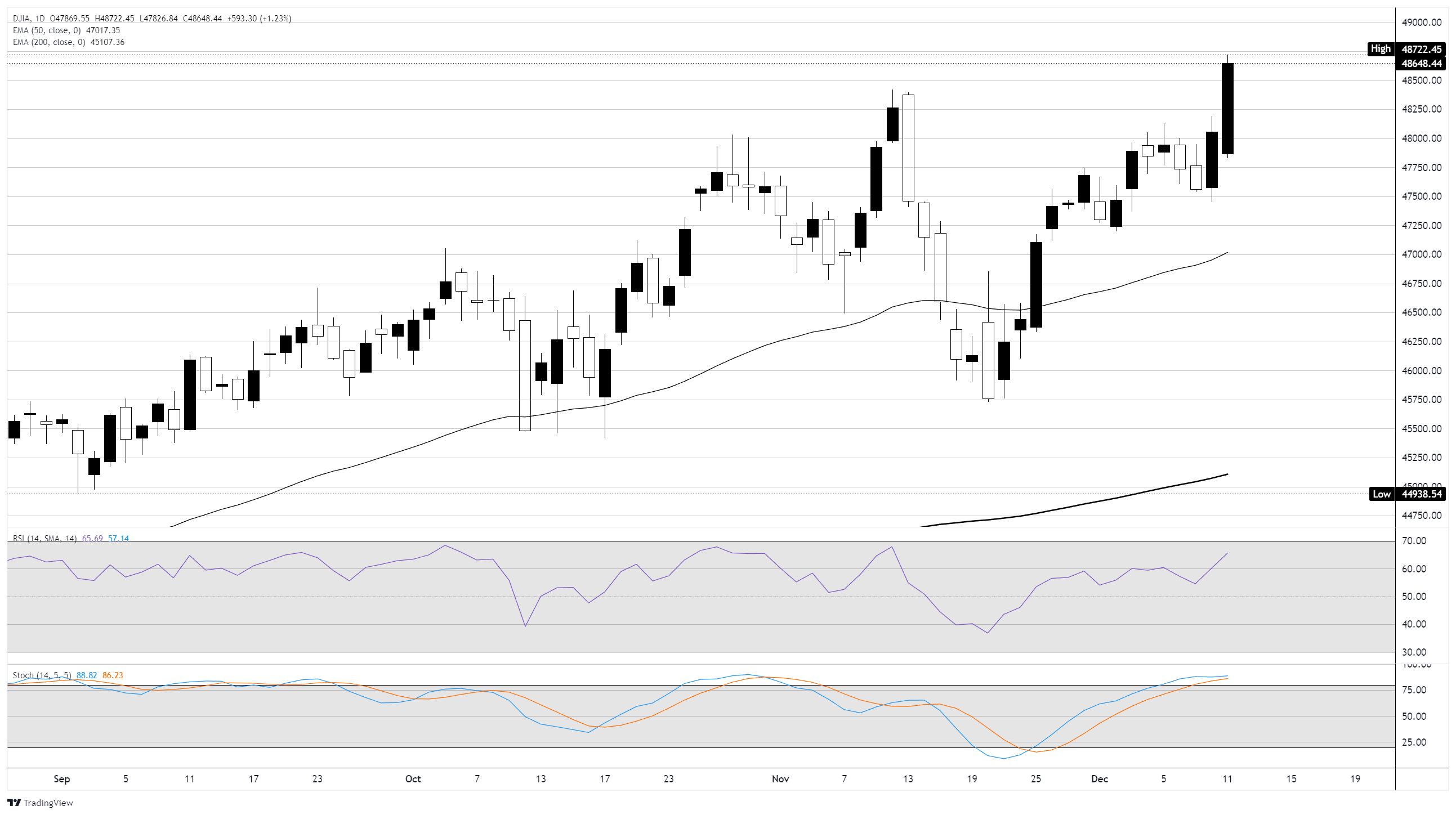
Dow Jones Industrial Average jumps 600 points as investors pivot to growth stocks
- The Dow Jones climbed over 600 points on Thursday, bolstered by renewed market optimism.
- A third straight interest rate cut has sent investors piling into ‘real economy’ stocks.
- Despite a few bright spots, the AI tech sector rally is deflating as investors fund bullish moves elsewhere.
The Dow Jones Industrial Average (DJIA) surged to a fresh record on Thursday as investors rotated out of pressured tech names and into stocks tied more closely to economic growth following the Federal Reserve’s (Fed) latest interest rate cut. Visa (V) helped lead the Dow higher after an analyst upgrade, while the S&P 500 hovered near flat and the Nasdaq slipped as traders digested a sharp pullback in major tech stocks.
Tech stocks slump, dragged down by key names
Oracle’s (ORCL) disappointing revenue, higher spending outlook, and sharply negative free cash flow rattled markets and intensified concerns about how quickly companies can profit from large AI investments. The stock fell 12%, dragging other AI-related names lower and fueling debate about whether the sector’s rapid run-up has outpaced near-term fundamentals. Analysts cut price targets and flagged uncertainty around Oracle’s path forward.
Meanwhile, lower interest rates supported cyclicals and small-cap stocks, pushing the Russell 2000 to an intraday record alongside the Dow. Investors considered the possibility of a year-end 'Santa Claus rally,' even as some strategists warned of potential 2025–2026 headwinds, including AI-sector fatigue, political shifts, and a change in Fed leadership.
US economic data takes a back seat to rate cut focus
Outside equities, jobless claims jumped meaningfully following the holiday period, though continuing claims fell sharply. In corporate news, OpenAI unveiled its new GPT-5.2 model, aimed at boosting productivity features. At the same time, Rivian announced it is developing its own AI chip to reduce reliance on Nvidia and accelerate its autonomous-driving roadmap.
Dow Jones daily chart
Dow Jones FAQs
The Dow Jones Industrial Average, one of the oldest stock market indices in the world, is compiled of the 30 most traded stocks in the US. The index is price-weighted rather than weighted by capitalization. It is calculated by summing the prices of the constituent stocks and dividing them by a factor, currently 0.152. The index was founded by Charles Dow, who also founded the Wall Street Journal. In later years it has been criticized for not being broadly representative enough because it only tracks 30 conglomerates, unlike broader indices such as the S&P 500.
Many different factors drive the Dow Jones Industrial Average (DJIA). The aggregate performance of the component companies revealed in quarterly company earnings reports is the main one. US and global macroeconomic data also contributes as it impacts on investor sentiment. The level of interest rates, set by the Federal Reserve (Fed), also influences the DJIA as it affects the cost of credit, on which many corporations are heavily reliant. Therefore, inflation can be a major driver as well as other metrics which impact the Fed decisions.
Dow Theory is a method for identifying the primary trend of the stock market developed by Charles Dow. A key step is to compare the direction of the Dow Jones Industrial Average (DJIA) and the Dow Jones Transportation Average (DJTA) and only follow trends where both are moving in the same direction. Volume is a confirmatory criteria. The theory uses elements of peak and trough analysis. Dow’s theory posits three trend phases: accumulation, when smart money starts buying or selling; public participation, when the wider public joins in; and distribution, when the smart money exits.
There are a number of ways to trade the DJIA. One is to use ETFs which allow investors to trade the DJIA as a single security, rather than having to buy shares in all 30 constituent companies. A leading example is the SPDR Dow Jones Industrial Average ETF (DIA). DJIA futures contracts enable traders to speculate on the future value of the index and Options provide the right, but not the obligation, to buy or sell the index at a predetermined price in the future. Mutual funds enable investors to buy a share of a diversified portfolio of DJIA stocks thus providing exposure to the overall index.
추천 기사


