


Bitcoin Price Forecast: BTC weakens as CLARITY Act fails to advance ahead of Fed decision
- Bitcoin trades below $76,000 on Wednesday after dropping 3.25% the previous day as the CLARITY Act failed to advance in the US Senate.
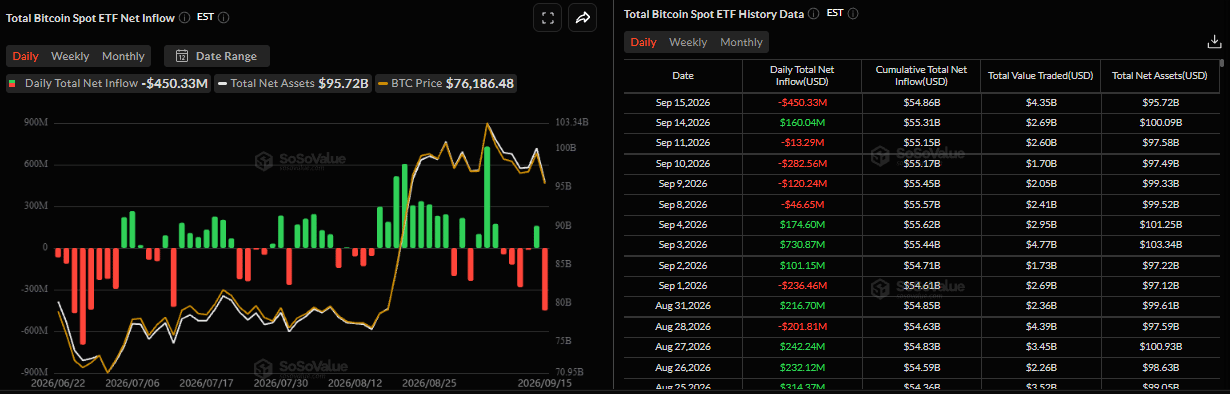
- US-listed spot ETFs recorded an outflow of $450.33 million on Tuesday, following an inflow of $160.04 million the previous day.
- Traders await the Fed’s interest rate decision and forward guidance on Wednesday, which could influence BTC’s outlook.
Bitcoin (BTC) remains under pressure, trading below $76,000 at the time of writing on Wednesday after falling over 3% the previous day and as the CLARITY Act failed to advance in the US Senate. Mixed institutional demand suggests caution amid heightened Middle East tensions. Meanwhile, market participants now await the Federal Reserve’s (Fed) interest rate decision and Fed Chairman Kevin Warsh's words at the press conference on Wednesday, which could shape the near-term outlook for the Crypto King.
CLARITY Act fails to pass the US Senate
The Crypto CLARITY Act has officially failed to pass in the US Senate on Tuesday, after falling short of the 60 votes needed to invoke cloture. Cloture is the formal Senate procedure used to break legislative gridlock and force a final vote on a bill.
The measure received 49 YEA and 50 NAY votes, falling short of the 60 threshold by 11 despite a series of negotiations from Republican lawmakers and a push from US President Donald Trump. The crypto market corrected slightly after this news, with Bitcoin losing 3.25% on the day and closing Tuesday at $75,644.
In an exclusive interview, Bitunix Analyst Dean Chen told FXStreet that the Senate’s failure to advance the CLARITY Act is a major setback for US crypto regulation, but not the end of the legislation, as it can still be revised and renegotiated.
Chen noted that the next major hurdles are likely to include ethics and conflict-of-interest provisions, stablecoin policy and banking-sector concerns, and differences between the House and Senate over regulatory jurisdiction.
“In the short term, I think the market needs to reprice part of the regulatory premium that had already been associated with the expectation of clearer U.S. crypto rules,” Chen said.
He added that if Congress remains unable to pass legislation, the Securities and Exchange Commission (SEC) and Commodity Futures Trading Commission (CFTC) can continue using their existing authorities to develop parts of the regulatory framework. However, this would provide less durable policy certainty than congressional legislation.
For institutional investors, Chen said the biggest consequence could be a delay in the timeline for large-scale institutional capital entering the US crypto market rather than a permanent reversal of adoption.
Mixed signs among institutional investors
Institutional demand shows mixed signs so far this week. SoSoValue data shows that spot ETFs recorded an outflow of $450.33 million on Tuesday following an inflow of $160.04 million on Monday. These mixed flows suggest investors remain cautious amid heightened Middle East tensions and uncertainty around the Federal Reserve’s (Fed) monetary policy decision.
All eyes on Fed rate decision
Bitcoin traders appear reluctant to take aggressive directional positions ahead of the Fed's decision, with investors largely staying on the sidelines as they await the outcome and forward guidance on Wednesday, which could shape the near-term outlook for the Crypto King.
The central bank is widely expected to raise interest rates by 25 basis points (bps) at its September 15–16 meeting. Meanwhile, the focus will be on the Fed’s updated economic projections, including the so-called dot plot.
When asked about Wednesday’s Fed decision, Bitunix Analyst Dean Chen told FXStreet that his base case is a 25-basis-point rate hike to 3.75%- 4.00%, although the move is already largely priced into markets.
With the probability of a 25 bps hike above 90%, according to the CME FedWatch Tool, Chen expects the decision itself to have a limited impact on volatility. Instead, he said markets will focus on how Fed Chair Kevin Warsh communicates the policy path beyond Wednesday. With oil prices elevated, inflation pressures remaining persistent and Treasury yields near multi-year highs, investors will assess whether the bank signals that borrowing costs could stay higher for longer or leaves the door open to further tightening.
Chen said the Fed’s forward guidance, the US Dollar (USD) and Treasury yields could therefore have a greater influence on Bitcoin than the rate hike itself. A more restrictive policy outlook could push Treasury yields and the Greenback higher, increasing institutional funding costs and potentially weighing on spot Bitcoin ETF demand. At the same time, higher USD funding costs could tighten stablecoin liquidity and make leverage more expensive, increasing liquidation risks and short-term BTC volatility.
“My near-term view remains bearish-to-range-bound, but the direction after the FOMC will depend more on the language around future policy than on the rate hike itself,” Chen said.
He added that the CLARITY Act setback, combined with a potentially restrictive Fed backdrop, leaves Bitcoin without a strong regulatory or liquidity catalyst for sustained upside.
Bitcoin technical outlook: Momentum indicators show cooling signs
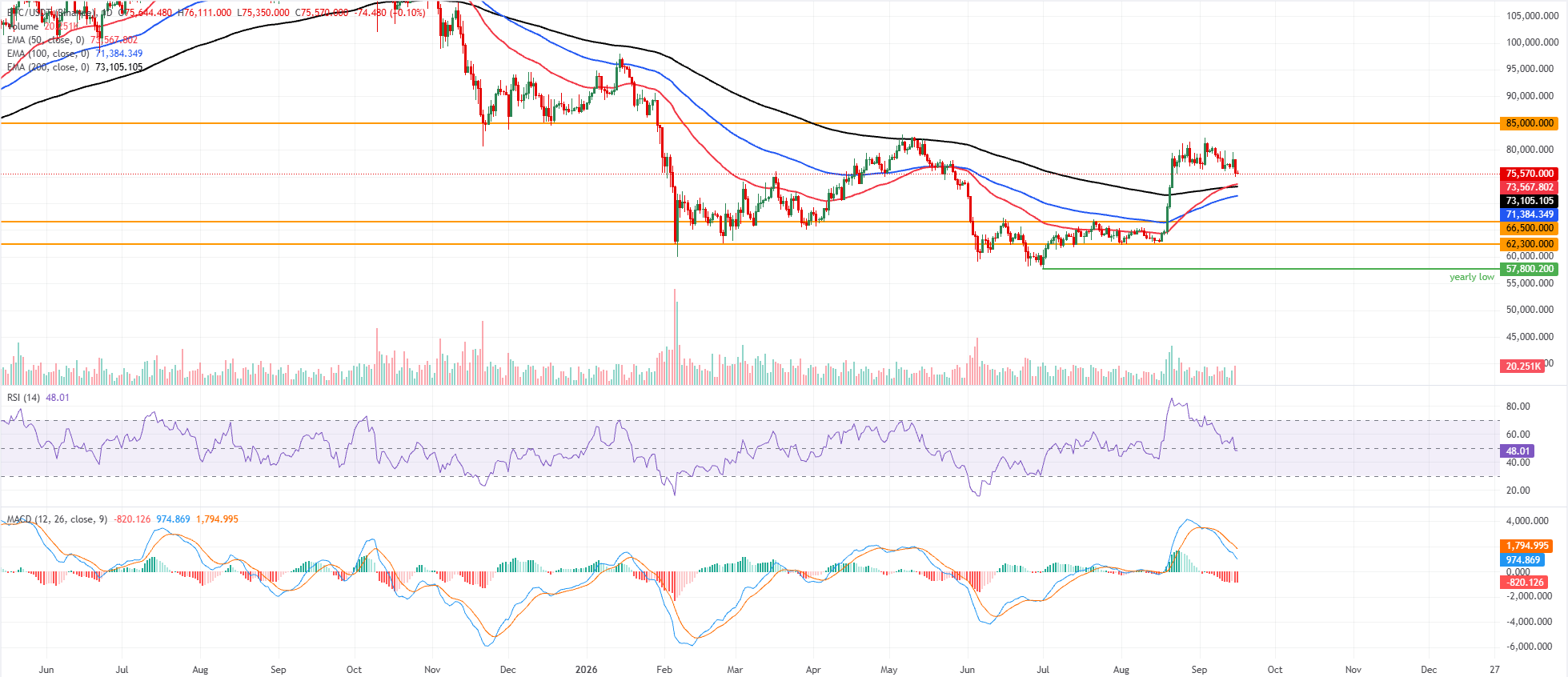
Bitcoin price trades below $75,600 on Wednesday, after falling over 3% the previous day. Despite this pullback, BTC holds a constructive bullish bias as it consolidates well above the key Exponential Moving Averages (EMAs).
The 50-day EMA at $73,567, the 200-day EMA at $73,105, and the 100-day EMA at $71,384 all sit comfortably below the current trading level, suggesting an underlying uptrend despite the recent pause.
However, momentum has cooled, with the Relative Strength Index (RSI) slipping toward a neutral 48 and the Moving Average Convergence Divergence (MACD) extending deeper into negative territory, suggesting upside impulses lack near-term follow-through.
On the downside, initial support is aligned with the 50-day EMA at $73,567, backed by the 200-day EMA at $73,105 and the 100-day EMA at $71,384, forming a dense demand band before more distant horizontal floors at $66,500 and $62,300.
On the topside, bulls face a clear objective at the horizontal resistance near $85,000, where a break and daily close above would reopen the advance toward fresh highs. In contrast, failure to clear this barrier could see price gravitate back toward the EMA cluster for another test of trend support.
(The technical analysis of this story was written with the help of an AI tool. Know more.)
Bitcoin, altcoins, stablecoins FAQs
Bitcoin is the largest cryptocurrency by market capitalization, a virtual currency designed to serve as money. This form of payment cannot be controlled by any one person, group, or entity, which eliminates the need for third-party participation during financial transactions.
Altcoins are any cryptocurrency apart from Bitcoin, but some also regard Ethereum as a non-altcoin because it is from these two cryptocurrencies that forking happens. If this is true, then Litecoin is the first altcoin, forked from the Bitcoin protocol and, therefore, an “improved” version of it.
Stablecoins are cryptocurrencies designed to have a stable price, with their value backed by a reserve of the asset it represents. To achieve this, the value of any one stablecoin is pegged to a commodity or financial instrument, such as the US Dollar (USD), with its supply regulated by an algorithm or demand. The main goal of stablecoins is to provide an on/off-ramp for investors willing to trade and invest in cryptocurrencies. Stablecoins also allow investors to store value since cryptocurrencies, in general, are subject to volatility.
Bitcoin dominance is the ratio of Bitcoin's market capitalization to the total market capitalization of all cryptocurrencies combined. It provides a clear picture of Bitcoin’s interest among investors. A high BTC dominance typically happens before and during a bull run, in which investors resort to investing in relatively stable and high market capitalization cryptocurrency like Bitcoin. A drop in BTC dominance usually means that investors are moving their capital and/or profits to altcoins in a quest for higher returns, which usually triggers an explosion of altcoin rallies.
추천 기사


