


Zcash Price Forecast: ZEC downside risks escalate as core development quits amid internal disagreements
- Zcash tumbles near 14% as news of internal governance disagreements spooks investors.
- The Zcash core development team at the Electric Coin Company resigns amid disputes with Bootstrap’s board members over nonprofit policies.
- Bootstrap, the nonprofit organisation created to oversee Zcash development, claims the disputes erupted over compliance and legal issues.
Zcash (ZEC) is trading down as volatility reaps through the cryptocurrency market on Thursday. The privacy-focused token is down nearly 14%, marking the largest intraday loss since December 1.
The decline can largely be attributed to internal leadership wrangles between Bootstrap, a nonprofit organisation created to oversee the operations of the Electric Coin Company (ECC), a major development company within the Zcash crypto network.
Zcash core development team resigns
Developers under ECC have unanimously resigned following a dispute with Bootstrap’s board members. Josh Swihart, ECC’s CEO, highlighted via X that the majority of the board members have, over the past few weeks, “moved into clear misalignment with the mission of Zcash.”
Swihart further stated that the entire core ECC core development team had “left after being constructively discharged by ZCAM.” He cited changes to the terms of employment that made it impossible for the ECC team to perform its duties effectively.
The ECC team announced through Swihart that it was forming a new company that will retain the same team and align with the mission of building privacy-focused money.
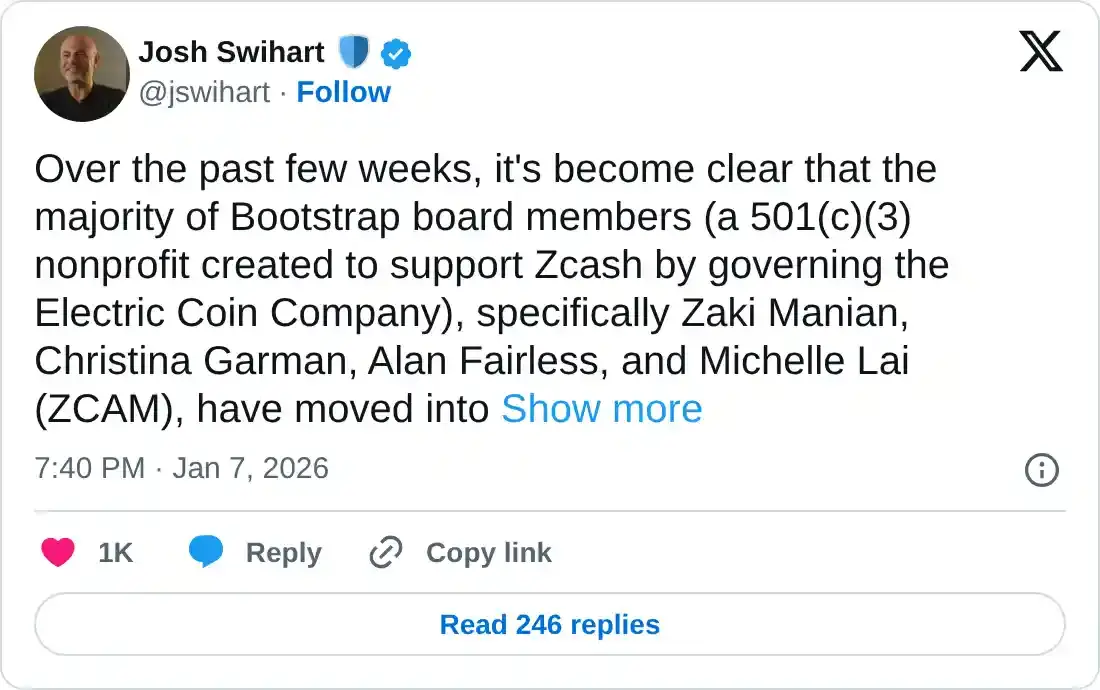
Swihart emphasised that the Zcash protocol remains unaffected and that the decision was made to protect the team’s efforts from what he called “malicious governance actions.”
According to a report by CoinDesk, Bootstrap released a statement highlighting the disagreement as a governance issue linked to the company’s mandate as a public-benefit nonprofit.
While the board added that it had been exploring external investment opportunities, including structures such as Zcash’s wallet Zashi, it cautioned that such actions must comply with nonprofit laws to ensure that mission-owned assets are not captured by private parties.
Technical outlook: Zcash recovery in jeopardy
Zcash is delicately holding above $400, following an intraday low of $381 on Thursday. The privacy-oriented token opened trading at $469 before succumbing to intense selling as investors adjusted to the dispute outlined above.
ZEC currently holds below the 50-day Exponential Moving Average (EMA), which caps the upside at $452, while the 100-day EMA provides support at $389. After a sharp decline, the Relative Strength Index (RSI) holds at 39, suggesting bearish momentum is increasing.
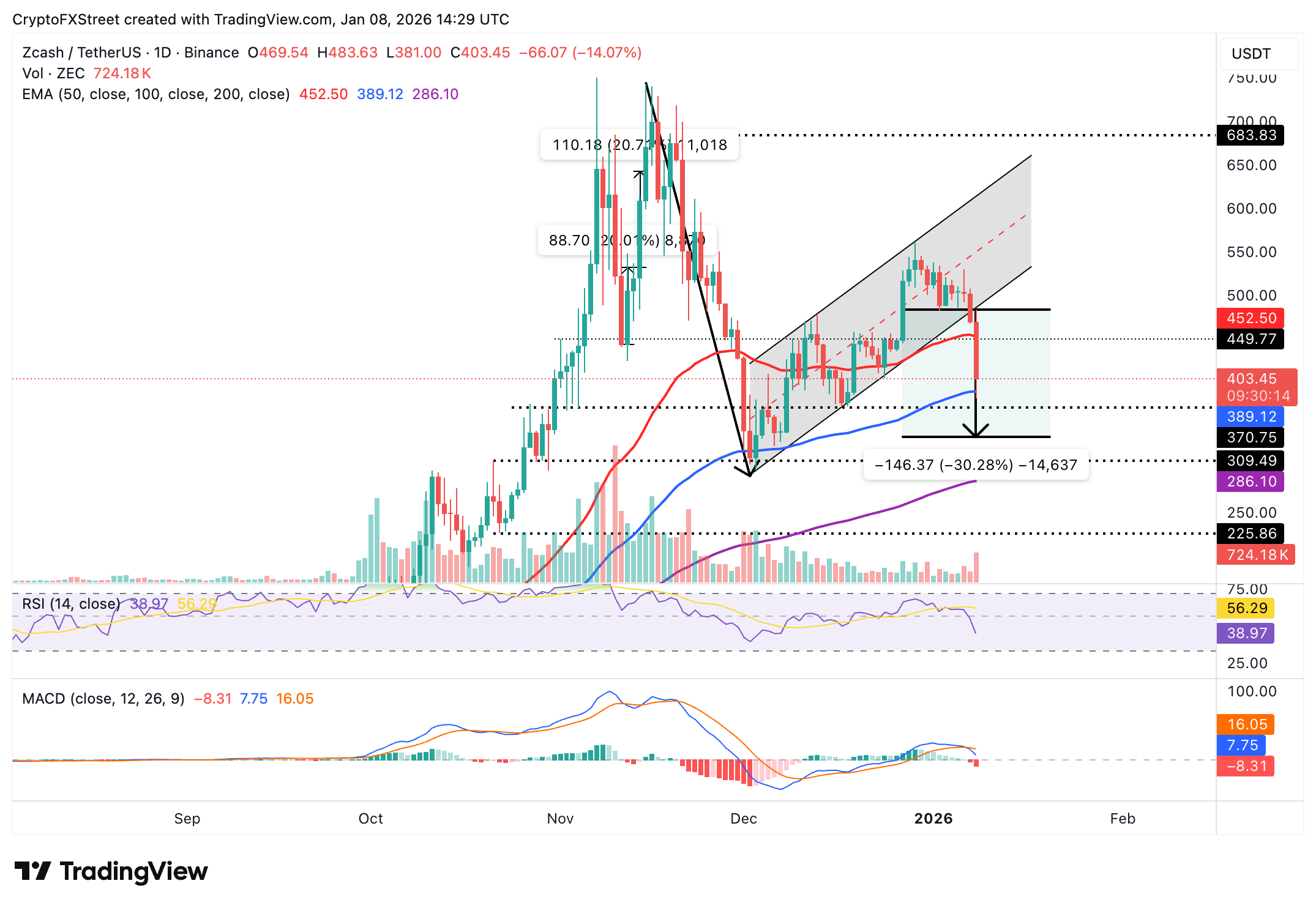
The Moving Average Convergence Divergence (MACD) indicator on the same chart reinforces the bearish outlook as it slopes downward toward the mean line. Red histogram bars are expanding below the same mean line, which may prompt traders to further reduce their risk exposure.
Still, a knee-jerk reaction could occur if investors move to buy the dip after the dust from the dispute settles. A close above the 50-day EMA at $469 could confirm the uptrend.
Cryptocurrency prices FAQs
Token launches influence demand and adoption among market participants. Listings on crypto exchanges deepen the liquidity for an asset and add new participants to an asset’s network. This is typically bullish for a digital asset.
A hack is an event in which an attacker captures a large volume of the asset from a DeFi bridge or hot wallet of an exchange or any other crypto platform via exploits, bugs or other methods. The exploiter then transfers these tokens out of the exchange platforms to ultimately sell or swap the assets for other cryptocurrencies or stablecoins. Such events often involve an en masse panic triggering a sell-off in the affected assets.
Macroeconomic events like the US Federal Reserve’s decision on interest rates influence crypto assets mainly through the direct impact they have on the US Dollar. An increase in interest rate typically negatively influences Bitcoin and altcoin prices, and vice versa. If the US Dollar index declines, risk assets and associated leverage for trading gets cheaper, in turn driving crypto prices higher.
Halvings are typically considered bullish events as they slash the block reward in half for miners, constricting the supply of the asset. At consistent demand if the supply reduces, the asset’s price climbs.
추천 기사


