




Pound Sterling falls further against US Dollar in countdown to NFP
- The Pound Sterling declines for the fourth straight day against the US Dollar.
- The Greenback trades firmly ahead of the US NFP data release for December.
- Investors await UK employment figures for fresh cues on the BoE’s monetary policy outlook.
The Pound Sterling (GBP) trades near its weekly low around 1.3420 against the US Dollar (USD) during the European trading session on Friday. The GBP/USD pair is under pressure as the US Dollar rallies further ahead of the United States (US) Nonfarm Payrolls (NFP) data for December, which will be published at 13:30 GMT.
During the press time, the US Dollar Index (DXY), which tracks the Greenback’s value against six major currencies, trades 0.17% higher near 99.00, the highest level seen in four weeks.
Investors will pay close attention to US official employment data to get fresh cues on the Federal Reserve’s (Fed) monetary policy outlook. Also, the significance of the December NFP report is higher as numbers from previous months were distorted due to the historically-longest government shutdown.
According to estimates, the US economy created 60K fresh jobs in December, slightly lower than 64K in November. The Unemployment Rate dropped to 4.5% from the prior reading of 4.6%. Signs of soft job demand would boost Fed dovish expectations, while the negative impact of upbeat data would be limited on them, as one-time good figures would be insufficient to dramatically ease policymakers’ concerns over the labor market.
Markets will also focus on Average Hourly Earnings figures for new insights about inflation. This key measure of wage growth is expected to have grown at a faster pace of 3.6% year-on-year (YoY) in December against 3.5% the previous month. On a monthly basis, the wage growth measure is estimated to have risen at a faster pace of 0.3% against the prior reading of 0.1%.
Daily Digest Market Movers: US President Trump reaches decision on Fed’s next Chairman
- The Pound Sterling trades mixed against its major currency peers in Friday’s European trading hours. The British currency is expected to stay on the sidelines as markets shift focus to the United Kingdom (UK) labor market data for three months ending in November.
- Investors will closely monitor UK employment data to get fresh cues on the current state of the job market. UK labor market conditions remained weak in 2025 as firms slowed down hiring to offset the impact of an increase in employers’ contributions to social security schemes. In three months ending October, the Unemployment Rate rose to 5.1%, the highest level seen since March 2021.
- The UK labor market data will significantly influence market expectations for the Bank of England’s (BoE) monetary policy outlook. At December's meeting, the BoE guided that the monetary policy will remain on a “gradual downward path”.
- This month, the major trigger for the GBP/USD pair would be the announcement of Fed Chairman Jerome Powell’s successor. In December, US President Donald Trump said that he would announce the new Fed chair in early January.
- On Wednesday, US President Trump said in an interview with The New York Times (NYT) that he has made a decision on who will be the next Fed boss, but has not talked about it with anybody. In the interview, Trump refrained from confirming White House Economic Adviser Kevin Hassett to replace Powell, but kept the option on the table. According to recent comments from the president, former Fed Governor Kevin Warsh, and current ones Christopher Waller and Michelle Bowman are also leading contenders to be in charge of the central bank.
Technical Analysis: GBP/USD falls below 20-day EMA
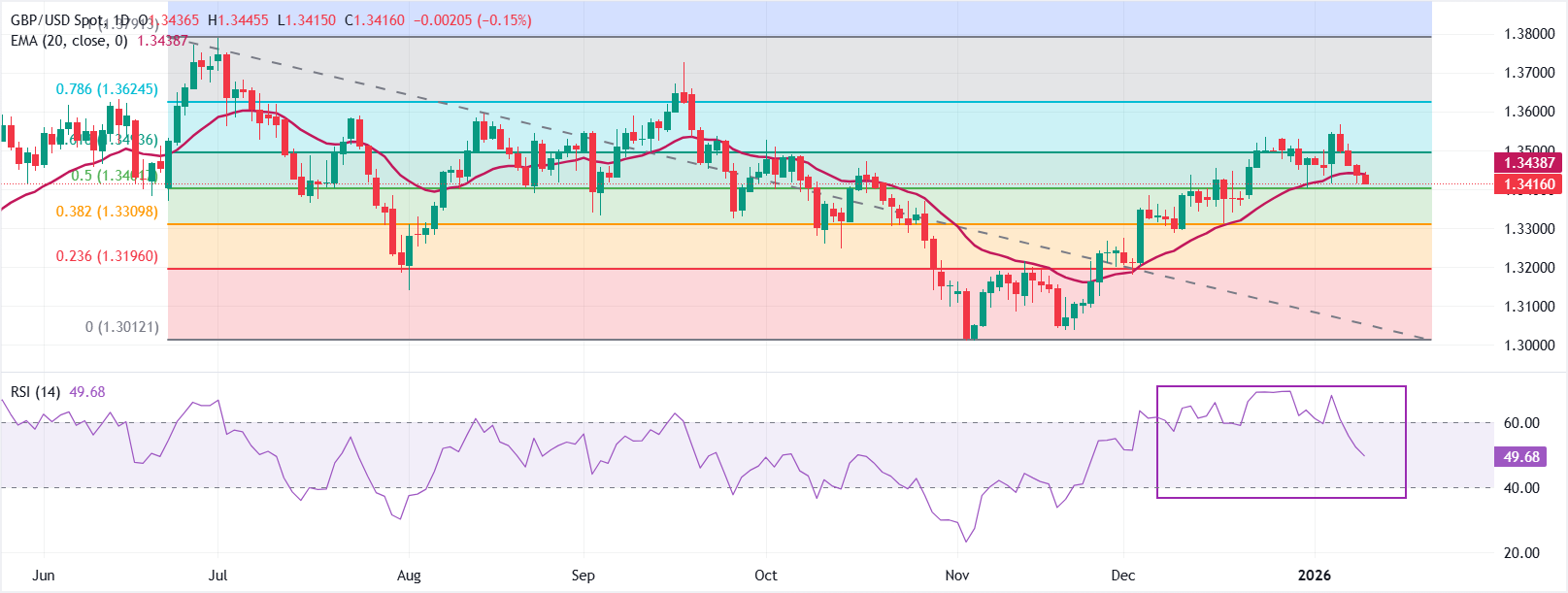
GBP/USD trades lower at 1.3416 at the time of writing. The 20-day Exponential Moving Average (EMA) slopes higher but the pair tests it from below at 1.3439, where it caps near-term recovery attempts.
The 14-day Relative Strength Index (RSI) at 50 (neutral) confirms momentum has cooled after recent overbought readings.
Measured from the 1.3791 high to the 1.3012 low, the 50% Fibonacci retracement at 1.3402 stands as a nearby pivot after failing to hold the 61.8% Fibonacci retracement at 1.3494. A recovery move above the same would open the path toward the round-level resistance of 1.3600.
On the contrary, the continuous close below the 20-day EMA would prompt negative bias and open the door for further downside towards the 38.2% Fibonacci retracement at 1.3309.
(The technical analysis of this story was written with the help of an AI tool.)
Pound Sterling FAQs
The Pound Sterling (GBP) is the oldest currency in the world (886 AD) and the official currency of the United Kingdom. It is the fourth most traded unit for foreign exchange (FX) in the world, accounting for 12% of all transactions, averaging $630 billion a day, according to 2022 data. Its key trading pairs are GBP/USD, also known as ‘Cable’, which accounts for 11% of FX, GBP/JPY, or the ‘Dragon’ as it is known by traders (3%), and EUR/GBP (2%). The Pound Sterling is issued by the Bank of England (BoE).
The single most important factor influencing the value of the Pound Sterling is monetary policy decided by the Bank of England. The BoE bases its decisions on whether it has achieved its primary goal of “price stability” – a steady inflation rate of around 2%. Its primary tool for achieving this is the adjustment of interest rates. When inflation is too high, the BoE will try to rein it in by raising interest rates, making it more expensive for people and businesses to access credit. This is generally positive for GBP, as higher interest rates make the UK a more attractive place for global investors to park their money. When inflation falls too low it is a sign economic growth is slowing. In this scenario, the BoE will consider lowering interest rates to cheapen credit so businesses will borrow more to invest in growth-generating projects.
Data releases gauge the health of the economy and can impact the value of the Pound Sterling. Indicators such as GDP, Manufacturing and Services PMIs, and employment can all influence the direction of the GBP. A strong economy is good for Sterling. Not only does it attract more foreign investment but it may encourage the BoE to put up interest rates, which will directly strengthen GBP. Otherwise, if economic data is weak, the Pound Sterling is likely to fall.
Another significant data release for the Pound Sterling is the Trade Balance. This indicator measures the difference between what a country earns from its exports and what it spends on imports over a given period. If a country produces highly sought-after exports, its currency will benefit purely from the extra demand created from foreign buyers seeking to purchase these goods. Therefore, a positive net Trade Balance strengthens a currency and vice versa for a negative balance.
추천 기사


