


Gold crashes below $4,600 as US yields spike, Fed cut bets delayed until 2027
- XAU/USD sinks to $4,588 as US 10-year yields jump near 4.29%.
- Strong jobless claims data and a hawkish Fed outlook erase 2026 cut expectations.
- The Middle East conflict fuels an energy shock, with LNG disruptions raising inflation risks.
Gold (XAU/USD) retreats more than 4.5% on Thursday as US Treasury yields rise amid investor concerns about high energy prices, while a solid US jobs report prompted traders to price out a rate cut in 2026, with expectations of the first move in 2027. At the time of writing, XAU/USD trades at $4,588, after falling from a daily high of $4,867.
Bullion plunges over 4.5% as strong US data and energy-driven inflation fears lift yields
Major central banks across the globe decided to hold rates this week on a slight hawkish tilt, spurred by the escalation of hostilities in the war between the US and Israel against Iran. Recently, the Bank of England (BoE) and the European Central Bank (ECB) joined the Bank of Japan (BoJ) and the Federal Reserve (Fed) in deciding to maintain the status quo, with the ECB eyeing a rate hike, according to sources cited by Bloomberg.
In the US, the Federal Reserve kept the Fed funds rate in the 3.50%-3.75% range, citing higher inflation and a stable labour market. The voting split was 11 to 1, with Stephen Miran opting for a 25-basis-point rate cut.
The Summary of Economic Projections (SEP), in which policymakers express their views on the path of interest rates and other economic indicators, revealed that the Fed is expected to cut rates once in 2026 and in 2027. Furthermore, they expect the US economy to grow by 2.4% in 2026, up from 2.3% in the December forecast, while core inflation is projected to edge higher from 2.5% to 2.7%.
Headline Personal Consumption Expenditures (PCE) Price Index is forecast to rise from 2.5% to 2.7%, while the Unemployment Rate is projected to remain steady at 4.4%, unchanged.
The latest jobs report from the US, Initial Jobless Claims for the week ending March 14, dipped from 213K to 205K, below estimates of a rise to 215K, as revealed by the US Department of Labor.
Following the data release, US Treasury yields rocketed, with the US 10-year Treasury note rising by close to three basis points to 4.289%. Contrarily, the Greenback extended its losses as the US Dollar Index (DXY), which measures the buck’s value against six currencies, fell 0.7% to 99.52.
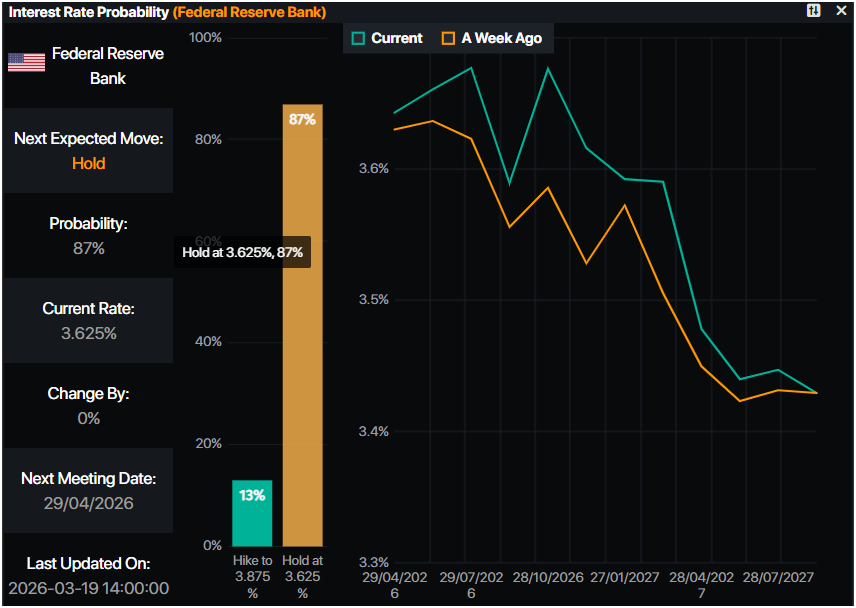
Despite the SEP forecast of one rate cut this year, money markets do not expect a Fed rate cut in 2026, with the first move expected in the first half of 2027, according to Prime Market Terminal data.
Geopolitical developments fueled the appetite for other FX safe-haven currencies, such as the Japanese Yen (JPY) and the Swiss Franc (CHF). Earlier, Iran attacked Qatari gas facilities. QatarEnergy CEO added that “Two out of 14 of our LNG trains and one out of two of our gas-to-liquids (GTL) facility were damaged in the attacks.” He added that “We may have to declare force majeure on long-term contracts for up to five years for LNG supplies to Italy, Belgium, Korea and China.”
XAU/USD technical outlook: Poised to test $4,500 if it cracks the 100-day SMA
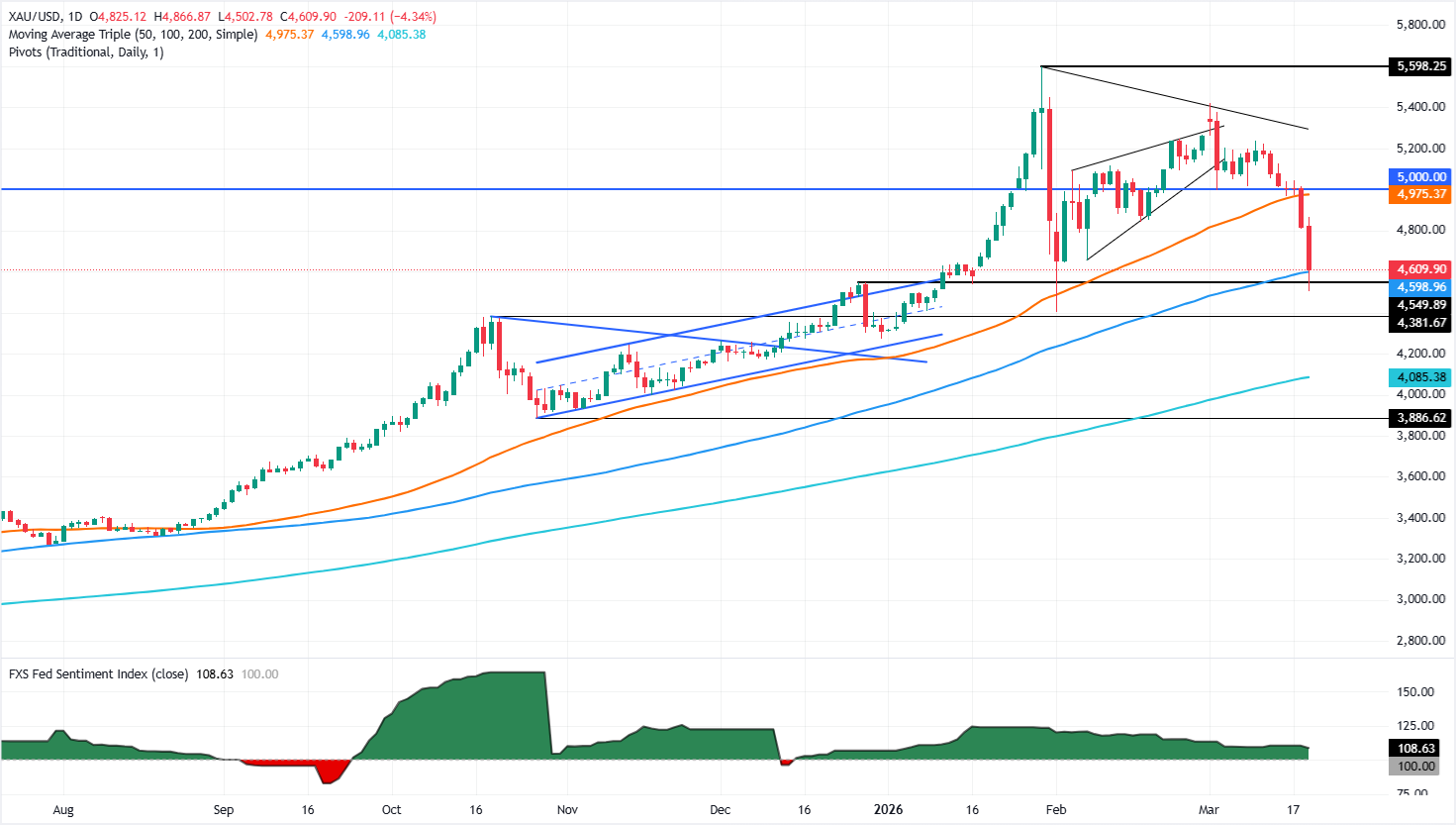
Gold technical picture remains upward-biased, with the 100-day Simple Moving Average (SMA) at $4,577 acting as a key support level that, if broken decisively, could open the door to $4,200.
Sellers are gathering strong momentum, as indicated by the Relative Strength Index (RSI), which could open the door to further downside.
If XAU/USD closes daily below the 100-day SMA, look for a test of $4,500. Once surpassed, the next stop would be February 2 swing low at $4,402 ahead of $4,200. Downwards, the next area of interest will be the 200-day SMA at $4,060.
Conversely, if Gold reclaims $4,650, the immediate resistance would be the February 17 low-turned-resistance at $4,841.
Gold FAQs
Gold has played a key role in human’s history as it has been widely used as a store of value and medium of exchange. Currently, apart from its shine and usage for jewelry, the precious metal is widely seen as a safe-haven asset, meaning that it is considered a good investment during turbulent times. Gold is also widely seen as a hedge against inflation and against depreciating currencies as it doesn’t rely on any specific issuer or government.
Central banks are the biggest Gold holders. In their aim to support their currencies in turbulent times, central banks tend to diversify their reserves and buy Gold to improve the perceived strength of the economy and the currency. High Gold reserves can be a source of trust for a country’s solvency. Central banks added 1,136 tonnes of Gold worth around $70 billion to their reserves in 2022, according to data from the World Gold Council. This is the highest yearly purchase since records began. Central banks from emerging economies such as China, India and Turkey are quickly increasing their Gold reserves.
Gold has an inverse correlation with the US Dollar and US Treasuries, which are both major reserve and safe-haven assets. When the Dollar depreciates, Gold tends to rise, enabling investors and central banks to diversify their assets in turbulent times. Gold is also inversely correlated with risk assets. A rally in the stock market tends to weaken Gold price, while sell-offs in riskier markets tend to favor the precious metal.
The price can move due to a wide range of factors. Geopolitical instability or fears of a deep recession can quickly make Gold price escalate due to its safe-haven status. As a yield-less asset, Gold tends to rise with lower interest rates, while higher cost of money usually weighs down on the yellow metal. Still, most moves depend on how the US Dollar (USD) behaves as the asset is priced in dollars (XAU/USD). A strong Dollar tends to keep the price of Gold controlled, whereas a weaker Dollar is likely to push Gold prices up.
추천 기사


