




Gold crushes $5,000 as geopolitics, US Dollar rout fuel rally
- Gold jumps over 2% as renewed geopolitical tensions revive aggressive safe-haven demand.
- The US Dollar slides to four-month lows amid talk of Yen intervention, amplifying bullion’s upside momentum.
- Traders eye the Fed decision and Powell’s guidance as the next volatility trigger.
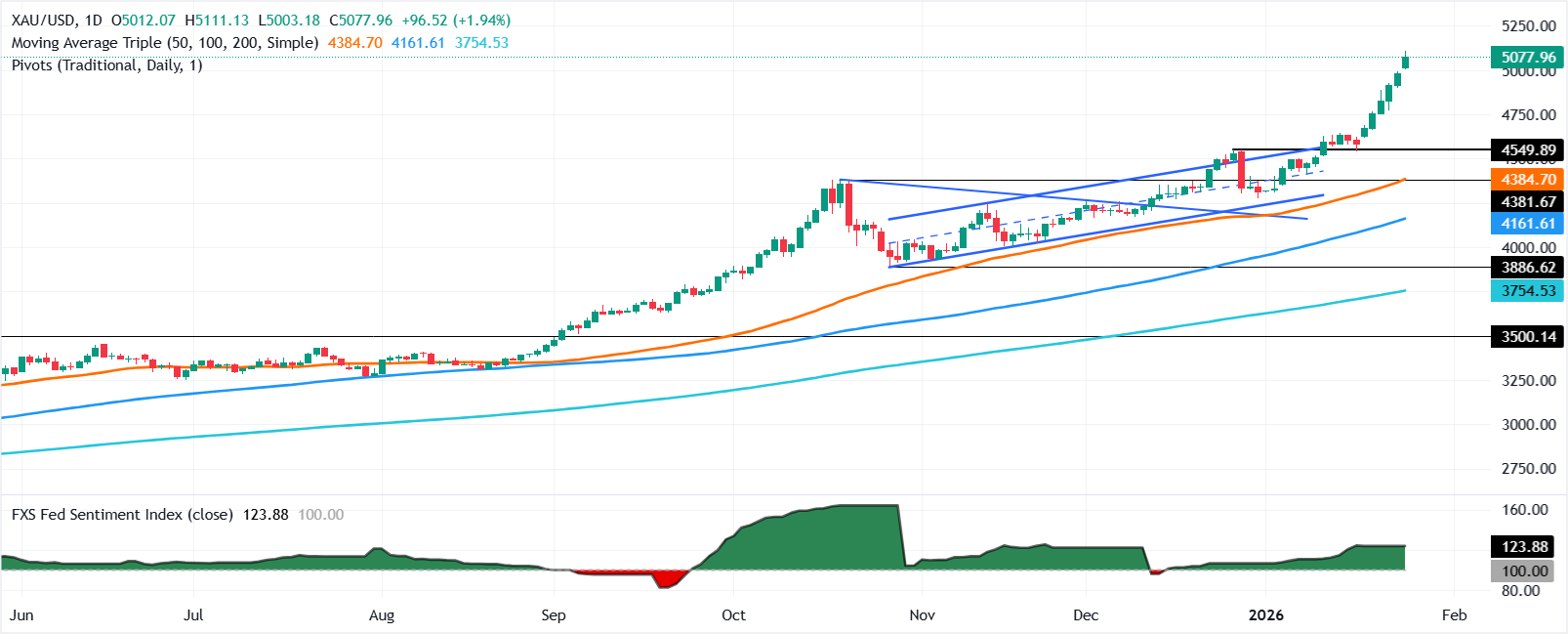
Gold (XAU/USD) surges over 2% on Monday, clearing the $5,000 milestone and extending its gains towards $5,100 amid renewed geopolitical tensions and central banks continuing to buy the yellow metal as a diversification of reserves. At the time of writing, XAU/USD trades at $5,095 after hitting a record high of $5,111.
Bullion surges toward $5,100 on trade-war fears, central bank buying
Canada’s Prime Minister Mark Carney's speech at the World Economic Forum in Davos increased tensions between Canada and the White House. Over the weekend, US President Donald Trump escalated the trade war, threatening to impose 100% tariffs on Canadian products if they negotiate a trade deal with China.
In the meantime, intervention threats by US and Japanese authorities to proper the Japanese Yen, weighed on the Dollar, which has weakened to a four-month low, below the 97.00 threshold, according to the US Dollar Index (DXY). The DXY, which measures the performance of the buck’s value against six currencies, is down 0.44% to 97.04.
US economic data was solid, with the Commerce Department featuring Durable Goods Orders for November. The data was solid, rising more than double of October’s figures, yet overall US Dollar weakness increased Gold’s appeal.
Ahead in the week, traders' focus shifts to the Federal Reserve’s (Fed) monetary policy decision on Wednesday, alongside the Fed Chair Jerome Powell press conference.
Daily digest market movers: Gold prices, boosted by soft US Dollar
- Rumors of a possible intervention by Japanese and US authorities to boost the Yen weakened the Greenback. There are speculations that the Federal Reserve Bank of New York “contacted financial institutions to ask about the yen’s exchange rate,” according to Bloomberg.
- US Durable Goods Orders surged in November, jumped 5.3% MoM, sharply reversing October’s 2.1% contraction and beating forecasts of 0.5%. The rebound underscored a strong pickup in demand for long-lasting goods. Core capital goods orders,a key proxy for underlying business investment, rose 0.5% MoM, topping expectations of 0.3% and improving from October’s 0.1% gain.
- The Federal Reserve is expected to hold rates unchanged at the 3.50%-3.75% range in this week's meeting. Following the release of the policy statement, traders will scrutinize Fed Chair Jerome Powell’s words regarding the future of monetary policy and also his stance regarding staying in the Fed after he succeeds as the Chair of the US central bank.
- US Treasury yields are also diving, a tailwind for Bullion prices. The US 10-year Treasury note yield is down two and a half basis points at 4.207%.
- Prime Market Terminal data shows that traders are expecting 44 basis points of easing by the Federal Reserve towards the end of the year.
Technical outlook: Gold price clears $5,000, poised to challenge $5,100
Gold’s parabolic uptrend touched a record high of $5,111 before retreating towards $5,090, posting gains of over 2%. The yellow metal is up nearly 18% in the first month of the year, poised to extend its gains towards $5,200, and the first updates to the Gold price forecast see the yellow metal $5,200, followed by $5,500.
On the flipside, a drop below $5,050 clears the path for a pullback to $5,000 and below, with the January 23 daily low being the next support level at $4,899.
Gold FAQs
Gold has played a key role in human’s history as it has been widely used as a store of value and medium of exchange. Currently, apart from its shine and usage for jewelry, the precious metal is widely seen as a safe-haven asset, meaning that it is considered a good investment during turbulent times. Gold is also widely seen as a hedge against inflation and against depreciating currencies as it doesn’t rely on any specific issuer or government.
Central banks are the biggest Gold holders. In their aim to support their currencies in turbulent times, central banks tend to diversify their reserves and buy Gold to improve the perceived strength of the economy and the currency. High Gold reserves can be a source of trust for a country’s solvency. Central banks added 1,136 tonnes of Gold worth around $70 billion to their reserves in 2022, according to data from the World Gold Council. This is the highest yearly purchase since records began. Central banks from emerging economies such as China, India and Turkey are quickly increasing their Gold reserves.
Gold has an inverse correlation with the US Dollar and US Treasuries, which are both major reserve and safe-haven assets. When the Dollar depreciates, Gold tends to rise, enabling investors and central banks to diversify their assets in turbulent times. Gold is also inversely correlated with risk assets. A rally in the stock market tends to weaken Gold price, while sell-offs in riskier markets tend to favor the precious metal.
The price can move due to a wide range of factors. Geopolitical instability or fears of a deep recession can quickly make Gold price escalate due to its safe-haven status. As a yield-less asset, Gold tends to rise with lower interest rates, while higher cost of money usually weighs down on the yellow metal. Still, most moves depend on how the US Dollar (USD) behaves as the asset is priced in dollars (XAU/USD). A strong Dollar tends to keep the price of Gold controlled, whereas a weaker Dollar is likely to push Gold prices up.
추천 기사


