




Gold rallies above $4,600 amid US Dollar weakness and Iran tensions
- Gold climbs to $4,615 as deteriorating risk sentiment drives investors toward safe-haven assets.
- Strong US PPI and Retail Sales fail to lift the US Dollar, keeping Fed easing expectations intact for 2026.
- Rising Iran tensions and potential US intervention add geopolitical premium to Gold prices.
Gold (XAU/USD) makes a U-turn and registers solid gains on Wednesday, sponsored by broad US Dollar weakness, even though the latest inflation data cemented the case for the Federal Reserve (Fed) to hold rates unchanged in January. XAU/USD trades at $4,615, up 0.65%.
Bullion rebounds sharply as broad US Dollar weakness and escalating Iran tensions outweigh firm US inflation data
Risk appetite continues to deteriorate, a reason for traders to rotate to the yellow metal. The Producer Price Index (PPI) report for October in the US showed that producer prices are far from the Fed’s 2% goal, yet traders remain confident that the central bank will cut rates in 2026.
Further data revealed that Retail Sales exceeded estimates, an indication that American households increased spending, mostly on motor vehicles and elsewhere.
Recent news revealed that tensions in Iran are increasing after two European officials said US military intervention could come in the next 24 hours, according to Reuters.
In the meantime, the Fed parade continued as a flurry of policymakers crossed the wires.
On Thursday, the economic docket will feature Initial Jobless Claims for the week ending January 10, with estimates that 215K Americans filed for unemployment benefits, above the 208K witnessed in the previous week. Additionally, the Fed regional banks' manufacturing indices will see the light of day.
Daily digest market movers: Gold price pushes higher as US Treasury yields plunge
- US Dollar weakness is underpinning Gold prices. The US Dollar Index (DXY), which tracks the buck’s value against a basket of six currencies, is down 0.04% at 99.15. US Treasury yields are plummeting with the 10-year T-note yield down three-and-a-half basis points to 4.14%.
- The US Bureau of Labor Statistics revealed October’s and November’s figures, but market participants remained focused on the latest release. The PPI in November rose by 0.2% MoM, aligned with estimates and up from October’s 0.1%. The annual print was 3%, exceeding forecasts of 2.7% and October’s 2.8% reading.
- Regarding core PPI, it dipped from 0.3% to 0% MoM, beneath forecasts of a 0.2% decrease, and in the 12 months to November, it rose by 3%, exceeding estimates of 2.7% and the previous print of 3.9%.
- US Retail Sales for November increased by 0.6% MoM, following October’s 0.1% contraction and above forecasts of 0.4%. Control Gorup Retail Sales, used by the Census Bureau for calculation of the GDP, expanded by 0.4% as expected, down from a downwardly revised print of 0.6%.
- A flurry of Fed officials crossed the wires. Atlanta’s Raphael Bostic commented that inflation is still quite far from where we need to be and that policy needs to be restrictive. Meanwhile, the Minneapolis Fed's Neel Kashkari said the Fed needs to monitor both sides of its mandates, and that the economy has not slowed as expected. He sees pretty good growth, the job market stabilizing and inflation easing.
- Fed Governor Miran reiterates the need for 150 basis points of easing this year. Echoing some of his dovish remarks, Anna Paulson of the Philadelphia Fed said that inflation could reach the Fed’s 2% goal by year end and that policy is a “little restrictive.”
- Chicago Fed President Austan Goolsbee said that central bank independence is key to low prices.
- Money markets have priced in 50 basis points of easing toward the end of the year, according to Prime Market Terminal.

Technical analysis: Gold price hurdles above $4,600, bulls target $4,700
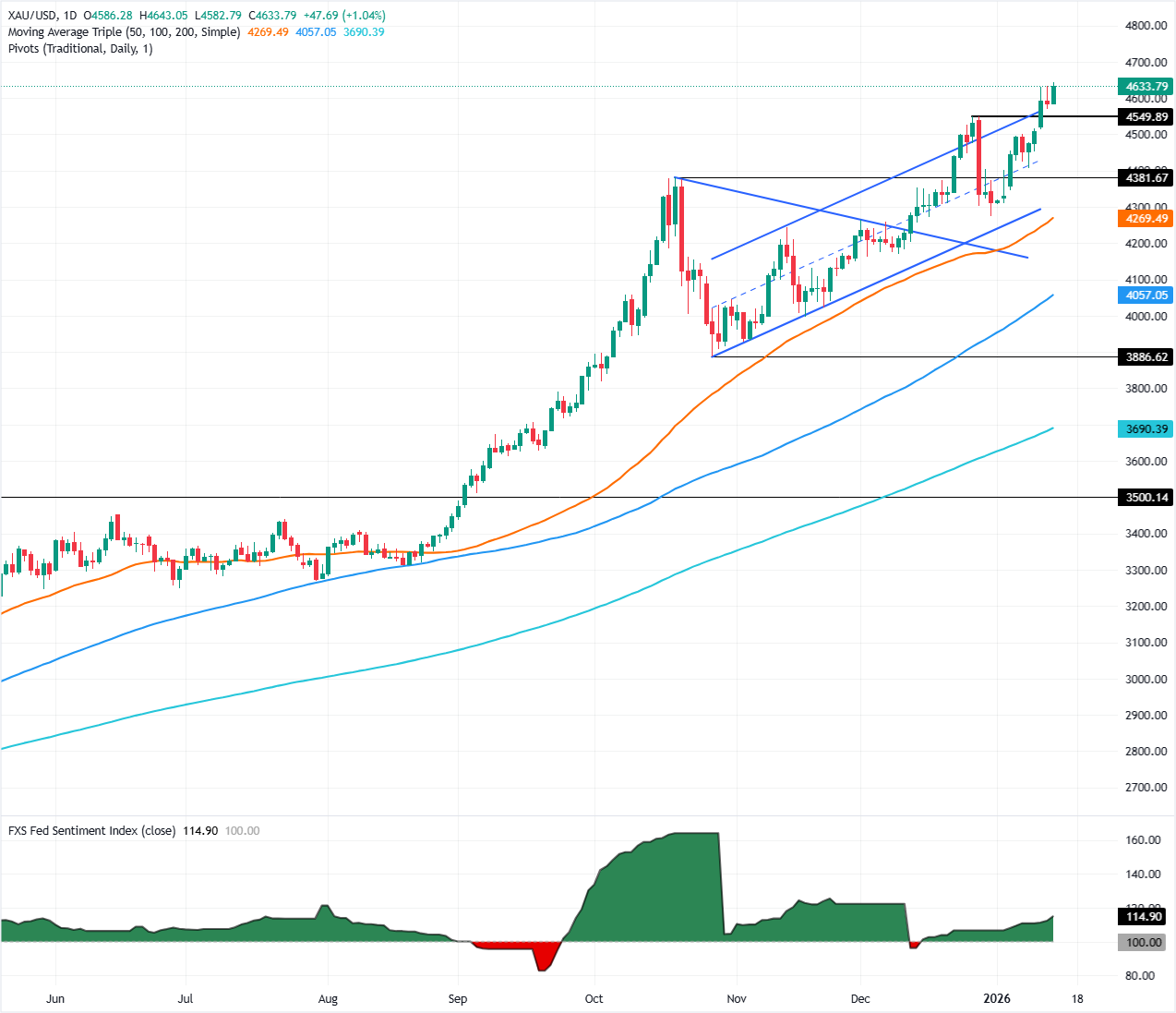
Gold price uptrend remains intact as the yellow metal reaches a new record high of $4,643, with further upside seen once buyers clear $4,650 as they will focus on pushing prices toward $4,700. Nevertheless, bulls seem to be losing some steam as depicted by the Relative Strength Index (RSI), which is flat near overbought territory.
Conversely, if XAU/USD slides below $4,600, traders could look for a pullback, initially toward $4,550. The next key support would be the $4,500 figure.
Gold FAQs
Gold has played a key role in human’s history as it has been widely used as a store of value and medium of exchange. Currently, apart from its shine and usage for jewelry, the precious metal is widely seen as a safe-haven asset, meaning that it is considered a good investment during turbulent times. Gold is also widely seen as a hedge against inflation and against depreciating currencies as it doesn’t rely on any specific issuer or government.
Central banks are the biggest Gold holders. In their aim to support their currencies in turbulent times, central banks tend to diversify their reserves and buy Gold to improve the perceived strength of the economy and the currency. High Gold reserves can be a source of trust for a country’s solvency. Central banks added 1,136 tonnes of Gold worth around $70 billion to their reserves in 2022, according to data from the World Gold Council. This is the highest yearly purchase since records began. Central banks from emerging economies such as China, India and Turkey are quickly increasing their Gold reserves.
Gold has an inverse correlation with the US Dollar and US Treasuries, which are both major reserve and safe-haven assets. When the Dollar depreciates, Gold tends to rise, enabling investors and central banks to diversify their assets in turbulent times. Gold is also inversely correlated with risk assets. A rally in the stock market tends to weaken Gold price, while sell-offs in riskier markets tend to favor the precious metal.
The price can move due to a wide range of factors. Geopolitical instability or fears of a deep recession can quickly make Gold price escalate due to its safe-haven status. As a yield-less asset, Gold tends to rise with lower interest rates, while higher cost of money usually weighs down on the yellow metal. Still, most moves depend on how the US Dollar (USD) behaves as the asset is priced in dollars (XAU/USD). A strong Dollar tends to keep the price of Gold controlled, whereas a weaker Dollar is likely to push Gold prices up.
추천 기사


