

Gold losses shine as Fed-cut bulls assess how dovish soft CPI is
- Gold slips after nearing record highs as traders book profits following softer US inflation.
- US CPI hits multi-year lows, but shutdown disruptions cloud data reliability.
- Limited near-term Fed easing priced; weak US Dollar and geopolitical risks keep bullion supported.
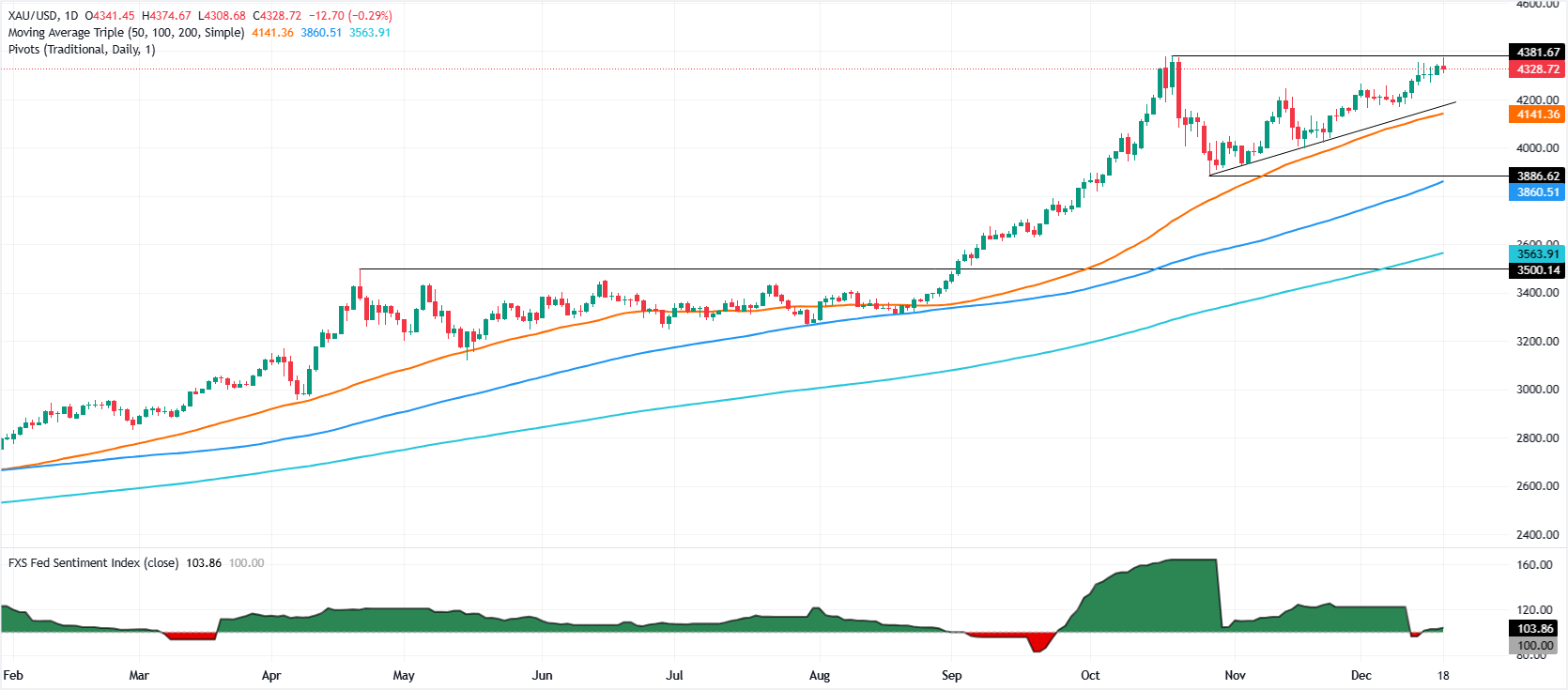
Gold (XAU/USD) erases earlier gains on Thursday after the non-yielding metal approached the all-time high (ATH) following the release of a weaker than expected inflation report in the US. XAU/USD trades at $4,335 after bouncing off daily lows of $4,308.
Bullion retreats as markets question inflation data reliability, keep January Fed cut odds unchanged
The US Consumer Price Index (CPI) print in November fell to its lowest level since early 2021, revealed the US Bureau of Labor Statistics (BLS). Both headlined and core CPIs dipped but economists warned that the 43-day government shutdown could distort some of the data that BLS workers compile for the release.
As inflation eased, expectations that the Fed would cut rates should rise, but traders took the data with a pinch of salt, because jobs data was solid as the Department of Labor revealed in the latest Initial Jobless Claims report.
Expectations that the Fed will cut rates at the next meeting in January 28 remain unchanged at 24%, according to Capital Edge Rate probability data. Nonetheless, for the full year ahead, investors had priced 60 basis points if easing, with the first cut expected in June.
This should keep the Dollar pressured and a tailwind for Bullion prices.
Meanwhile, easing geopolitical tensions could cap Gold’s advance as talks between the US and Russia would resume during the weekend in Miami, according to Politico.
Ahead the US economic docket will feature the release of the Fed’s favorite inflation gauge, the Core Personal Consumption Expenditures (PCE) Price Index along with the University of Michigan Consumer Sentiment Index for its final release.
Daily digest market movers: Gold fails to gain traction as US inflation dips
- The US Consumer Price Index (CPI) rose 2.7% YoY in November, easing from 3.0% in September and falling short of market expectations for a 3.1% increase, data from the US Bureau of Labor Statistics (BLS) showed. Core CPI, which excludes food and energy, cooled to 2.6% YoY, down from 3.0% previously, signaling further easing in underlying inflation pressures.
- Initial Jobless Claims for the week ending December 13 declined to 224K, down from the downwardly revised 237K prior reading and below forecasts of 225K, according to the US Department of Labor.
- A contraction of physical Gold exports from Switzerland to India, dropped 15%, its lowest level since February, revealed Swiss customs on data released on Thursday. The reason behind the contraction is that prices are higher.
- Gold exports from Switzerland to India plunged to 2 metric tons in November, down sharply from 26 tons in October, while shipments to China, another major bullion consumer, rose to 12 tons from 2 tons over the same period.
- US Treasury yields are falling, with the 10-year benchmark note rate down three basis points at 4.12%. US real yields, which correlate inversely with Gold prices, plunged four basis points to 1.88%.
- The US Dollar Index (DXY), which tracks Greenbacks’ performance against a basket of six peers, is up 0.03% at 98.43.
Technical Analysis: Gold’s uptrend pauses as it drops below $4,350
Gold seems to have consolidated as buyers failed to clear the previous record high of $4,381 to challenge the $4,400 mark. Bullish momentum is fading as depicted by the Relative Strength Index (RSI), which retreated from overbought territory.
If XAU/USD closes on a daily basis below $4,350, the first support would be $4,300. A breach of the latter will expose the December 11 high at $4,285, with further support at $4,250 ahead of a deeper pullback toward $4,200.
Gold FAQs
Gold has played a key role in human’s history as it has been widely used as a store of value and medium of exchange. Currently, apart from its shine and usage for jewelry, the precious metal is widely seen as a safe-haven asset, meaning that it is considered a good investment during turbulent times. Gold is also widely seen as a hedge against inflation and against depreciating currencies as it doesn’t rely on any specific issuer or government.
Central banks are the biggest Gold holders. In their aim to support their currencies in turbulent times, central banks tend to diversify their reserves and buy Gold to improve the perceived strength of the economy and the currency. High Gold reserves can be a source of trust for a country’s solvency. Central banks added 1,136 tonnes of Gold worth around $70 billion to their reserves in 2022, according to data from the World Gold Council. This is the highest yearly purchase since records began. Central banks from emerging economies such as China, India and Turkey are quickly increasing their Gold reserves.
Gold has an inverse correlation with the US Dollar and US Treasuries, which are both major reserve and safe-haven assets. When the Dollar depreciates, Gold tends to rise, enabling investors and central banks to diversify their assets in turbulent times. Gold is also inversely correlated with risk assets. A rally in the stock market tends to weaken Gold price, while sell-offs in riskier markets tend to favor the precious metal.
The price can move due to a wide range of factors. Geopolitical instability or fears of a deep recession can quickly make Gold price escalate due to its safe-haven status. As a yield-less asset, Gold tends to rise with lower interest rates, while higher cost of money usually weighs down on the yellow metal. Still, most moves depend on how the US Dollar (USD) behaves as the asset is priced in dollars (XAU/USD). A strong Dollar tends to keep the price of Gold controlled, whereas a weaker Dollar is likely to push Gold prices up.
추천 기사


