


Gold retreats from multi-week top amid risk-on mood; downside seems limited
- Gold attracts some sellers on Friday as the upbeat market mood undermines safe-haven assets.
- The Fed’s dovish outlook keeps the USD depressed and offers some support to the commodity.
- The fundamental backdrop favors the XAU/USD bulls and backs the case for a further move up.
Gold (XAU/USD) edges lower during the Asian session on Friday and erodes a part of the previous day's strong gains, snapping a three-day winning streak to the $4,285-4,286 region, or the highest level since October 21. The prevalent risk-on environment – as depicted by a generally positive tone around the equity markets – is seen undermining demand for the safe-haven precious metal. Apart from this, a modest US Dollar (USD) recovery from a two-month low touched on Thursday turns out to be another factor exerting some pressure on the commodity.
Any meaningful USD appreciation, however, still seems elusive in the wake of dovish Federal Reserve (Fed) expectations, which might continue to offer support to the non-yielding Gold. Apart from this, persistent geopolitical uncertainties, amid stalled talks on the Russia-Ukraine peace deal, help limit the downside for the XAU/USD pair. Nevertheless, the bullion remains on track to register strong weekly gains. Moving ahead, traders now look forward to speeches from influential FOMC members to grab short-term opportunities heading into the weekend.
Daily Digest Market Movers: Gold is pressured by receding safe-haven demand; dovish Fed favors bulls
- The US Federal Reserve's dovish outlook dragged the US Dollar to an over two-month low and lifted the non-yielding Gold to its highest level since October 21 on Thursday. In a widely expected move, the US central bank lowered borrowing costs by 25 basis points on Wednesday and projected just one more rate cut in 2026.
- Fed Chair Jerome Powell said during the post-meeting press conference that the US labor market has significant downside risks and that the central bank does not want its policy to push down on job creation. This fueled speculations about two more rate cuts by the Fed next year and, in turn, favors the XAU/USD bulls.
- Meanwhile, Asian stocks tracked the overnight strength on Wall Street and advanced in early trade on Friday, which is seen undermining demand for the traditional safe-haven bullion. However, prospects for lower interest rates in the US, along with persistent geopolitical uncertainties, could lend support to the commodity.
- Meanwhile, US President Donald Trump is extremely frustrated with Russia and Ukraine, and he doesn't want any more talk, his spokeswoman said on Thursday. Earlier, Ukrainian President Volodymyr Zelensky said that the US was pushing it to cede land to Russia as part of an agreement to end a nearly four-year war.
- There isn't any relevant market-moving economic data due for release from the US on Friday, leaving the USD at the mercy of speeches from influential FOMC members. Apart from this, the broader risk sentiment could provide some impetus to the yellow metal, which remains on track to register strong weekly gains.
Gold seems poised to climb further; overnight breakout through a two-week-old range remains in play
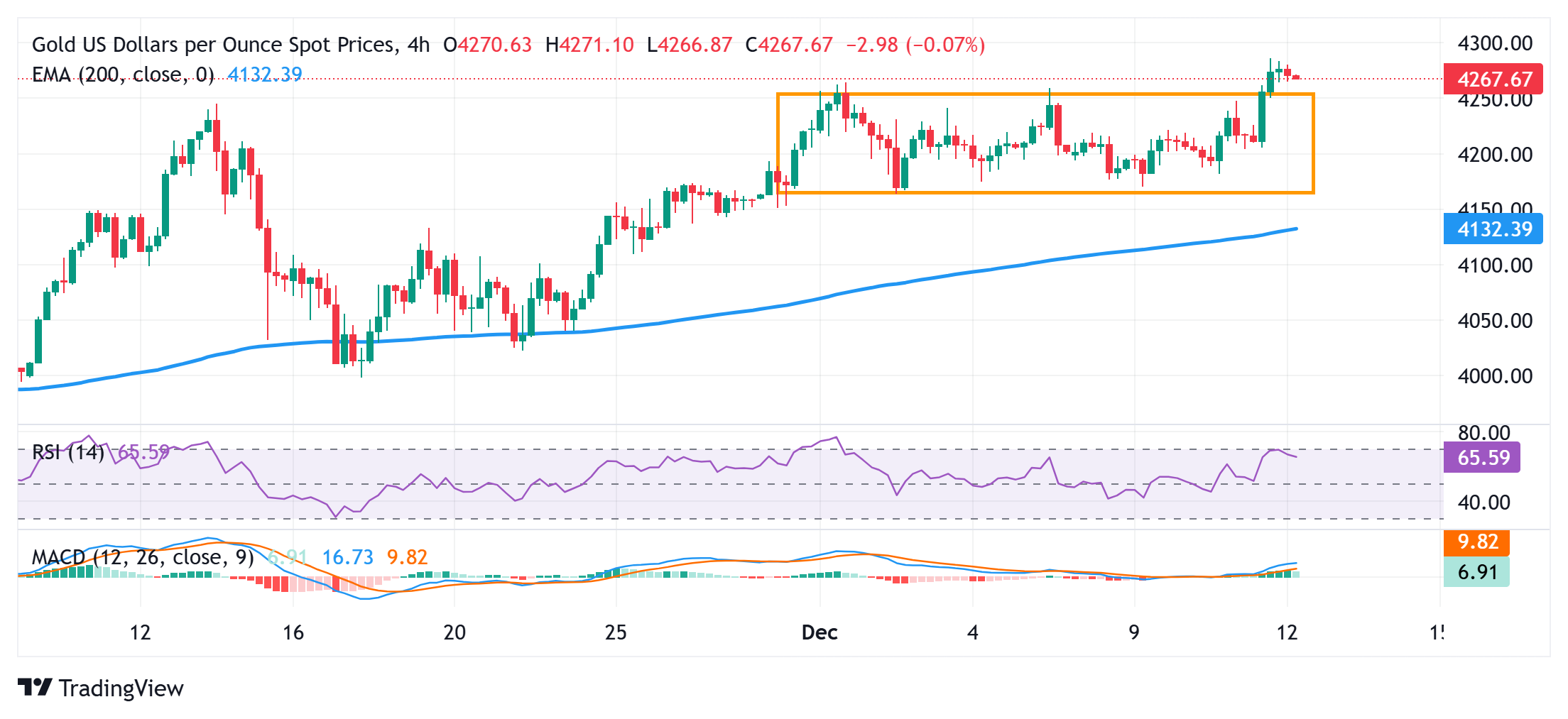
The overnight strong move up confirmed a fresh bullish breakout through a nearly two-week-old trading range hurdle, around the $4,245-4,250 region. Moreover, oscillators on the daily chart are holding in positive territory and are still away from being in the overbought zone, suggesting that the path of least resistance for the Gold price remains to the upside. Hence, any further pullback towards the aforementioned resistance breakpoint could be seen as a buying opportunity. This should limit losses for the XAU/USD pair near the $4,220-4,218 region, which is followed by the $4,200 mark and the $4,170-4,165 support area. A convincing break below the latter might shift the bias in favor of bearish traders and pave the way for deeper losses.
On the flip side, the $4,300 mark now seems to act as an immediate hurdle, above which the XAU/USD pair could climb to the next relevant hurdle near the $4,328-4,330 region. The momentum could extend further and allow the Gold to aim towards challenging the all-time peak, around the $4,380 zone, touched in October. Some follow-through buying beyond the $4,400 round figure will be seen as a fresh trigger for bullish traders and set the stage for an extension of the commodity's recent well-established uptrend from the October monthly swing low.
Gold FAQs
Gold has played a key role in human’s history as it has been widely used as a store of value and medium of exchange. Currently, apart from its shine and usage for jewelry, the precious metal is widely seen as a safe-haven asset, meaning that it is considered a good investment during turbulent times. Gold is also widely seen as a hedge against inflation and against depreciating currencies as it doesn’t rely on any specific issuer or government.
Central banks are the biggest Gold holders. In their aim to support their currencies in turbulent times, central banks tend to diversify their reserves and buy Gold to improve the perceived strength of the economy and the currency. High Gold reserves can be a source of trust for a country’s solvency. Central banks added 1,136 tonnes of Gold worth around $70 billion to their reserves in 2022, according to data from the World Gold Council. This is the highest yearly purchase since records began. Central banks from emerging economies such as China, India and Turkey are quickly increasing their Gold reserves.
Gold has an inverse correlation with the US Dollar and US Treasuries, which are both major reserve and safe-haven assets. When the Dollar depreciates, Gold tends to rise, enabling investors and central banks to diversify their assets in turbulent times. Gold is also inversely correlated with risk assets. A rally in the stock market tends to weaken Gold price, while sell-offs in riskier markets tend to favor the precious metal.
The price can move due to a wide range of factors. Geopolitical instability or fears of a deep recession can quickly make Gold price escalate due to its safe-haven status. As a yield-less asset, Gold tends to rise with lower interest rates, while higher cost of money usually weighs down on the yellow metal. Still, most moves depend on how the US Dollar (USD) behaves as the asset is priced in dollars (XAU/USD). A strong Dollar tends to keep the price of Gold controlled, whereas a weaker Dollar is likely to push Gold prices up.
추천 기사


