


Gold soars above $4,270 as Fed cut ignites Bullion breakout
- Gold surges following the Fed’s 25 bps rate cut as traders downplay signals of a policy pause.
- Weak US Jobless Claims data adds pressure on the US Dollar, accelerating Bullion’s upside.
- The lack of progress in Ukraine’s peace discussions increased Gold’s safety appeal.
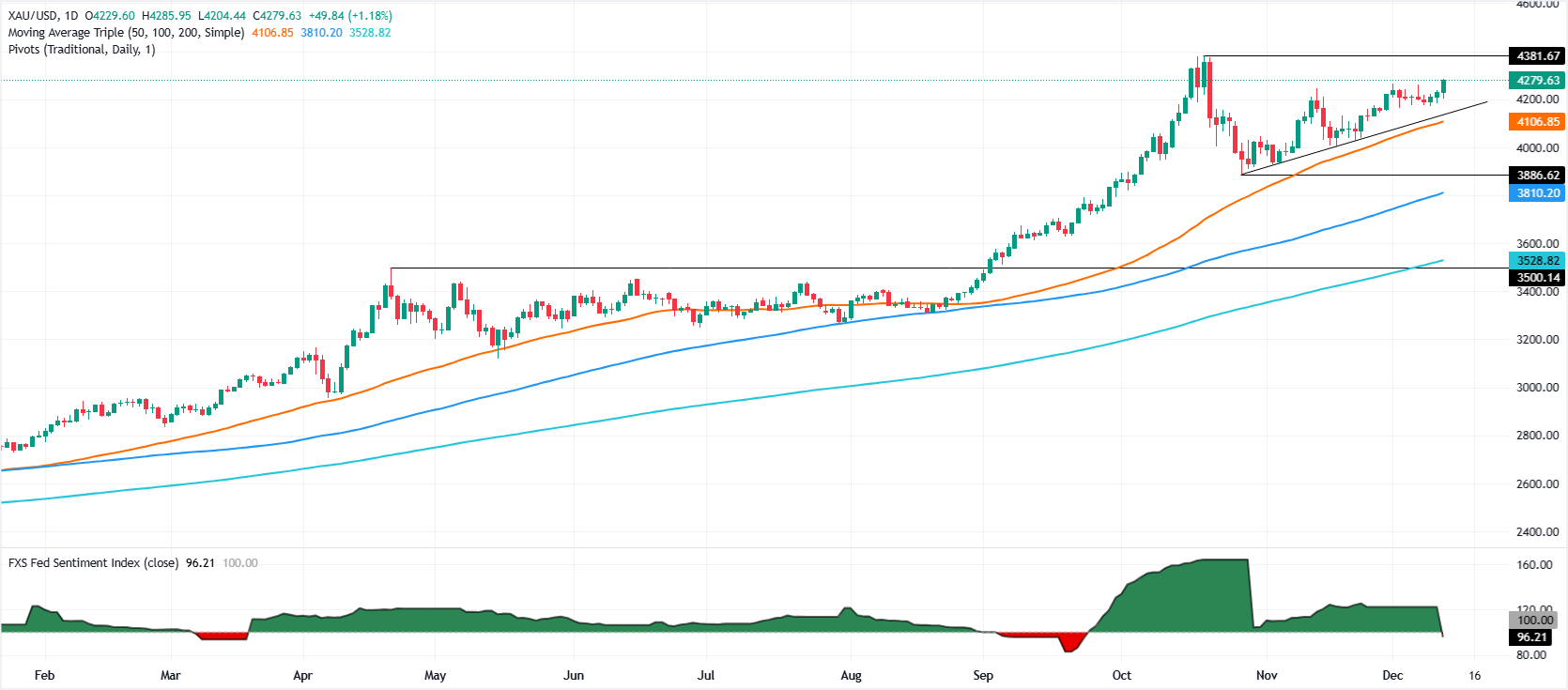
Gold (XAU/USD) skyrockets on Thursday after the Federal Reserve (Fed) cut rates as expected on Wednesday, and even though it hinted at a pause in the easing cycle, it was not an excuse for the rally in precious metals. At the time of writing, XAU/USD trades at $4,278 after bouncing off a daily low of $4,204.
Precious metal rallies despite Powell signaling a pause, as soft US labor data fuel safe-haven demand
On Wednesday, the Fed reduced rates by 25 basis points amid a period of elevated prices, as inflation is nearing 3%. However, the central bank hinted at a pause in its easing cycle, as Chair Jerome Powell reiterated that they are in a wait-and-see mode, and that rates are on the higher range for neutral.
US jobs data was softer than expected, as Jobless Claims for the previous week missed forecasts. Other data showed that the trade deficit narrowed in September, according to the US Census Bureau.
Regarding geopolitics, talks between Ukraine, the US and Russia to agree to a peace deal continued with Ukrainian President Zelenskyy handing over a revised 20-point peace plan proposal to the US, via ABC News.
Ahead, the US economic docket will feature Fed speakers, led by Philadelphia’s Fed Anna Paulson, Cleveland’s Fed Beth Hammack and Chicago’s Austan Goolsbee.
Daily digest market movers: Gold underpinned by US data, Fed’s rate cut
- US Treasury yields are diving, with the 10-year benchmark note rate down three basis points at 4.122%. US real yields, which correlate inversely with Gold prices, fall nearly two and a half basis points to 1.872%, a tailwind for Bullion.
- The US Dollar Index (DXY), which tracks the Greenbacks’ performance against a basket of six peers, is down 0.44% to 98.19.
- US Initial Jobless Claims for the week ending December 6 rose to 236K, up sharply from the prior week’s upwardly revised 192K, according to the Department of Labor. In contrast, Continuing Claims for the week ending November 29 fell to 1.838 million from 1.937 million, suggesting some stabilization in longer-term unemployment.
- The US Goods and Services Trade Balance narrowed to –$52.8 billion in September, improving from –$59.3 billion in August and outperforming expectations for a widening deficit toward –$63.3 billion.
- The Fed's monetary policy statement was almost unchanged, highlighting that employment risks are tilted to the upside, while inflation pressures continued to remain high.
- Fed Chair Jerome Powell said that there is tension between the central bank dual mandate. He added that the central bank is “well positioned” to “wait and see” how the economy evolves, after easing policy 75 basis points this year, and commented that the Fed funds rate is within the upper range of estimates for neutrality.
- Powell said that after 175 basis points of cuts, “we have moved back our policy back down to where it is certainly not strongly restrictive at this point,” he said. “I think it is sort of in the range of neutral,” added.
Technical Analysis: Gold breaks off range, eyes on $4,300
Gold technical picture improved substantially, as XAU/USD rose sharply past $4,250, hitting a six-week high at $4,285 before retreating somewhat. Bullish momentum is increasing as depicted by the Relative Strength Index (RSI), an indication of further upside lying ahead.
If XAU/USD achieves a daily close above $4,300, this clears the path to challenge $4,350 ahead of the record high of $4,381. Conversely, the first support is $4,250, followed by the $4,200 mark. Once surpassed, the next support is the 20-day Simple Moving Average (SMA) at $4,158.
Gold FAQs
Gold has played a key role in human’s history as it has been widely used as a store of value and medium of exchange. Currently, apart from its shine and usage for jewelry, the precious metal is widely seen as a safe-haven asset, meaning that it is considered a good investment during turbulent times. Gold is also widely seen as a hedge against inflation and against depreciating currencies as it doesn’t rely on any specific issuer or government.
Central banks are the biggest Gold holders. In their aim to support their currencies in turbulent times, central banks tend to diversify their reserves and buy Gold to improve the perceived strength of the economy and the currency. High Gold reserves can be a source of trust for a country’s solvency. Central banks added 1,136 tonnes of Gold worth around $70 billion to their reserves in 2022, according to data from the World Gold Council. This is the highest yearly purchase since records began. Central banks from emerging economies such as China, India and Turkey are quickly increasing their Gold reserves.
Gold has an inverse correlation with the US Dollar and US Treasuries, which are both major reserve and safe-haven assets. When the Dollar depreciates, Gold tends to rise, enabling investors and central banks to diversify their assets in turbulent times. Gold is also inversely correlated with risk assets. A rally in the stock market tends to weaken Gold price, while sell-offs in riskier markets tend to favor the precious metal.
The price can move due to a wide range of factors. Geopolitical instability or fears of a deep recession can quickly make Gold price escalate due to its safe-haven status. As a yield-less asset, Gold tends to rise with lower interest rates, while higher cost of money usually weighs down on the yellow metal. Still, most moves depend on how the US Dollar (USD) behaves as the asset is priced in dollars (XAU/USD). A strong Dollar tends to keep the price of Gold controlled, whereas a weaker Dollar is likely to push Gold prices up.
추천 기사


