


EUR/USD sinks towards 1.1600 as US inflation rises and crushes Fed cut hopes
- EUR/USD drops as US CPI beats forecasts, reinforcing the Fed’s stance to keep rates steady.
- Trump pushes for rate cuts, threatens more tariffs, seals Indonesia trade deal.
- Germany’s ZEW sentiment jumps to 52.7, the highest since February 2022.
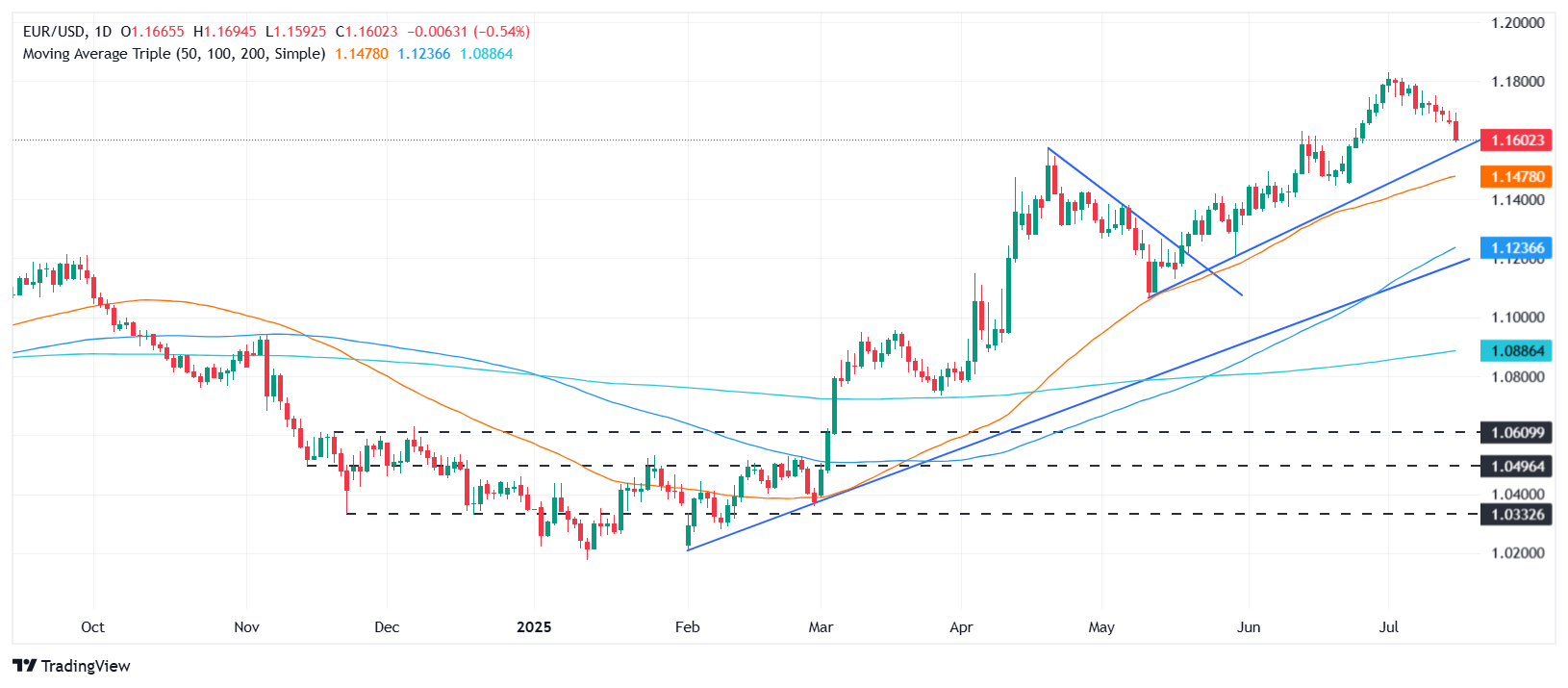
The EUR/USD fell some 0.55% on Tuesday after the latest US inflation report revealed that prices are edging higher, justifying the Federal Reserve's current policy stance. Hence, traders trimmed bets that the Fed would cut rates at the July meeting. At the time of writing, the pair trades at 1.1599, having reached a high of 1.1694.
The Consumer Price Index (CPI) in June exceeded estimates in headline and core figures. Aside from this, the US President Donald Trump demanded that the Fed reduce interest rates, revealed a trade agreement with Indonesia, and threatened to impose additional tariffs on Russia.
Boston Fed President Susan Collins said that she’s in no rush to cut rates, as the data suggests that duties will drive up prices.
Across the pond, the European Union (EU) economic docket revealed that Germany’s ZEW Economic Sentiment Index improved to 52.7, above estimates of 50.4 and up from June’s 47.5 reading, the highest level since February 2022.
Daily digest market movers: EUR/USD on the backfoot on uncertainty about an EU-US deal
- The latest US inflation data showed the Consumer Price Index (CPI) rose 2.7% year-over-year in June, matching market expectations. Core CPI came in at 2.9%, just below the 3.0% forecast but still notably above the Federal Reserve’s 2% target. After the data, money markets reduced bets that the Fed will cut rates at the July meeting, with traders eyeing 43 bps of easing.
- Consequently, money markets had priced in less than 50 basis points (bps) of easing, with investors pricing in over 43 bps of rate cuts toward the end of the year.
- US President Donald Trump unveiled a new trade agreement with Indonesia, under which Indonesian goods will face a 19% duty, while US exports will be exempt from tariffs. He added that similar deals are in the works, and that “Indonesia has committed to purchasing $15 Billion Dollars in U.S. Energy, $4.5 Billion Dollars in American Agricultural Products, and 50 Boeing Jets, many of them 777’s.”
- The Wall Street Journal reported that the EU plans retaliatory tariffs for US goods if a trade deal is not reached. They targeted aircraft and alcohol. The EU Trade Commissioner Sefcovic will speak with USTR Jamie Greer “this early evening.”
- Trump’s letter to the EU triggered the alarms on the European Central Bank (ECB), which is set to paint a more negative scenario next week than previously thought in June. However, traders seem convinced that the ECB will hold rates unchanged at the next meeting.
- ECB's Joachim Nagel said a steady hand is needed on ECB rates, according to Handelsblatt.
Euro technical outlook: EUR/USD clears 20-day SMA, further downside eyed
After clearing the 20-day Simple Moving Average (SMA) of 1.1679, the EUR/USD remains neutral to bearish biased, with sellers eyeing further losses. Momentum is bearish as depicted by the Relative Strength Index (RSI) but has turned flat. This indicates that consolidation lies ahead.
If EUR/USD drops below 1.1600, the next support would be the 50-day SMA at 1.1481. Once surpassed, the next stop would be the 1.1400 figure, followed by the 100-day SMA at 1.1254. On the flip side, if the pair climbs past the 20-day SMA, expect a move toward 1.1700, followed by the July 20 daily high at 1.1749, ahead of 1.1800 and the recent high of 1.1829.
Euro FAQs
The Euro is the currency for the 19 European Union countries that belong to the Eurozone. It is the second most heavily traded currency in the world behind the US Dollar. In 2022, it accounted for 31% of all foreign exchange transactions, with an average daily turnover of over $2.2 trillion a day. EUR/USD is the most heavily traded currency pair in the world, accounting for an estimated 30% off all transactions, followed by EUR/JPY (4%), EUR/GBP (3%) and EUR/AUD (2%).
The European Central Bank (ECB) in Frankfurt, Germany, is the reserve bank for the Eurozone. The ECB sets interest rates and manages monetary policy. The ECB’s primary mandate is to maintain price stability, which means either controlling inflation or stimulating growth. Its primary tool is the raising or lowering of interest rates. Relatively high interest rates – or the expectation of higher rates – will usually benefit the Euro and vice versa. The ECB Governing Council makes monetary policy decisions at meetings held eight times a year. Decisions are made by heads of the Eurozone national banks and six permanent members, including the President of the ECB, Christine Lagarde.
Eurozone inflation data, measured by the Harmonized Index of Consumer Prices (HICP), is an important econometric for the Euro. If inflation rises more than expected, especially if above the ECB’s 2% target, it obliges the ECB to raise interest rates to bring it back under control. Relatively high interest rates compared to its counterparts will usually benefit the Euro, as it makes the region more attractive as a place for global investors to park their money.
Data releases gauge the health of the economy and can impact on the Euro. Indicators such as GDP, Manufacturing and Services PMIs, employment, and consumer sentiment surveys can all influence the direction of the single currency. A strong economy is good for the Euro. Not only does it attract more foreign investment but it may encourage the ECB to put up interest rates, which will directly strengthen the Euro. Otherwise, if economic data is weak, the Euro is likely to fall. Economic data for the four largest economies in the euro area (Germany, France, Italy and Spain) are especially significant, as they account for 75% of the Eurozone’s economy.
Another significant data release for the Euro is the Trade Balance. This indicator measures the difference between what a country earns from its exports and what it spends on imports over a given period. If a country produces highly sought after exports then its currency will gain in value purely from the extra demand created from foreign buyers seeking to purchase these goods. Therefore, a positive net Trade Balance strengthens a currency and vice versa for a negative balance.
추천 기사


