


USD/INR weakens on improved risk appetite
- Indian Rupee gathers strength in Wednesday’s Asian session.
- Improved risk appetite and a weakening USD support the INR.
- Investors await the US August New Home Sales and Fed’s Kugler speech on Wednesday.
The Indian Rupee (INR) edges higher on Wednesday. Improved risk appetite following China’s stimulus measures and the softer US Dollar (USD) boost the local currency on the day. Nonetheless, rising crude oil prices, outflows related to a rejig of the FTSE equity indexes and renewed USD demand from large Indian importers might exert some selling pressure on the INR.
The US New Home Sales data for August is due on Wednesday. Traders will take more cues from the US Federal Reserve’s (Fed) Governor Adriana Kugler speech. Any dovish remarks from the Fed officials are likely to weigh on the Greenback against the Indian Rupee. The highlight for this week will be the US August Personal Consumption Expenditures (PCE) Price Index data, which will be published on Friday.
Daily Digest Market Movers: Indian Rupee remains firmer amid a global risk-on mood
- S&P Global Ratings on Tuesday retained India's Gross Domestic Product (GDP) growth forecast at 6.8% while noting that the Reserve Bank of India (RBI) may cut interest rates in October.
- "We expect the rupee to trade with a positive bias amid improved global risk appetite following China's stimulus and softness in the dollar. However, elevated crude oil and other commodity prices may cap sharp upside," noted Anuj Choudhary, Research Analyst at Sharekhan by BNP Paribas.
- The Conference Board’s US Consumer Confidence Index dropped to 98.7 in September from a revised 105.6 in August. This figure registered the biggest decline since August 2021.
- Fed Governor Michelle Bowman said on Tuesday that key measures of inflation remain "uncomfortably above" the 2% target, warranting caution as the Fed proceeds with cutting interest rates. However, she preferred the Fed to lower by a quarter percentage point, more in line with the traditional moves at the central bank.
- The markets have priced in nearly 56% odds of a second 50 bps rate cut in the November meeting, while the chance of 25 bps stands at 44%, according to the CME FedWatch Tool.
Technical Analysis: USD/INR’s negative bias remains unchanged in the longer term
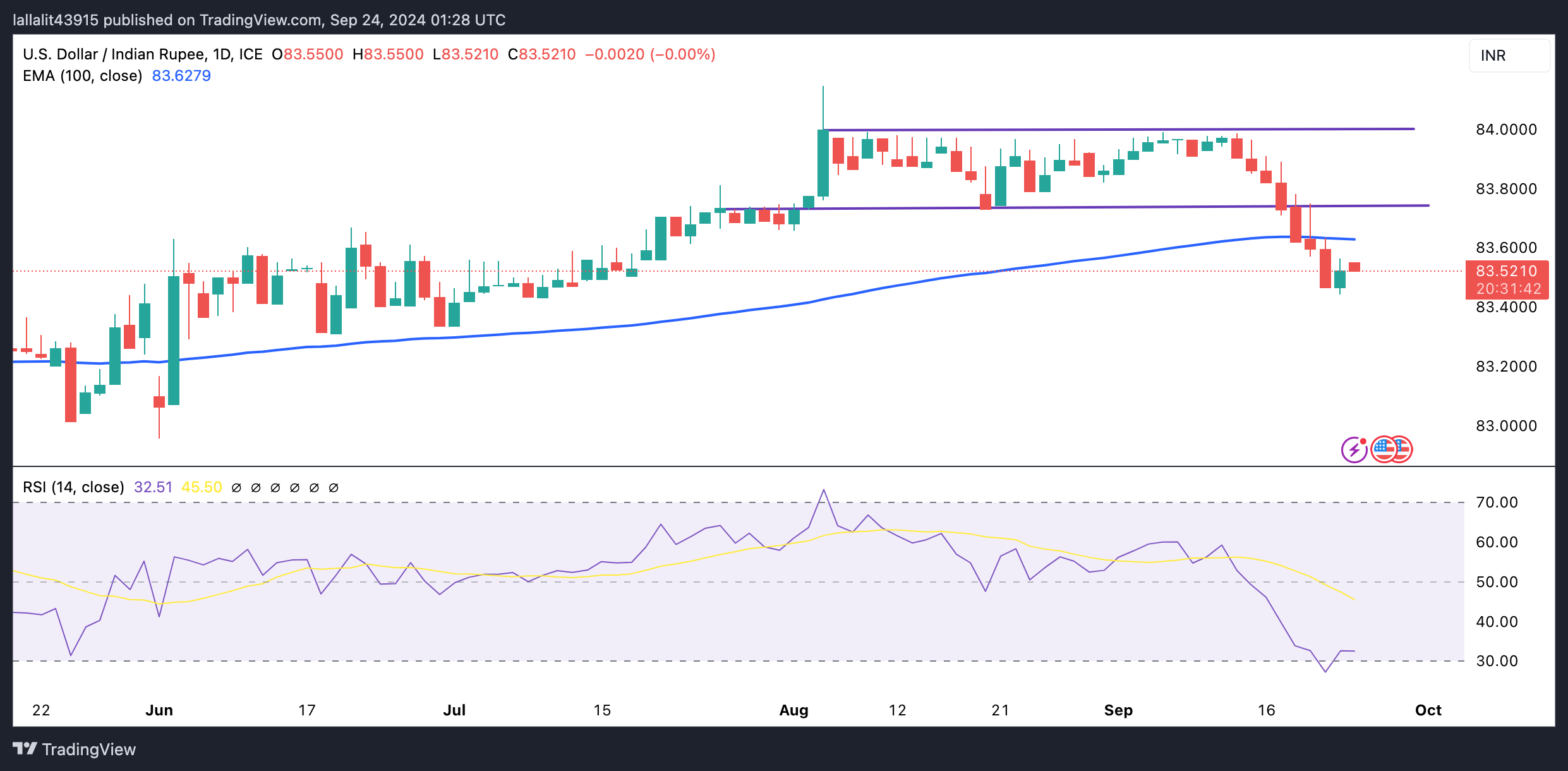
The Indian Rupee trades on a stronger note on the day. The negative outlook of the USD/INR pair prevails as the price remains capped under the key 100-day Exponential Moving Average (EMA) on the daily chart. The downward momentum is supported by the 14-day Relative Strength Index (RSI), which stands below the midline near 36.00.
The first downside target for the pair emerges at 83.44, the low of September 23. A breach of this level will see a drop to the crucial support level at 83.00, representing the psychological level and the low of May 24.
Sustained trading above the 100-day EMA at 83.62 could pave the way to the support-turned-resistance level at 83.75. The key barrier for USD/INR is located at the 84.00 round mark.
Indian Rupee FAQs
The Indian Rupee (INR) is one of the most sensitive currencies to external factors. The price of Crude Oil (the country is highly dependent on imported Oil), the value of the US Dollar – most trade is conducted in USD – and the level of foreign investment, are all influential. Direct intervention by the Reserve Bank of India (RBI) in FX markets to keep the exchange rate stable, as well as the level of interest rates set by the RBI, are further major influencing factors on the Rupee.
The Reserve Bank of India (RBI) actively intervenes in forex markets to maintain a stable exchange rate, to help facilitate trade. In addition, the RBI tries to maintain the inflation rate at its 4% target by adjusting interest rates. Higher interest rates usually strengthen the Rupee. This is due to the role of the ‘carry trade’ in which investors borrow in countries with lower interest rates so as to place their money in countries’ offering relatively higher interest rates and profit from the difference.
Macroeconomic factors that influence the value of the Rupee include inflation, interest rates, the economic growth rate (GDP), the balance of trade, and inflows from foreign investment. A higher growth rate can lead to more overseas investment, pushing up demand for the Rupee. A less negative balance of trade will eventually lead to a stronger Rupee. Higher interest rates, especially real rates (interest rates less inflation) are also positive for the Rupee. A risk-on environment can lead to greater inflows of Foreign Direct and Indirect Investment (FDI and FII), which also benefit the Rupee.
Higher inflation, particularly, if it is comparatively higher than India’s peers, is generally negative for the currency as it reflects devaluation through oversupply. Inflation also increases the cost of exports, leading to more Rupees being sold to purchase foreign imports, which is Rupee-negative. At the same time, higher inflation usually leads to the Reserve Bank of India (RBI) raising interest rates and this can be positive for the Rupee, due to increased demand from international investors. The opposite effect is true of lower inflation.
추천 기사


