


The Australian Dollar is inches away from generational highs against the Yen
- AUD/JPY trades close to 114.75, 19 pips under a seventeen-year ceiling.
- Australian capex fell 3.6% in Q2 against a flat consensus and 6.9% prior.
- Tokyo core is seen easing to 1.7% at 23:30 GMT from 1.9% in July.
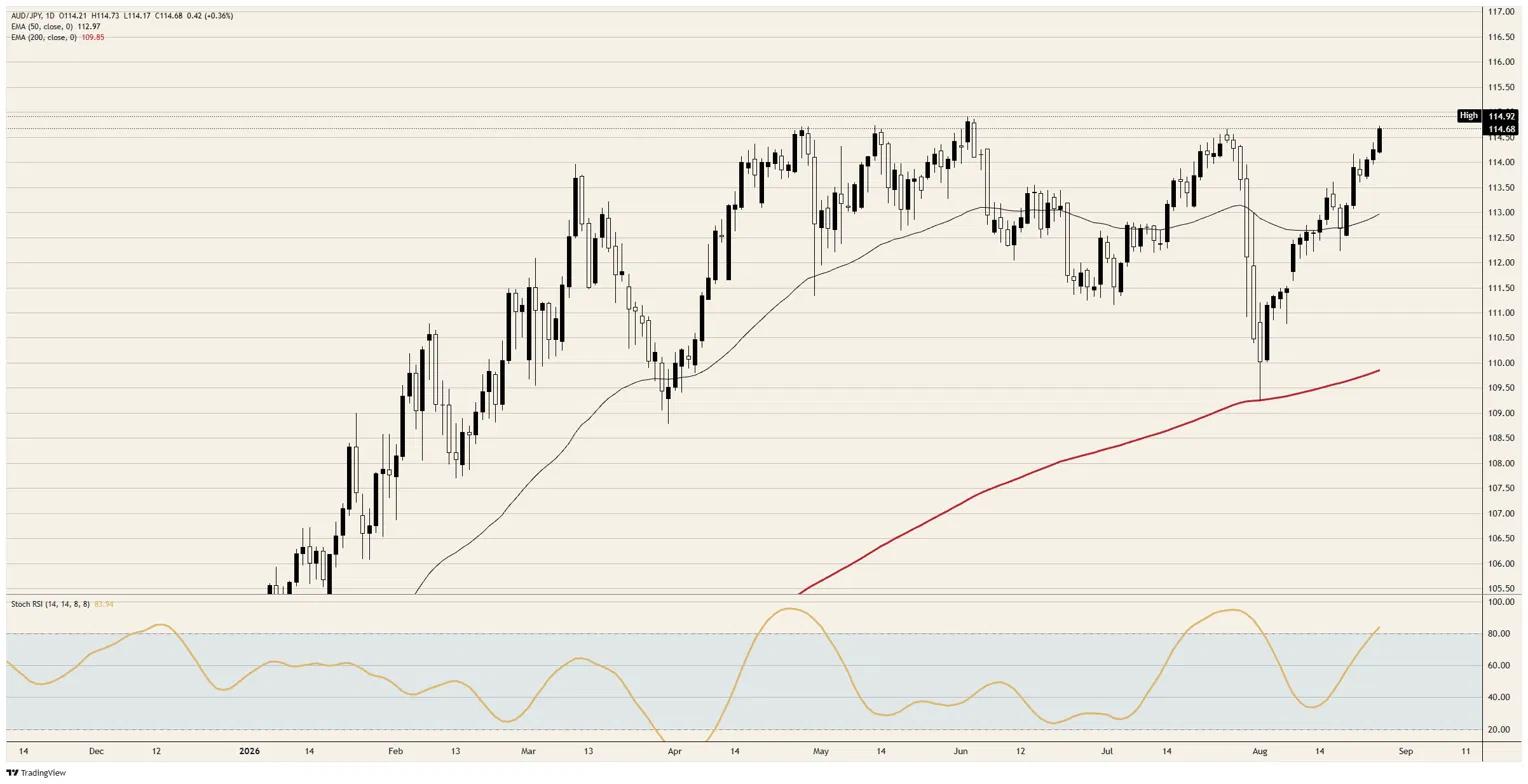
AUD/JPY traded close to 114.75 on Thursday, ahead 0.36% on the session, with a high that stops nineteen pips beneath a ceiling the pair has not traded above since September 7, 1990. The August bar is running 3.80% higher and trading at its own high with two sessions left in it, and price sits well clear of a 50-day Exponential Moving Average (EMA) at the 113.00 handle, with the daily Stochastic Relative Strength Index (Stoch RSI) near 84.
The defence lasted three weeks
Late July broke this cross roughly 450 pips in two sessions, from just under 114.50 into the 110.00 area, on the largest currency defence ever mounted in a single session. Four weeks on the pair trades above where it stood before any of it happened. The whole break has been recovered and then some, which is a different outcome from the Dollar leg, where USD/JPY has taken back only about half of its equivalent move.
The asymmetry is the point. Where the Yen was defended directly it half held, and on the crosses it did not hold at all, because an intervention moves a level while leaving the reason for the level untouched. Australia's cash rate is 4.35% against a Japanese policy rate of 1.00%, a gap of 335 basis points, and the September increase the market has at just under four-in-five odds still leaves 310 of them. Selling reserves against that is renting a price rather than buying one.
Australia does contribute one thing to this cross, and it is the rate rather than the economy, three increases this year having widened the gap the whole trade is built on. The same monthly frame also carries the cost of being wrong about it. This pair lost better than twenty percent from a 2024 peak near 109.50 into the mid-80s the last time the funding trade came apart, and it did that in weeks rather than quarters. Carry positions pay slowly and unwind instantly.
Australia is not in this trade
Business investment contracted 3.6% in the June quarter against a consensus for no change and a 6.9% prior, a swing of more than ten points in a single quarter, and it printed at 01:30 GMT Thursday. The pair went up anyway. Iron Ore has spent the summer beneath $100 a tonne, so the commodity leg is not carrying the currency either.
The demand side is worse. China's official manufacturing gauge sits at 49.2 and its non-manufacturing gauge at 49, both beneath the line dividing expansion from contraction, and China is where Australian exports go. A currency whose largest customer is shrinking on both surveys and whose own capital spending just went backwards does not trade at a seventeen-year high on merit. It trades there because it is the receiving end of a funding trade, and the ticker on the front of the pair is close to incidental.
Both legs report inside a week
Tokyo inflation lands at 23:30 GMT Thursday, headline and the ex food and energy measure both from a 2% prior, core seen easing to 1.7% from 1.9%, with July unemployment alongside at 2.5% unchanged. That print will not decide the September meeting, which has moved on political and currency grounds rather than price ones, but a soft number removes the last cover for anyone arguing the increase is about inflation. Japanese retail trade follows at 23:50 GMT Sunday from 0.5% on the year and minus 4.1% MoM.
The Australian leg then reports almost daily. China's official surveys arrive Monday at 01:30 GMT with manufacturing seen at 49.7 from 49.2, second-quarter Gross Domestic Product (GDP) lands Wednesday at 01:30 GMT from 0.3% on the quarter and 2.5% on the year, and the July trade balance follows Thursday against a prior surplus close to 1.9 billion. Building permits and an industry survey running at minus 29.9 round it out. If the cross clears its ceiling before Wednesday, it will have done so with Australian growth still unreported.
Levels
Resistance: Just short of 115.00 is the ceiling and Thursday's high stops nineteen pips beneath it. Above there the chart runs out of modern history, leaving round numbers as the only marks, 115.50 first and then 116.50.
Support: 114.00 is the near shelf, then the 50-day EMA at the 113.00 handle, with the 200-day EMA and the intervention low sitting together in the 110.00 area beneath that.
Bias: Bullish. A funding gap of 335 basis points that a quarter point does not close, against a ceiling nineteen pips overhead and a monthly bar trading at its own high with two sessions to run, is a setup that resolves upward. A daily Stoch RSI at 84 under a monthly reading at 90 argues the break arrives fast rather than durably. Invalidation on a daily close beneath 113.00.
AUD/JPY daily chart
Australian Dollar FAQs
One of the most significant factors for the Australian Dollar (AUD) is the level of interest rates set by the Reserve Bank of Australia (RBA). Because Australia is a resource-rich country another key driver is the price of its biggest export, Iron Ore. The health of the Chinese economy, its largest trading partner, is a factor, as well as inflation in Australia, its growth rate and Trade Balance. Market sentiment – whether investors are taking on more risky assets (risk-on) or seeking safe-havens (risk-off) – is also a factor, with risk-on positive for AUD.
The Reserve Bank of Australia (RBA) influences the Australian Dollar (AUD) by setting the level of interest rates that Australian banks can lend to each other. This influences the level of interest rates in the economy as a whole. The main goal of the RBA is to maintain a stable inflation rate of 2-3% by adjusting interest rates up or down. Relatively high interest rates compared to other major central banks support the AUD, and the opposite for relatively low. The RBA can also use quantitative easing and tightening to influence credit conditions, with the former AUD-negative and the latter AUD-positive.
China is Australia’s largest trading partner so the health of the Chinese economy is a major influence on the value of the Australian Dollar (AUD). When the Chinese economy is doing well it purchases more raw materials, goods and services from Australia, lifting demand for the AUD, and pushing up its value. The opposite is the case when the Chinese economy is not growing as fast as expected. Positive or negative surprises in Chinese growth data, therefore, often have a direct impact on the Australian Dollar and its pairs.
Iron Ore is Australia’s largest export, accounting for $118 billion a year according to data from 2021, with China as its primary destination. The price of Iron Ore, therefore, can be a driver of the Australian Dollar. Generally, if the price of Iron Ore rises, AUD also goes up, as aggregate demand for the currency increases. The opposite is the case if the price of Iron Ore falls. Higher Iron Ore prices also tend to result in a greater likelihood of a positive Trade Balance for Australia, which is also positive of the AUD.
The Trade Balance, which is the difference between what a country earns from its exports versus what it pays for its imports, is another factor that can influence the value of the Australian Dollar. If Australia produces highly sought after exports, then its currency will gain in value purely from the surplus demand created from foreign buyers seeking to purchase its exports versus what it spends to purchase imports. Therefore, a positive net Trade Balance strengthens the AUD, with the opposite effect if the Trade Balance is negative.
추천 기사


