


Dollar Index nudges to a fresh high and slips back as Japan raises rates
- DXY tops 100.50, its best level since late July, as Japan raises rates.
- The Bank of Japan raised its rate to 1.25%, the highest since 1995.
- Futures put another Fed increase on October 28 at 57.6%.
The Bank of Japan (BoJ) raised its rate to 1.25% on Friday and the Yen weakened anyway. The Dollar Index ran to its highest level since late July on that and has given the move back, trading just above 100.30. The Euro is 57.6% of this index and the Yen is 13.6%, so seven tenths of what the Dollar is measured against belongs to a central bank that raised rates in September.
Three central banks, a quarter point each, and the same two gaps
The European Central Bank (ECB) raised its deposit rate to 2.50% on September 10. The Federal Reserve raised its rate to 3.75-4.00% on September 16. The BoJ raised its own to 1.25% on September 18. All three moved by a quarter point, so the two gaps that set most of this index are as wide as they were nine days ago. Japan's rate is the highest it has been since 1995 and exactly a third of the bottom of the Fed's range.
An increase that made the next one less certain
The Japanese vote was 7-2, with board members Asada and Sato, both appointed this year, against. Speculators had flipped to betting on a stronger Yen before the meeting on the view that the BoJ would keep going, so two dissents were enough to turn the currency the other way.
BoJ Governor Ueda said the bank will keep raising rates as the economy and prices allow, and that underlying inflation risks running above the 2% target. The dissenters had the more recent number behind them, because Japanese core inflation eased to 1.7% in August from 1.8% in July, its first slowdown in four months. The Yen had reached a seven-month high against the Dollar earlier in September on the view that more increases were coming, and traders who wanted a date for the next one got a direction instead.
What the Dollar is actually being paid
Cash in Dollars earns 3.75-4.00%, cash in Euros earns 2.50% and cash in Yen earns 1.25%, and none of those differences changed this month. Further out, the 10-year American government bond pays about 5.00% and the Japanese one about 2.95%.
What changed is the path. Futures put another Fed increase on October 28 at better than even odds, take the rate to 4.50-4.75% by the middle of 2027, and then price nothing at all for the eighteen months after that. The market has the Dollar's advantage growing no further after June 2027, and it is paying up for that advantage in September 2026.
Europe is the bigger half of that trade and the quieter one. The ECB has raised twice this year, in June and September, and economists do not expect the next move before December, which leaves the Euro's 57.6% of the index sitting on a rate that is not going anywhere for three months. The Yen's 13.6% is where the argument is, because the BoJ has now moved twice in three months after moving once every six.
The Pound is 11.9% of the index and the Bank of England (BoE) left its rate at 3.75% on Thursday, where it has been since December. That is the one gap of the three that got wider in September, and it got wider because the Fed moved rather than because the BoE did. Between them the Euro, the Yen and the Pound are more than eight tenths of this index, so the case rests on what the Fed does next.
Ten Fed speeches loom ahead
The American calendar is mostly talk. Ten Fed speeches are scheduled between Monday and Friday, three of them from New York Fed President Williams, with Chicago Fed President Goolsbee going first on Monday at 10:30 GMT. Fed Chair Warsh has spent his time in the job refusing to give forward guidance, and his committee is about to give ten speeches worth of it.
The data is thinner. An ADP four-week average of employment change lands Tuesday at 12:15 GMT against 16.25K, and the flash purchasing surveys at 13:45 GMT on Wednesday are the only real read on growth before the meeting, both of them forecast to slow while staying above 50. All of it feeds the October 28 pricing, which is what the Dollar's advantage over the Euro and the Yen currently rests on.
Levels and bias
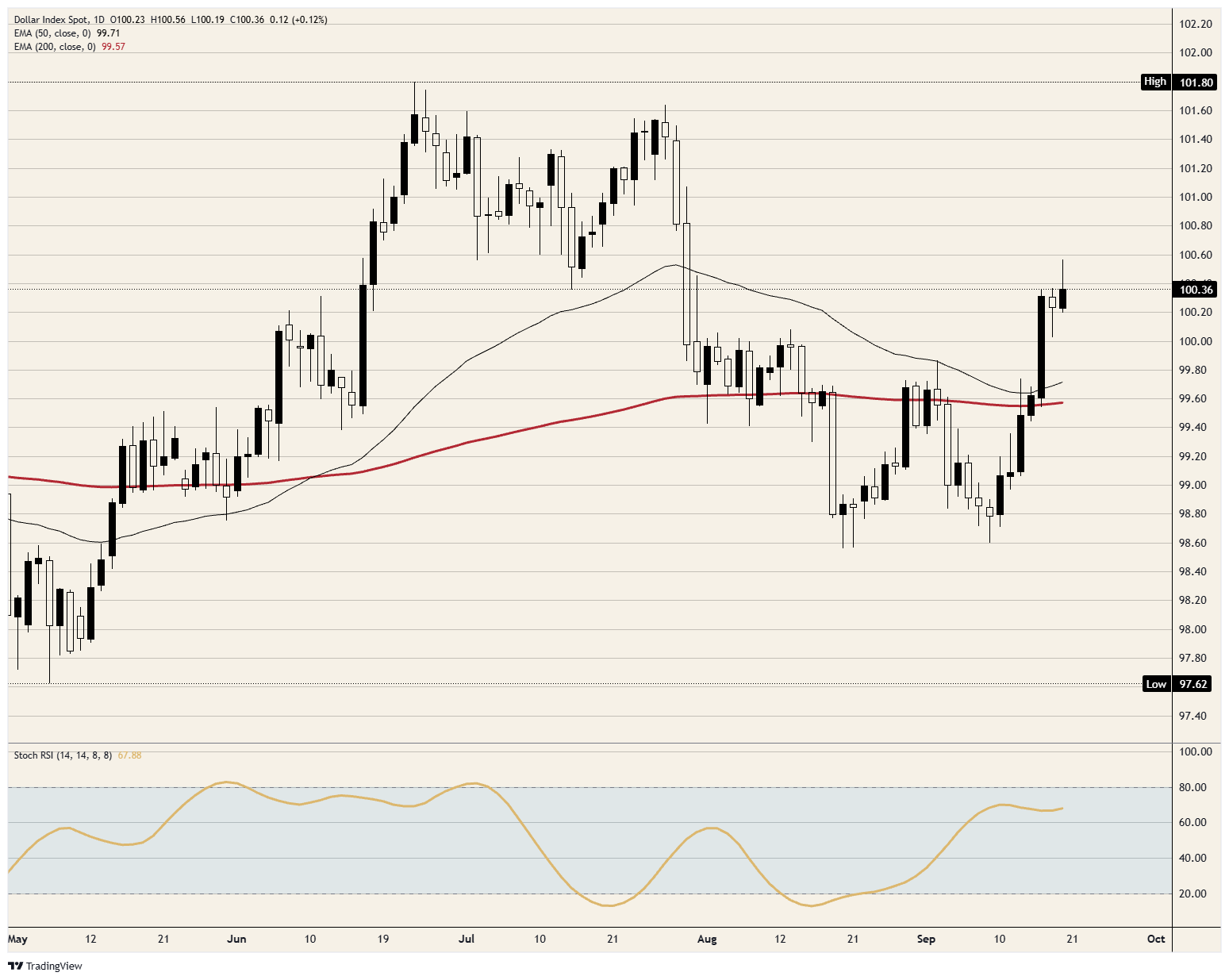
Resistance: 100.50 is where the buying stopped, with the session high just above it and no trade above that level since late July. Then 101.00, and the peak near 101.50 that the Dollar left behind at the end of July.
Support: 100.00 held through the session, with the low near 100.20. Beneath it, the 50-day Exponential Moving Average (EMA) near 99.70 is the level the Dollar reclaimed on Wednesday and has not traded below since.
Bias: Bullish while 100.00 holds. The first objective is 101.00 and the second is 101.50. The daily Stochastic Relative Strength Index (Stoch RSI), a momentum gauge, is near 68 and still rising, which fits a market working higher. A daily close below 99.70 ends the bullish case.
DXY daily chart
US Dollar FAQs
The US Dollar (USD) is the official currency of the United States of America, and the ‘de facto’ currency of a significant number of other countries where it is found in circulation alongside local notes. It is the most heavily traded currency in the world, accounting for over 88% of all global foreign exchange turnover, or an average of $6.6 trillion in transactions per day, according to data from 2022. Following the second world war, the USD took over from the British Pound as the world’s reserve currency. For most of its history, the US Dollar was backed by Gold, until the Bretton Woods Agreement in 1971 when the Gold Standard went away.
The most important single factor impacting on the value of the US Dollar is monetary policy, which is shaped by the Federal Reserve (Fed). The Fed has two mandates: to achieve price stability (control inflation) and foster full employment. Its primary tool to achieve these two goals is by adjusting interest rates. When prices are rising too quickly and inflation is above the Fed’s 2% target, the Fed will raise rates, which helps the USD value. When inflation falls below 2% or the Unemployment Rate is too high, the Fed may lower interest rates, which weighs on the Greenback.
In extreme situations, the Federal Reserve can also print more Dollars and enact quantitative easing (QE). QE is the process by which the Fed substantially increases the flow of credit in a stuck financial system. It is a non-standard policy measure used when credit has dried up because banks will not lend to each other (out of the fear of counterparty default). It is a last resort when simply lowering interest rates is unlikely to achieve the necessary result. It was the Fed’s weapon of choice to combat the credit crunch that occurred during the Great Financial Crisis in 2008. It involves the Fed printing more Dollars and using them to buy US government bonds predominantly from financial institutions. QE usually leads to a weaker US Dollar.
Quantitative tightening (QT) is the reverse process whereby the Federal Reserve stops buying bonds from financial institutions and does not reinvest the principal from the bonds it holds maturing in new purchases. It is usually positive for the US Dollar.
추천 기사


