


British Pound Sterling bounces into an empty week
- GBP/USD fell to a fresh near-term low on Tuesday after UK flash PMIs missed across the board.
- A late-session bounce lacked conviction and barely dented the June downtrend.
- With no UK data left this week, Thursday's US PCE print and a run of Fed speakers will drive direction.
Sterling spent Tuesday confirming what the macro backdrop already implied, that the United Kingdom has no growth story to sell right now. June flash Purchasing Managers Index (PMI) readings undershot across the board, the Services gauge sliding to 48.7 against a 50.0 consensus and deeper into contraction. Cable sold into the data, dipping just under 1.3200 before a late bid dragged it back near the handle. The recovery looks hollow; the Pound still closed lower, well inside the month's slide.
A rebound without a reason
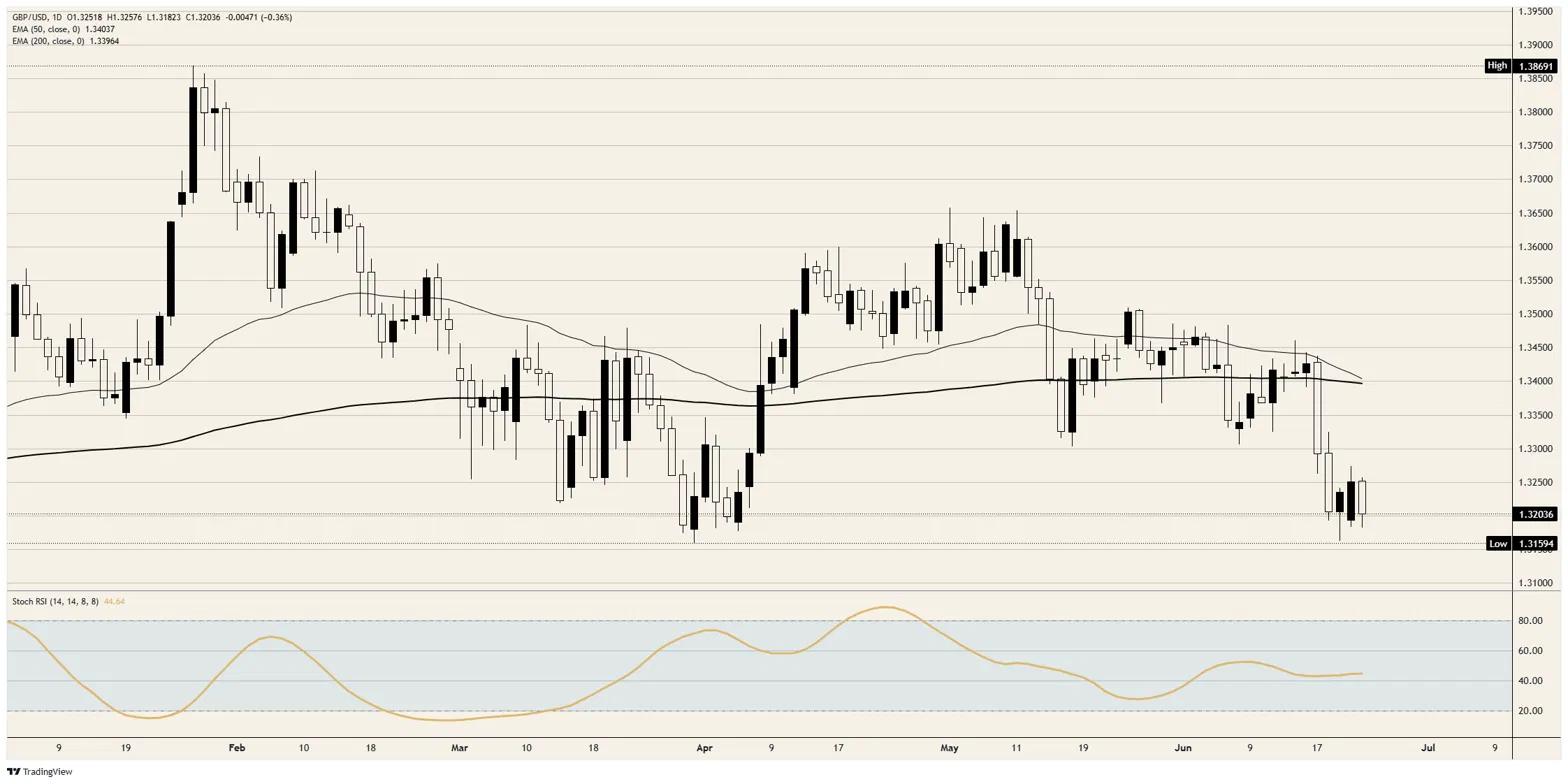
The genuinely odd part is that Cable bounced at all on a day when every domestic input pointed lower and firmer US PMIs kept the US Dollar bid. There was no UK data beat behind the lift and no shift in Bank of England (BoE) rate pricing; the move looked like a short-covering twitch, not a Sterling-specific bid. Intraday momentum agrees, with the Stochastic Relative Strength Index (Stoch RSI) rolling over as the bounce stalled near 1.3200. On the daily chart the structure stays firmly bearish, with price well below the 50-day Exponential Moving Average (EMA) near 1.3400 and the 200-day EMA just beneath it; the Pound is catching its breath, not recovering.
Nothing on the UK docket
From here the calendar becomes the problem for anyone hoping Sterling can lead its own recovery. The rest of the week carries no top-tier UK releases at all, leaving a scattering of BoE speakers as the only domestic input; the line-up skews dovish. With Downing Street still rudderless after the Prime Minister's resignation and no growth catalyst in sight, nothing scheduled could hand the Pound a reason to rally on its own. That leaves Cable a passenger for the back half of the week, its direction set almost entirely by moves in the Dollar.
Thursday's PCE is the catalyst that counts
The week's lone market-mover lands Thursday at 12:30 GMT, when the US releases the May Personal Consumption Expenditures Price Index (PCE), the inflation gauge the Federal Reserve (Fed) watches most closely. Core PCE is seen at 0.3% MoM and 3.4% YoY, both above the prior month. A hot print would validate the hawkish hold the Fed delivered last week and the higher-for-longer signal in its dot plot.
With near-term easing no longer priced, an upside surprise extends Dollar strength and shoves Cable back toward its lows. The same window brings the final first-quarter Gross Domestic Product (GDP) reading, Durable Goods Orders, and jobless claims, plus Fed speakers across both days; Friday's University of Michigan (UoM) sentiment and inflation expectations are a footnote.
Level watch
Resistance: The first ceiling sits near 1.3250, which capped Tuesday's early trade, with 1.3300 above it. The real wall is the moving-average cluster around 1.3400, where the 50-day and 200-day EMAs have flattened and converged; until Cable reclaims that zone, rallies are selling opportunities, not a base.
Support: The line in the sand is the recent low around 1.3150, which also marks the April trough and the floor of the year's range; a daily close beneath it confirms the breakdown and opens the way toward the 1.3100 handle. Tuesday's dip under 1.3200 was bought. With no UK catalyst to defend it, that support is a speed bump, not a foundation.
Bias: Bearish while price holds below the 1.3400 EMA cluster. With Sterling stripped of any domestic catalyst this week, the play is to sell rallies toward 1.3250 for a retest of 1.3150. A hot PCE print Thursday breaks that floor and opens 1.3100; only a soft inflation surprise and a daily close back above 1.3300 forces a rethink.
GBP/USD daily chart
Pound Sterling FAQs
The Pound Sterling (GBP) is the oldest currency in the world (886 AD) and the official currency of the United Kingdom. It is the fourth most traded unit for foreign exchange (FX) in the world, accounting for 12% of all transactions, averaging $630 billion a day, according to 2022 data. Its key trading pairs are GBP/USD, also known as ‘Cable’, which accounts for 11% of FX, GBP/JPY, or the ‘Dragon’ as it is known by traders (3%), and EUR/GBP (2%). The Pound Sterling is issued by the Bank of England (BoE).
The single most important factor influencing the value of the Pound Sterling is monetary policy decided by the Bank of England. The BoE bases its decisions on whether it has achieved its primary goal of “price stability” – a steady inflation rate of around 2%. Its primary tool for achieving this is the adjustment of interest rates. When inflation is too high, the BoE will try to rein it in by raising interest rates, making it more expensive for people and businesses to access credit. This is generally positive for GBP, as higher interest rates make the UK a more attractive place for global investors to park their money. When inflation falls too low it is a sign economic growth is slowing. In this scenario, the BoE will consider lowering interest rates to cheapen credit so businesses will borrow more to invest in growth-generating projects.
Data releases gauge the health of the economy and can impact the value of the Pound Sterling. Indicators such as GDP, Manufacturing and Services PMIs, and employment can all influence the direction of the GBP. A strong economy is good for Sterling. Not only does it attract more foreign investment but it may encourage the BoE to put up interest rates, which will directly strengthen GBP. Otherwise, if economic data is weak, the Pound Sterling is likely to fall.
Another significant data release for the Pound Sterling is the Trade Balance. This indicator measures the difference between what a country earns from its exports and what it spends on imports over a given period. If a country produces highly sought-after exports, its currency will benefit purely from the extra demand created from foreign buyers seeking to purchase these goods. Therefore, a positive net Trade Balance strengthens a currency and vice versa for a negative balance.
추천 기사


