


The Bank of Japan can't save the Japanese Yen
- USD/JPY heads into the Bank of Japan decision pinned near its highest levels in decades.
- A quarter-point hike to 1% is largely priced, leaving the guidance and the Fed to drive the pair.
- The BoJ acts with Governor Ueda hospitalized and unable to vote, a day before the FOMC and a fresh dot plot.
USD/JPY is grinding into the Bank of Japan's (BoJ) June meeting above the 160.00 handle, a whisker from multi-decade highs, while the central bank meant to defend the Yen prepares to raise rates to a three-decade high without lifting the currency at all. A quarter-point step to 1% has been roughly 80% priced for weeks, leaving the decision nearly a non-event. What matters is the guidance, the Federal Reserve (Fed) decision 24 hours later, and whether the BoJ still has any pull over a currency the carry trade keeps selling.
A hike the market has already spent
The Bank of Japan can do everything textbook policy prescribes and still watch the Yen sit on the floor. Lifting the benchmark to 1% sounds dramatic until you remember the Fed sits at 3.50% to 3.75%; even after Tuesday the rate gap stays near 275 basis points, wide enough to keep the carry trade paying. A fully priced tightening rarely rescues a currency on the day it lands; the bigger risk is that cautious, go-slow guidance simply sells the Yen on the fact.
A historic decision with an empty chair
The most consequential BoJ hike in thirty years arrives with a strange asterisk: Governor Kazuo Ueda will not be in the room to vote on it. Hospitalized for a liver infection, he will submit his views in writing while the meeting proceeds without him, the first regular policy decision ever taken with the governor absent.
The Fed then meets the next day under new Chair Kevin Warsh, his first decision since replacing Jerome Powell in May. Two of the planet's most important central banks set policy inside 48 hours, neither with its usual hand on the wheel.
The line in the sand has moved
Traders are no longer truly afraid of the 160.00 handle, the uncomfortable truth beneath this grind. Japanese authorities intervened around this level in 2024 and again in 2026, yet the pair climbed back above it each time. The Ministry of Finance (MoF) defends order rather than a number, reacting to the speed of a move more than its level, which is why a slow grind draws far less response than a violent spike.
Finance Minister Satsuki Katayama has spent weeks escalating warnings and even floating joint intervention with Washington; the Yen drifts lower regardless. Some desks now read official tolerance as closer to 162.00 than 160.00, which leaves the market grinding toward that zone to see who blinks first.
Overbought and still climbing
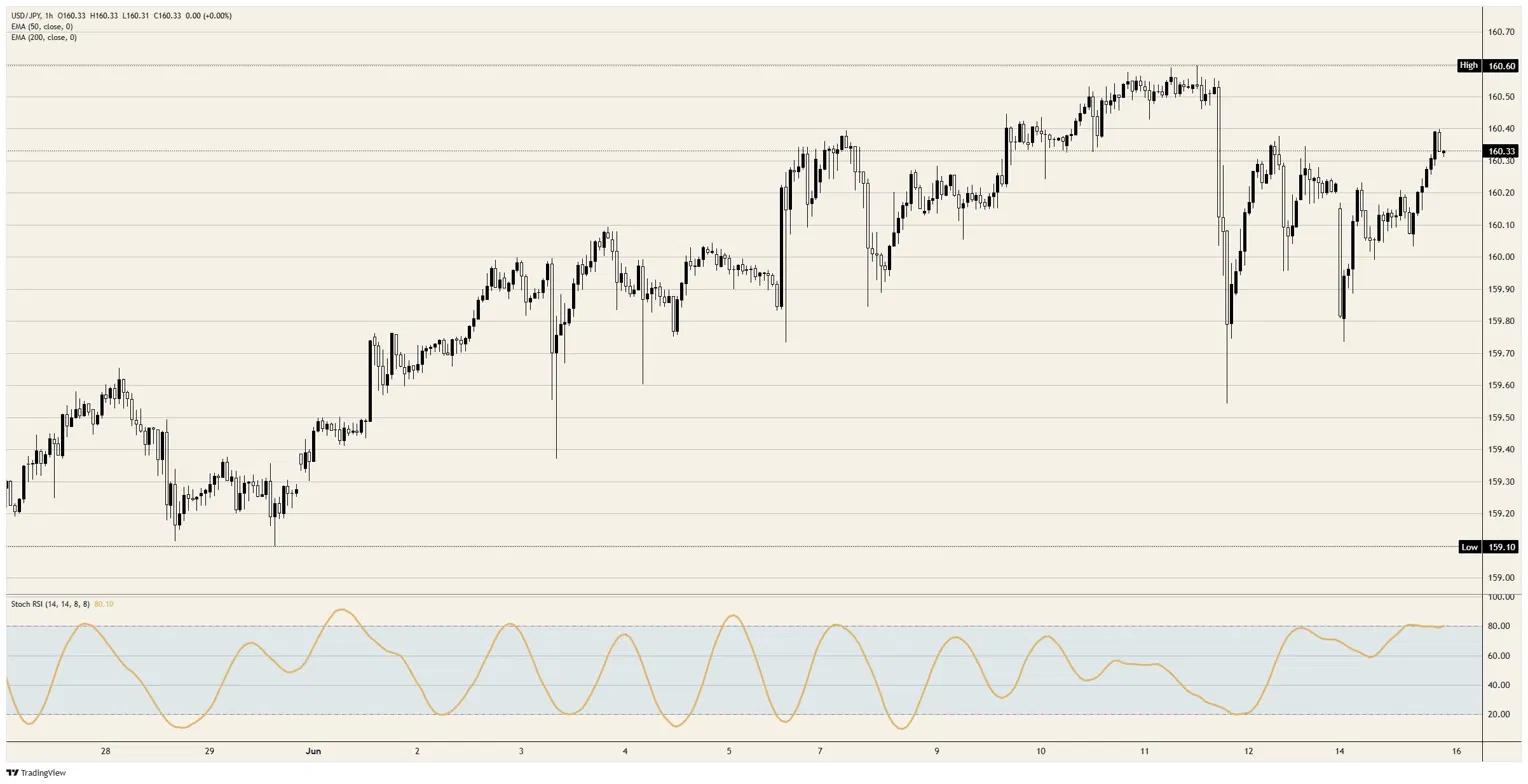
The chart does nothing to argue with the carry story. On the daily timeframe the Stochastic Relative Strength Index (Stoch RSI) sits near the top of its range above 87, while the hourly reading hovers around 80, the kind of stretched momentum that usually begs for a pullback. Price keeps grinding higher instead, the signature of a flow-driven, one-way market.
Structurally the uptrend is intact, with price holding well above a rising 50-period Exponential Moving Average (EMA) near 159.00 and recent dips bought close to 159.50.
The 48-hour gauntlet
This is a week where the calendar, not the chart, sets the risk. Tuesday brings the BoJ rate decision, statement, and scheduled press conference, followed late in the session by Japan's May trade balance and export figures. Wednesday then delivers the Federal Open Market Committee (FOMC) decision, the updated dot plot, and Warsh's first press conference, any of which can reprice the Dollar leg in seconds.
Thursday closes the loop with Japan's National Consumer Price Index (CPI) for May, where core readings have run near 1.4% to 1.9% YoY; another firm print would validate the BoJ's tightening path. With two rate decisions and a major inflation print in three days, position sizing matters more than any chart level.
How to play it
Resistance: The 160.50 area caps the recent range and the cycle highs; a clean break opens room toward the 161.00 handle, with 162.00 the zone where intervention odds climb sharply.
Support: The 160.00 handle is the first floor bulls have defended again and again; below it, 159.50 and then the 50-period EMA near 159.00 mark where the grind stalls.
Bias: Higher while 160.00 holds. The rate gap, the trend, and stretched but rising momentum all point the same way; a priced hike does little to change that. The picture only flips on a hawkish surprise to the BoJ's path, a dovish Warsh pivot, or genuine intervention, each of which would move fast.
USD/JPY daily chart
Japanese Yen FAQs
The Japanese Yen (JPY) is one of the world’s most traded currencies. Its value is broadly determined by the performance of the Japanese economy, but more specifically by the Bank of Japan’s policy, the differential between Japanese and US bond yields, or risk sentiment among traders, among other factors.
One of the Bank of Japan’s mandates is currency control, so its moves are key for the Yen. The BoJ has directly intervened in currency markets sometimes, generally to lower the value of the Yen, although it refrains from doing it often due to political concerns of its main trading partners. The BoJ ultra-loose monetary policy between 2013 and 2024 caused the Yen to depreciate against its main currency peers due to an increasing policy divergence between the Bank of Japan and other main central banks. More recently, the gradually unwinding of this ultra-loose policy has given some support to the Yen.
Over the last decade, the BoJ’s stance of sticking to ultra-loose monetary policy has led to a widening policy divergence with other central banks, particularly with the US Federal Reserve. This supported a widening of the differential between the 10-year US and Japanese bonds, which favored the US Dollar against the Japanese Yen. The BoJ decision in 2024 to gradually abandon the ultra-loose policy, coupled with interest-rate cuts in other major central banks, is narrowing this differential.
The Japanese Yen is often seen as a safe-haven investment. This means that in times of market stress, investors are more likely to put their money in the Japanese currency due to its supposed reliability and stability. Turbulent times are likely to strengthen the Yen’s value against other currencies seen as more risky to invest in.
추천 기사


