


USD/INR ticks lower as Iran truce hopes batter US Dollar
- The Indian Rupee edges higher against the US Dollar due to continued underperformance from the US Dollar.
- Investors await the outcome of Israel-Lebanon talks, which are scheduled later in the day.
- Foreign investors raise little stake in the Indian stock market on Wednesday.
The Indian Rupee (INR) opens slightly higher against the US Dollar (USD) on Thursday. The USD/INR pair edges down to near 93.28 as the US Dollar (USD) faces intense selling pressure due to improving hopes of a permanent ceasefire between the United States (US) and Iran.
During the day, the US Dollar Index (DXY), which gauges the Greenback’s value against six major currencies, posts a fresh six-week low near 97.85.
US-Iran optimism diminishes US Dollar’s safe-haven appeal
The optimism over the US-Iran permanent truce has diminished demand for safe-haven assets, such as the US Dollar, and riskier assets are attracting strong buying interest globally. The Iran truce hopes are prompted by comments from US President Donald Trump that the war with Tehran is “very close” to over. Trump also stated on Wednesday that there could be some positive announcements regarding the US-Iran truce in the next two days. "I think you’re going to be watching an amazing two days ahead. I really do," Trump said in an interview with ABC News.
Though the US Dollar has been battered heavily in the last few trading days due to US-Iran truce hopes, the downside in the USD/INR pair has remained limited due to stronger demand for US Dollars by Indian importers.
According to a Reuters report, most bankers see limited upside for the rupee from current levels amid continued hedging demand from importers and interest in locking in longer‑term dollar liabilities.
FIIs add little stake in Indian stock market on Wednesday
Foreign Institutional Investors (FIIs) remained net buyers in the Indian equity market on Wednesday after paring stake on Monday. However, the investment poured in was very small in comparison with the outflows seen this month. On Wednesday, FIIs bought shares worth Rs. 666.15 crore. So far in April, overseas investors have remained net buyers in only two trading days and have bought stake cumulatively worth Rs. 1,338.24 crore. In the remaining days, FIIs remained net sellers and offloaded stake worth Rs. 41,627.90 crore.
Going forward, investors will focus on negotiations between Israel and Lebanon, which are scheduled later in the day. Investors will pay close attention to Israel-Lebanon talks to get cues about whether both nations want to de-escalate military actions or escalate them.
The confirmation from both nations stopping military actions would improve the credibility of the two-week ceasefire between the US and Iran, which will expire on April 21. It will also improve hopes of a permanent truce between the two nations. Earlier, Tehran accused Washington of violating the terms of the temporary ceasefire by continuing attacks on Iran-backed Hezbollah in Lebanon.
Technical Analysis:
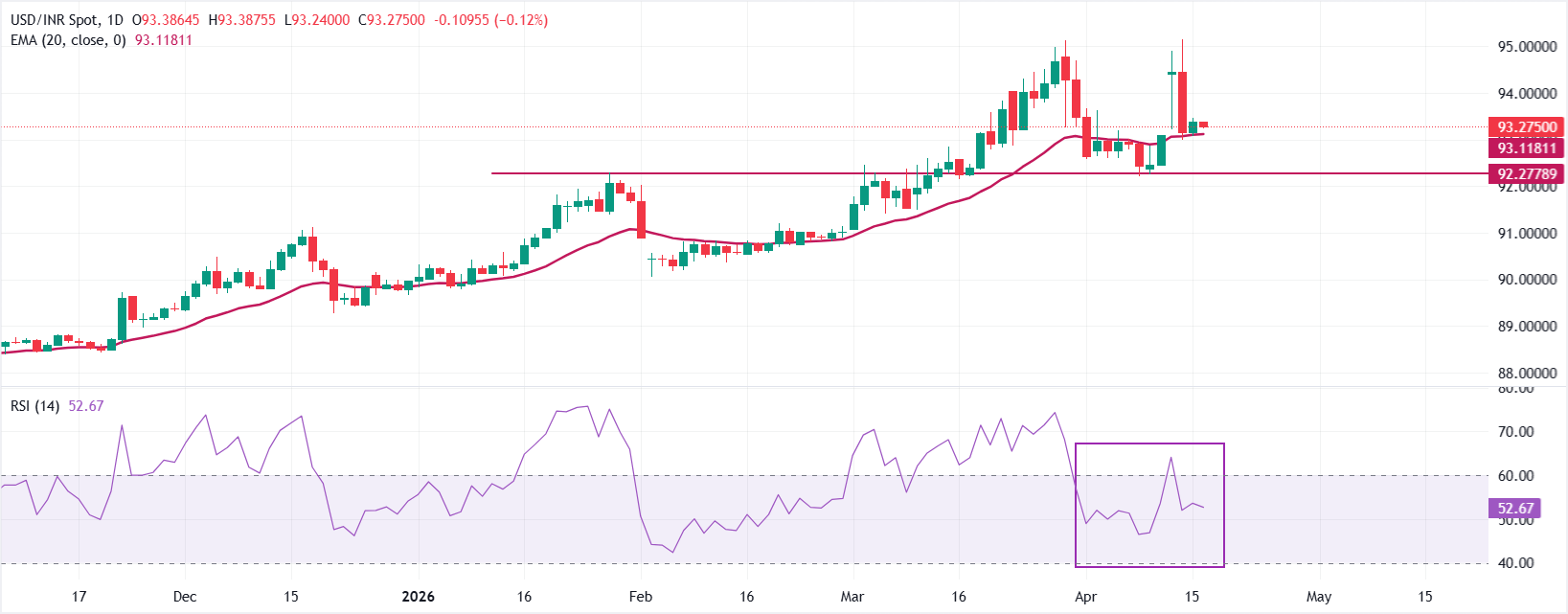
In the daily chart, USD/INR trades at 93.28, maintaining a mildly bullish near-term bias as it holds above the 20-day exponential moving average (EMA) at 93.1181. The pair is consolidating near recent highs, and the Relative Strength Index (RSI) around 52 suggests balanced momentum after easing from overbought territory, hinting that upside pressure has moderated but underlying demand remains intact while price stays above the short-term EMA.
On the downside, immediate support is located at the 20-day EMA near 93.12, where a sustained break would weaken the current constructive tone and expose a deeper corrective phase towards the January high of 92.29. Looking up, the pair could be hopeful of reclaiming the all-time high of 95.15 if it manages to recover sustainably above the 94.00 mark.
(The technical analysis of this story was written with the help of an AI tool.)
Indian Rupee FAQs
The Indian Rupee (INR) is one of the most sensitive currencies to external factors. The price of Crude Oil (the country is highly dependent on imported Oil), the value of the US Dollar – most trade is conducted in USD – and the level of foreign investment, are all influential. Direct intervention by the Reserve Bank of India (RBI) in FX markets to keep the exchange rate stable, as well as the level of interest rates set by the RBI, are further major influencing factors on the Rupee.
The Reserve Bank of India (RBI) actively intervenes in forex markets to maintain a stable exchange rate, to help facilitate trade. In addition, the RBI tries to maintain the inflation rate at its 4% target by adjusting interest rates. Higher interest rates usually strengthen the Rupee. This is due to the role of the ‘carry trade’ in which investors borrow in countries with lower interest rates so as to place their money in countries’ offering relatively higher interest rates and profit from the difference.
Macroeconomic factors that influence the value of the Rupee include inflation, interest rates, the economic growth rate (GDP), the balance of trade, and inflows from foreign investment. A higher growth rate can lead to more overseas investment, pushing up demand for the Rupee. A less negative balance of trade will eventually lead to a stronger Rupee. Higher interest rates, especially real rates (interest rates less inflation) are also positive for the Rupee. A risk-on environment can lead to greater inflows of Foreign Direct and Indirect Investment (FDI and FII), which also benefit the Rupee.
Higher inflation, particularly, if it is comparatively higher than India’s peers, is generally negative for the currency as it reflects devaluation through oversupply. Inflation also increases the cost of exports, leading to more Rupees being sold to purchase foreign imports, which is Rupee-negative. At the same time, higher inflation usually leads to the Reserve Bank of India (RBI) raising interest rates and this can be positive for the Rupee, due to increased demand from international investors. The opposite effect is true of lower inflation.
추천 기사


