


USD/INR surges as Iran vows retaliation against Trump’s 48-hour ultimatum
- The Indian Rupee refreshes lifetime lows at 94.40 against the US Dollar amid Middle East tensions.
- Iran pledges indefinite closure of Hormuz and attacks on regional infrastructure.
- FIIs continue to sell their stake on the Indian stock market.
The Indian Rupee (INR) extends its downfall against the US Dollar (USD) at the start of the holiday-shortened week. Indian markets will remain closed on Thursday due to Shri Ram Navami.
The USD/INR pair posts a fresh lifetime high at 94.40 as the Indian Rupee faces the heat of escalating conflicts in the Middle East, following United States (US) President Donald Trump’s ultimatum to Iran to reopen the Strait of Hormuz within 48 hours through a post on Truth Social.
Iran threatens indefinite closure of Hormuz
US President Donald Trump said on Saturday that they will “obliterate” Iran’s power plants, starting with the biggest one, if they refuse to open the Strait of Hormuz within 48 hours.
Meanwhile, Iran has responded with threats of indefinite closure of the Strait of Hormuz and targeting all infrastructure of energy, information technology (IT), and desalination facilities in the region belonging to the US and Israel, The Politico reported.
Escalating conflicts in the Middle East have dampened demand for riskier assets, forcing investors to shift to safe-haven assets. Asian stock markets have bled due to the Iran conflict, with the Nifty 50 slumping almost 2% to a fresh over 11-month low near 22,650.
Amid Middle East conflicts, the US Dollar (USD) trades slightly higher, with the US Dollar Index (DXY) rising 0.15% to near 99.65. The US Dollar has been broadly firm as investors expect the Federal Reserve (Fed) to adopt an extended pause on interest rates, with inflation expectations de-anchoring due to higher energy prices.
FIIs continue to pare stake in the Indian equity market
Overseas investors continue to dump their stake in the Indian stock market amid the war in the Middle East. So far in March, Foreign Institutional Investors (FIIs) have remained net sellers on all trading days and offloaded their stake worth Rs. 86,780.89 crore.
FIIs are keeping a distance from the Indian equity market amid fears that higher oil prices due to energy supply disruption would result in lower earnings reports by Indian companies in the fourth quarter of FY 2025-26 than previously estimated.
Meanwhile, oil supply to the Asian region will be squeezed further as Saudi Aramco, the world's top oil exporter, cut crude supply to Asian buyers for a second month in April after the US-Israeli war with Iran disrupted trade via the Strait of Hormuz.
This week, investors will focus on the preliminary India and US private sector Purchasing Managers’ Index (PMI) data for March, which will be released on Tuesday.
Technical Analysis: USD/INR shifts into uncharted territory
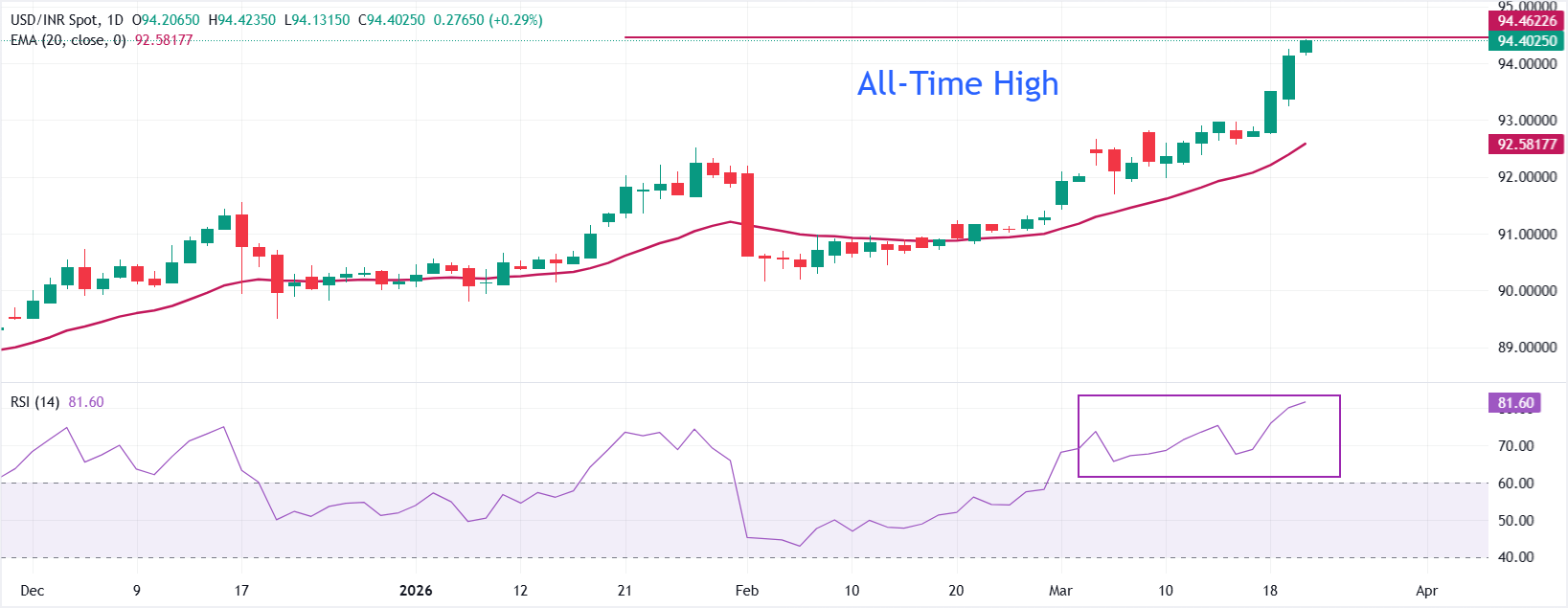
USD/INR jumps above 94.40 in the opening trade on Monday. The near-term bias is bullish as price extends a steep advance above the rising 20-day Exponential Moving Average, which now trails well below spot and confirms an established uptrend.
Recent candles show no meaningful retracement despite the sharp climb, and momentum remains strong, with the 14-day Relative Strength Index (RSI) at 81.56 in overbought territory, signaling persistent buying pressure rather than immediate exhaustion.
The sequence of higher highs and higher lows over recent sessions reinforces the upside bias, while the absence of rejection wicks at the top of the range points to sustained demand on dips.
Initial resistance is now seen near 94.50, where intraday supply could emerge, followed by a higher barrier toward 95.00 as the next upside reference if bulls maintain control. On the downside, immediate support aligns around 94.00, where minor consolidation recently formed, ahead of firmer support at 93.50. The 20-day EMA near 92.60 underpins the broader bullish structure and marks a deeper pullback area that would need to hold to preserve the current uptrend.
(The technical analysis of this story was written with the help of an AI tool.)
Indian Rupee FAQs
The Indian Rupee (INR) is one of the most sensitive currencies to external factors. The price of Crude Oil (the country is highly dependent on imported Oil), the value of the US Dollar – most trade is conducted in USD – and the level of foreign investment, are all influential. Direct intervention by the Reserve Bank of India (RBI) in FX markets to keep the exchange rate stable, as well as the level of interest rates set by the RBI, are further major influencing factors on the Rupee.
The Reserve Bank of India (RBI) actively intervenes in forex markets to maintain a stable exchange rate, to help facilitate trade. In addition, the RBI tries to maintain the inflation rate at its 4% target by adjusting interest rates. Higher interest rates usually strengthen the Rupee. This is due to the role of the ‘carry trade’ in which investors borrow in countries with lower interest rates so as to place their money in countries’ offering relatively higher interest rates and profit from the difference.
Macroeconomic factors that influence the value of the Rupee include inflation, interest rates, the economic growth rate (GDP), the balance of trade, and inflows from foreign investment. A higher growth rate can lead to more overseas investment, pushing up demand for the Rupee. A less negative balance of trade will eventually lead to a stronger Rupee. Higher interest rates, especially real rates (interest rates less inflation) are also positive for the Rupee. A risk-on environment can lead to greater inflows of Foreign Direct and Indirect Investment (FDI and FII), which also benefit the Rupee.
Higher inflation, particularly, if it is comparatively higher than India’s peers, is generally negative for the currency as it reflects devaluation through oversupply. Inflation also increases the cost of exports, leading to more Rupees being sold to purchase foreign imports, which is Rupee-negative. At the same time, higher inflation usually leads to the Reserve Bank of India (RBI) raising interest rates and this can be positive for the Rupee, due to increased demand from international investors. The opposite effect is true of lower inflation.
추천 기사


