




EUR/USD pulls back from multi-year highs as the Fed comes into focus
- EUR/USD consolidates above 1.2000 after hitting multi-year highs at 1.2082 on Tuesday.
- The USD plunged on Tuesday following Trump's comments praising the currency's depreciation.
- The Fed is set to announce its monetary policy decision on Wednesday amid growing concerns about its autonomy.
The Euro shows moderate losses on Wednesday, retreating to 1.1985 at the time of writing, from over four-year highs at 1.2082 hit on Tuesday. The US Dollar is picking up as the impact of US President Donald Trump's comments, praising the US Dollar’s (USD) depreciation, diminishes, and the chances of further European Central Bank (ECB) monetary easing increase.
ECB board member Martin Kocher put a lid on the Euro rally, opening the doors to a further interest rate cut in July if the common currency's appreciation starts to undermine the bank's inflation projections. Eurozone money markets have boosted the odds of a July rate cut to 25% from around 15% on Tuesday, according to data released by Reuters.
The pair had rallied about 1.24% on Tuesday after Trump said in a visit to Iowa that the current US Dollar value "is great" and that the currency has not fallen too low, which provided investors with fresh reasons to sell the Greenback.
The focus on Wednesday shifts to the Federal Reserve (Fed), which is widely expected to leave interest rates unchanged, although investors’ attention is likely to be on the bank’s autonomy. The US president’s plans to replace Jerome Powell with a more dovish Fed chairman, the efforts to oust Fed Governor Lisa Cook, and the criminal investigation have put the independence of the central bank into question.
Euro Price Today
The table below shows the percentage change of Euro (EUR) against listed major currencies today. Euro was the strongest against the Swiss Franc.
| USD | EUR | GBP | JPY | CAD | AUD | NZD | CHF | |
|---|---|---|---|---|---|---|---|---|
| USD | 0.30% | 0.26% | 0.15% | -0.03% | 0.05% | 0.17% | 0.36% | |
| EUR | -0.30% | -0.04% | -0.16% | -0.33% | -0.25% | -0.13% | 0.06% | |
| GBP | -0.26% | 0.04% | -0.08% | -0.29% | -0.21% | -0.09% | 0.10% | |
| JPY | -0.15% | 0.16% | 0.08% | -0.18% | -0.11% | 0.00% | 0.20% | |
| CAD | 0.03% | 0.33% | 0.29% | 0.18% | 0.08% | 0.20% | 0.39% | |
| AUD | -0.05% | 0.25% | 0.21% | 0.11% | -0.08% | 0.12% | 0.30% | |
| NZD | -0.17% | 0.13% | 0.09% | -0.01% | -0.20% | -0.12% | 0.18% | |
| CHF | -0.36% | -0.06% | -0.10% | -0.20% | -0.39% | -0.30% | -0.18% |
The heat map shows percentage changes of major currencies against each other. The base currency is picked from the left column, while the quote currency is picked from the top row. For example, if you pick the Euro from the left column and move along the horizontal line to the US Dollar, the percentage change displayed in the box will represent EUR (base)/USD (quote).
Daily Digest market Movers: The Euro remains firm despite dovish ECB comments
- ECB official Martin Kocher has brought interest rate cuts back to the table, undermining the Euro's strength, although the impact on the EUR/USD has been mild. The US Dollar remains vulnerable, amid a combination of Trump’s erratic trade policies, higher government spending and his will to influence the Fed's monetary policy, altogether eroding the status of the US Dollar as a reserve currency.
- Apart from that, markets remain wary about a potential US-Japan coordinated intervention to support the Japanese Yen. News of rate checks by the Fed and the Bank of Japan (BoJ) on Friday acted as the strongest intervention warning so far this year and prompted speculative investors to scale down their USD/JPY long positions.
- US macroeconomic data failed to support the Greenback on Tuesday. The Conference Board's Consumer Confidence index fell by 9.7 points to 84.5 in January, its lowest level in more than 11 years, from an upwardly revised 94.2 in December, weighed by increased concerns about the labour market and the rising prices.
- The US ADP Employment Change 4-week average endorsed those views, as net jobs decreased for the third consecutive week, to an average of 7,750 jobs per week, from 8,000 the previous week.
- In the economic calendar on Wednesday, the highlight is the outcome of the Fed's monetary policy meeting. The bank is widely expected to leave rates at the current 3.50%-3.75% range and hint at steady rates for the foreseeable future. The questions about the bank's independence and the replacement of chairman Powell, whose term ends in May, are likely to grab investors' attention.
Technical Analysis: EUR/USD looks ripe for a correction
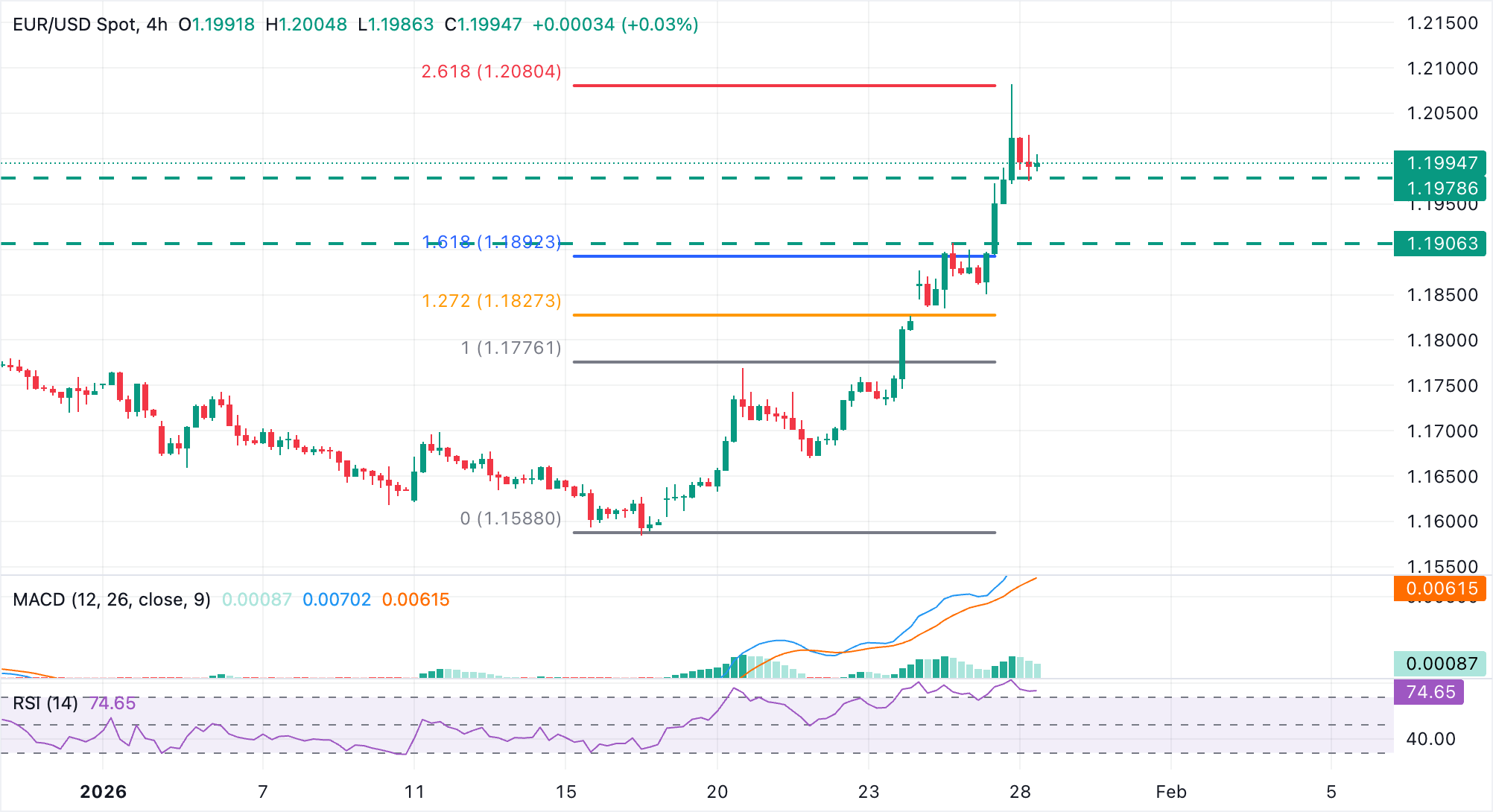
The EUR/USD pair has found resistance at the 251.8% Fibonacci extension of the January 16-20 uptrend, in the 1.2080 area. This is a common exhaustion level, which, together with the oversold momentum indicators, points to a potential correction, or at least some consolidation. Downside attempts, however, remain contained above the 1.1980 so far.
Technical indicators show an overstretched rally. The Moving Average Convergence Divergence (MACD) line keeps trending higher on the 4-hour chart, but the Relative Strength Index (RSI) is well above 70, levels that might cap further advances.
Bears should break intraday lows of 1.1980 to confirm a correction and shift the focus towards the January 26 high at 1.1907. On the upside, above Tuesday's high at 1.2082, there is no clear resistance until the 2021 peak, in the 1.2165 area.
(The technical analysis of this story was written with the help of an AI tool.)
Central banks FAQs
Central Banks have a key mandate which is making sure that there is price stability in a country or region. Economies are constantly facing inflation or deflation when prices for certain goods and services are fluctuating. Constant rising prices for the same goods means inflation, constant lowered prices for the same goods means deflation. It is the task of the central bank to keep the demand in line by tweaking its policy rate. For the biggest central banks like the US Federal Reserve (Fed), the European Central Bank (ECB) or the Bank of England (BoE), the mandate is to keep inflation close to 2%.
A central bank has one important tool at its disposal to get inflation higher or lower, and that is by tweaking its benchmark policy rate, commonly known as interest rate. On pre-communicated moments, the central bank will issue a statement with its policy rate and provide additional reasoning on why it is either remaining or changing (cutting or hiking) it. Local banks will adjust their savings and lending rates accordingly, which in turn will make it either harder or easier for people to earn on their savings or for companies to take out loans and make investments in their businesses. When the central bank hikes interest rates substantially, this is called monetary tightening. When it is cutting its benchmark rate, it is called monetary easing.
A central bank is often politically independent. Members of the central bank policy board are passing through a series of panels and hearings before being appointed to a policy board seat. Each member in that board often has a certain conviction on how the central bank should control inflation and the subsequent monetary policy. Members that want a very loose monetary policy, with low rates and cheap lending, to boost the economy substantially while being content to see inflation slightly above 2%, are called ‘doves’. Members that rather want to see higher rates to reward savings and want to keep a lit on inflation at all time are called ‘hawks’ and will not rest until inflation is at or just below 2%.
Normally, there is a chairman or president who leads each meeting, needs to create a consensus between the hawks or doves and has his or her final say when it would come down to a vote split to avoid a 50-50 tie on whether the current policy should be adjusted. The chairman will deliver speeches which often can be followed live, where the current monetary stance and outlook is being communicated. A central bank will try to push forward its monetary policy without triggering violent swings in rates, equities, or its currency. All members of the central bank will channel their stance toward the markets in advance of a policy meeting event. A few days before a policy meeting takes place until the new policy has been communicated, members are forbidden to talk publicly. This is called the blackout period.
추천 기사


