


EUR/USD extends losses as strong US data buoys the US Dollar
- EUR/USD dips below 1.1630, approaching one-month lows at 1.1618.
- Strong US PPI and Retail Sales data provided an additional impulse to the US Dollar on Wednesday.
- President Trump said that he has no plans to fire Fed's Powell, easing concerns about the bank's independence.
EUR/USD is trading lower for the third consecutive day on Thursday, changing hands at 1.1630 at the time of writing and drawing closer to one-month lows, at 1.1618. The US Dollar (USD) maintains its firm tone, supported by strong US macroeconomic figures and easing concerns about the US Federal Reserve’s (Fed) autonomy.
Economic data from the US released on Wednesday revealed a larger-than-expected acceleration in producer prices and a strong rebound in retail consumption in November, providing further reasons for the Fed to keep interest rates unchanged in the coming months.
Beyond that, US President Donald Trump calmed markets, stating that he has no plan to oust Fed Chairman Jerome Powell despite the criminal investigation against him. Investors’ concerns about the Fed’s independence sent the US Dollar tumbling earlier in the week and prompted most of the world's central bankers to sign a statement defending Powell.
The focus on Thursday will be on November's Eurozone Industrial Production figures. In the American session, the NY Empire State and the Philadelphia Fed manufacturing reports will attract some attention ahead of more speeches from Fed policymakers.
Euro Price Today
The table below shows the percentage change of Euro (EUR) against listed major currencies today. Euro was the strongest against the New Zealand Dollar.
| USD | EUR | GBP | JPY | CAD | AUD | NZD | CHF | |
|---|---|---|---|---|---|---|---|---|
| USD | 0.12% | 0.00% | -0.05% | 0.11% | 0.03% | 0.14% | 0.11% | |
| EUR | -0.12% | -0.11% | -0.18% | -0.01% | -0.10% | 0.01% | -0.01% | |
| GBP | -0.01% | 0.11% | -0.04% | 0.10% | 0.02% | 0.13% | 0.10% | |
| JPY | 0.05% | 0.18% | 0.04% | 0.14% | 0.06% | 0.14% | 0.15% | |
| CAD | -0.11% | 0.00% | -0.10% | -0.14% | -0.07% | 0.02% | 0.00% | |
| AUD | -0.03% | 0.10% | -0.02% | -0.06% | 0.07% | 0.11% | 0.08% | |
| NZD | -0.14% | -0.01% | -0.13% | -0.14% | -0.02% | -0.11% | -0.03% | |
| CHF | -0.11% | 0.00% | -0.10% | -0.15% | -0.01% | -0.08% | 0.03% |
The heat map shows percentage changes of major currencies against each other. The base currency is picked from the left column, while the quote currency is picked from the top row. For example, if you pick the Euro from the left column and move along the horizontal line to the US Dollar, the percentage change displayed in the box will represent EUR (base)/USD (quote).
Daily Digest Market Movers: US PPI and Retail Sales data support the US Dollar
- The US Dollar keeps heading higher against most of its peers, as US macroeconomic data endorses the view that the Fed is likely to keep its monetary policy unchanged in the coming months.
- On Wednesday, November's US Producer Price Index (PPI) report showed inflation accelerated to a 3% year-on-year pace from 2.8% in the previous month, compared to expectations of a slowdown to 2.7%. Likewise, the core PPI rose 3% in the year to November, from 2.9%, also against the market consensus of 2.7%.
- These figures come after Tuesday's Consumer Prices Index (CPI), which showed steady readings in December and revealed that price pressures remain high in the US.
- Also on Wednesday, data from the US Census Bureau showed that Retail Sales grew at a 0.6% pace in November, following a 0.1% decline in October, and beating market expectations of a 0.4% increase. The strong consumption figures add to the case of a strong US economic performance in the last quarter of the year and ease pressure on the Fed to lower borrowing costs further.
- Geopolitical tensions have eased somewhat, as President Trump affirmed that he believes the killings of protesters in Iran have subsided, as US experts warned about the risks of a military intervention against the Islamic Republic. Oil and safe havens like precious metals have pulled back following the comments, which are also likely to weigh on the US Dollar's rally.
- In Europe, later on Thursday, Eurostat will release the Eurozone's Industrial Production data. Factory output is expected to have increased 0.5% in November, following a 0.8% increase in October. Year-on-Year, production is seen growing at a steady 2% pace.
- In the US, the NY Empire State Manufacturing Index and the Philadelphia Fed Manufacturing Survey will provide some insight into the sector's activity ahead of speeches from Atlanta Fed President Raphael Bostic, Governor Michael Barr, Richmond Fed President Thomas Barkin, and Kansas City Fed President Jeffrey Schmid.
Technical Analysis: EUR/USD bears eyes 1.1618 lows
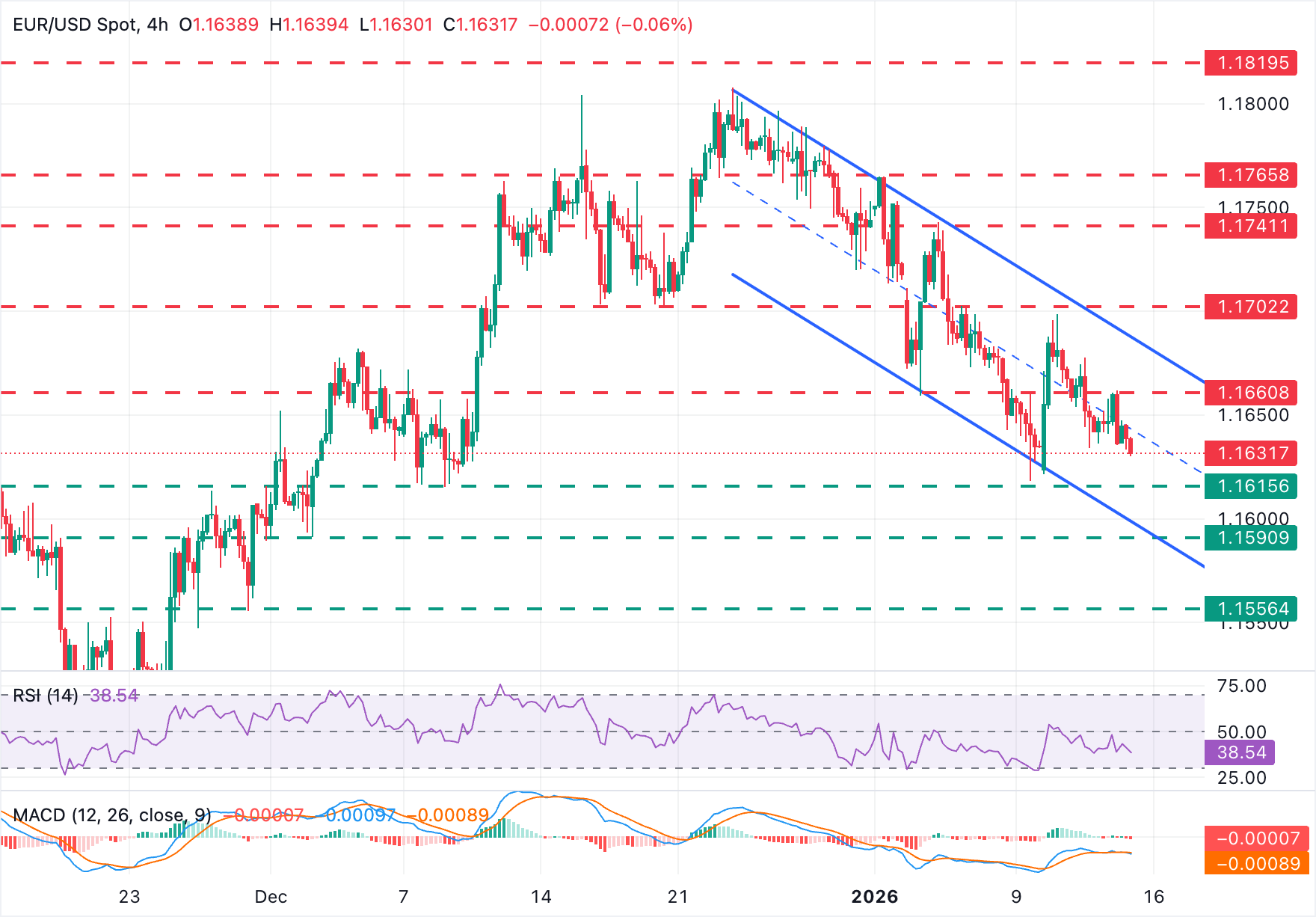
The EUR/USD trades at 1.1631 at the time of writing, extending its reversal from weekly highs near 1.1700 with price action contained within a descending channel since late December. The Moving Average Convergence Divergence (MACD) indicator holds around the zero line on the 4-hour chart, highlighting a neutral tone, while the Relative Strength Index (RSI) is pointing downwards at 38, suggesting increasing bearish momentum.
Bears are aiming for the January 9 low, in the vicinity of 1.1615. Further down, the area between the channel bottom, now around 1.1600, and the December 2 low, at 1.1590, is likely to be targeted. To the upside, Wednesday's high, at 1.1660, might pose some resistance ahead of the channel top, at 1.1690, and the January 12 high, near 1.1700.
(The technical analysis of this story was written with the help of an AI tool.)
Euro FAQs
The Euro is the currency for the 20 European Union countries that belong to the Eurozone. It is the second most heavily traded currency in the world behind the US Dollar. In 2022, it accounted for 31% of all foreign exchange transactions, with an average daily turnover of over $2.2 trillion a day. EUR/USD is the most heavily traded currency pair in the world, accounting for an estimated 30% off all transactions, followed by EUR/JPY (4%), EUR/GBP (3%) and EUR/AUD (2%).
The European Central Bank (ECB) in Frankfurt, Germany, is the reserve bank for the Eurozone. The ECB sets interest rates and manages monetary policy. The ECB’s primary mandate is to maintain price stability, which means either controlling inflation or stimulating growth. Its primary tool is the raising or lowering of interest rates. Relatively high interest rates – or the expectation of higher rates – will usually benefit the Euro and vice versa. The ECB Governing Council makes monetary policy decisions at meetings held eight times a year. Decisions are made by heads of the Eurozone national banks and six permanent members, including the President of the ECB, Christine Lagarde.
Eurozone inflation data, measured by the Harmonized Index of Consumer Prices (HICP), is an important econometric for the Euro. If inflation rises more than expected, especially if above the ECB’s 2% target, it obliges the ECB to raise interest rates to bring it back under control. Relatively high interest rates compared to its counterparts will usually benefit the Euro, as it makes the region more attractive as a place for global investors to park their money.
Data releases gauge the health of the economy and can impact on the Euro. Indicators such as GDP, Manufacturing and Services PMIs, employment, and consumer sentiment surveys can all influence the direction of the single currency. A strong economy is good for the Euro. Not only does it attract more foreign investment but it may encourage the ECB to put up interest rates, which will directly strengthen the Euro. Otherwise, if economic data is weak, the Euro is likely to fall. Economic data for the four largest economies in the euro area (Germany, France, Italy and Spain) are especially significant, as they account for 75% of the Eurozone’s economy.
Another significant data release for the Euro is the Trade Balance. This indicator measures the difference between what a country earns from its exports and what it spends on imports over a given period. If a country produces highly sought after exports then its currency will gain in value purely from the extra demand created from foreign buyers seeking to purchase these goods. Therefore, a positive net Trade Balance strengthens a currency and vice versa for a negative balance.
추천 기사


