




EUR/USD rallies from lows with Fed's independence into question
- EUR/USD rallies to session highs near 1.1700 after bouncing from 1.1620 lows.
- Concerns about the Fed's independence are hammering confidence in the US Dollar.
- The rising tensions in Iran are keeping the Greenback from depreciating further.
EUR/USD jumped 0.35% on Monday's Asian trading session, and is trading near 1.1680 at the time of writing, after bouncing from one-month lows at 1.1620. News that the US government is attempting to initiate a criminal investigation into Federal Reserve (Fed) Chairman Jerome Powell has hammered the US Dollar (USD). However, the growing tensions in Iran support the safe-haven USD keeping a lid on Euro (EUR) rallies.
The New York Times has reported that Powell is under criminal investigation for his testimony before the Senate Committee regarding renovations to a Federal Reserve building. Powell has responded with a video, stating that the investigation is “unprecedented” and framing it as a series of threats aimed at bending the central bank's arm into lowering interest rates.
The economic calendar is thin on Monday, but in this context, the speech from Atlanta Fed President Raphael Bostic will be observed with particular interest. Later this week, the release of the US Consumer Price Index (CPI) data, due on Tuesday, and a slew of speeches from Fed Officials might shed more light on the Fed's interest rate-cut path. On Wednesday, the US Supreme Court's ruling on US President Donald Trump's tariffs might also have a significant impact on the US Dollar.
Euro Price Today
The table below shows the percentage change of Euro (EUR) against listed major currencies today. Euro was the strongest against the US Dollar.
| USD | EUR | GBP | JPY | CAD | AUD | NZD | CHF | |
|---|---|---|---|---|---|---|---|---|
| USD | -0.40% | -0.25% | -0.02% | -0.25% | -0.23% | -0.33% | -0.53% | |
| EUR | 0.40% | 0.15% | 0.37% | 0.15% | 0.16% | 0.07% | -0.13% | |
| GBP | 0.25% | -0.15% | 0.23% | 0.00% | 0.02% | -0.08% | -0.28% | |
| JPY | 0.02% | -0.37% | -0.23% | -0.23% | -0.22% | -0.31% | -0.51% | |
| CAD | 0.25% | -0.15% | -0.00% | 0.23% | 0.02% | -0.08% | -0.28% | |
| AUD | 0.23% | -0.16% | -0.02% | 0.22% | -0.02% | -0.10% | -0.30% | |
| NZD | 0.33% | -0.07% | 0.08% | 0.31% | 0.08% | 0.10% | -0.20% | |
| CHF | 0.53% | 0.13% | 0.28% | 0.51% | 0.28% | 0.30% | 0.20% |
The heat map shows percentage changes of major currencies against each other. The base currency is picked from the left column, while the quote currency is picked from the top row. For example, if you pick the Euro from the left column and move along the horizontal line to the US Dollar, the percentage change displayed in the box will represent EUR (base)/USD (quote).
Daily Digest Market Movers: US Dollar tumbles with Fed's independence into question
- The criminal probe against Fed Chairman Powell marks a new stage in the unprecedented political pressures on the central bank and a message to the next Fed chair. This undermines the central bank's independence to set its monetary policy and erodes the US Dollar's status as a reserve currency.
- Meanwhile, tensions in Iran continue growing. News reported that the Islamic regime's response to the protests in the country has caused hundreds of deaths, and Tehran has threatened to target US military bases if they detect signs of an impending attack.
- On the macroeconomic front, data released on Friday revealed that the US labour market remains stalled but not deteriorating further. The jobless rate declined beyond expectations, adding to the case that the Fed will keep interest rates unchanged at its next monetary policy meeting, due on January 27 and 28.
- Beyond that, January's preliminary Michigan Consumer Sentiment Index rose to 54.0, from 52.9 in December, beyond the 53.5 reading expected by the market. These figures show the second consecutive improvement, which points to a stronger economic outlook and supports the idea of a steady monetary policy at January's Fed meeting.
- In the Eurozone, the only event worth mentioning on Monday is the Sentix Investors' Confidence Index, which has been showing negative numbers since August. The impact of this release, however, is likely to be limited as investors' focus remains on the US Federal Reserve and the tensions between the US and Iran.
Technical Analysis: EUR/USD recovery is likely to be tested at the 1.1700 area
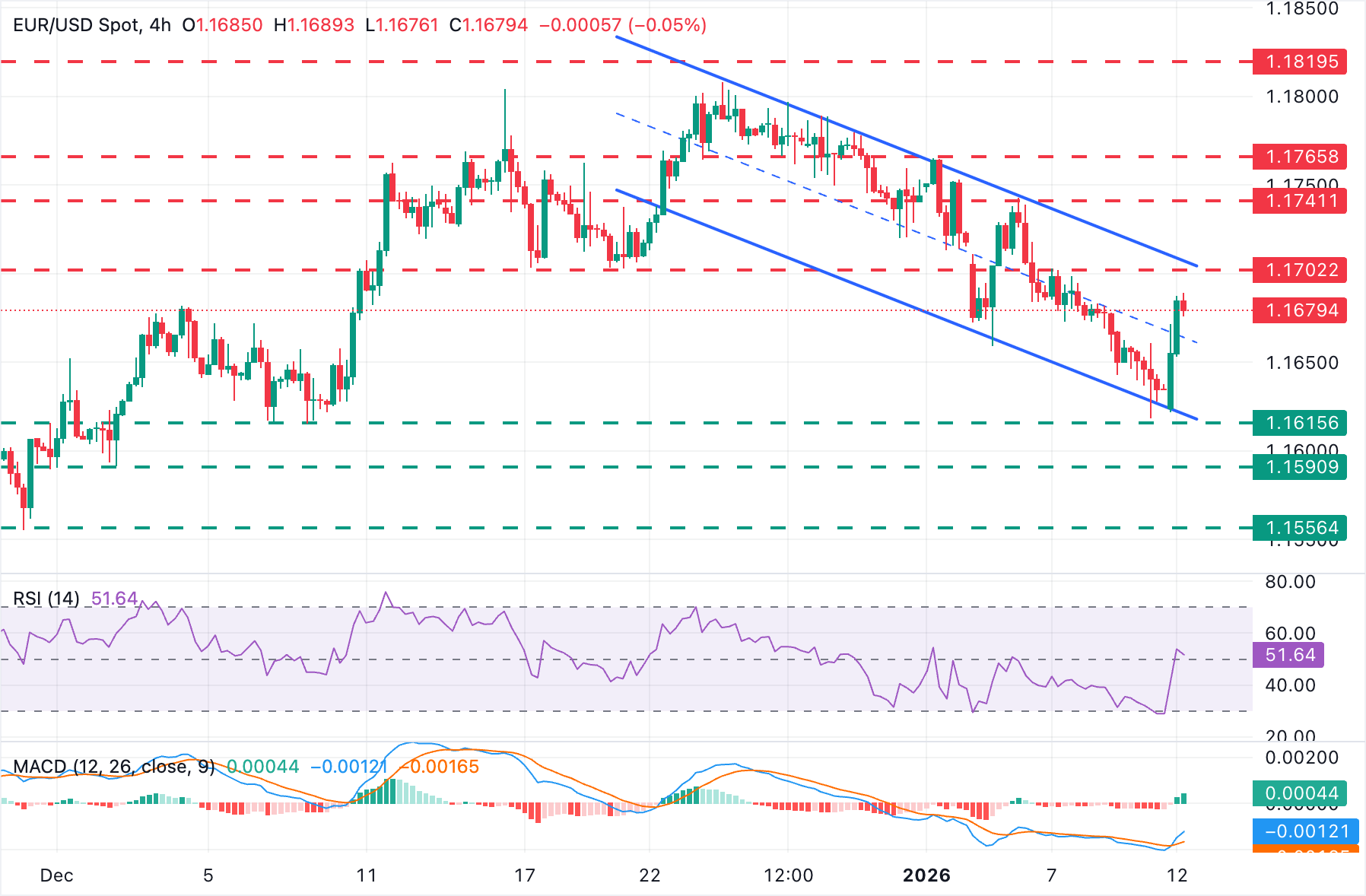
EUR/USD has bounced up strongly from one-month lows at the 1.1620 area. The pair remains trading within a descending channel from late-December highs, but technical indicators on the 4-hour chart have turned higher.
The Moving Average Convergence Divergence (MACD) line has crossed above the signal line, hinting at a fading bearish pressure, while the Relative Strength Index (RSI) has breached the key 50 level, signaling some momentum improvement.
On the upside, the pair is likely to find significant resistance at the confluence of the channel's top with the January 7 high, near 1.1700. Above here, the target is the January 6 high, at 1.1742. To the downside, the pair has a significant support above 1.1615 (December 8 and 9 lows) ahead of the December 2 low, near 1.1590.
(The technical analysis of this story was written with the help of an AI tool.)
Fed FAQs
Monetary policy in the US is shaped by the Federal Reserve (Fed). The Fed has two mandates: to achieve price stability and foster full employment. Its primary tool to achieve these goals is by adjusting interest rates. When prices are rising too quickly and inflation is above the Fed’s 2% target, it raises interest rates, increasing borrowing costs throughout the economy. This results in a stronger US Dollar (USD) as it makes the US a more attractive place for international investors to park their money. When inflation falls below 2% or the Unemployment Rate is too high, the Fed may lower interest rates to encourage borrowing, which weighs on the Greenback.
The Federal Reserve (Fed) holds eight policy meetings a year, where the Federal Open Market Committee (FOMC) assesses economic conditions and makes monetary policy decisions. The FOMC is attended by twelve Fed officials – the seven members of the Board of Governors, the president of the Federal Reserve Bank of New York, and four of the remaining eleven regional Reserve Bank presidents, who serve one-year terms on a rotating basis.
In extreme situations, the Federal Reserve may resort to a policy named Quantitative Easing (QE). QE is the process by which the Fed substantially increases the flow of credit in a stuck financial system. It is a non-standard policy measure used during crises or when inflation is extremely low. It was the Fed’s weapon of choice during the Great Financial Crisis in 2008. It involves the Fed printing more Dollars and using them to buy high grade bonds from financial institutions. QE usually weakens the US Dollar.
Quantitative tightening (QT) is the reverse process of QE, whereby the Federal Reserve stops buying bonds from financial institutions and does not reinvest the principal from the bonds it holds maturing, to purchase new bonds. It is usually positive for the value of the US Dollar.
추천 기사


