

EUR/USD dives further as US Dollar rallies ahead of a data-packed week
- EUR/USD hits four-week lows below 1.1700 amid the US Dollar's strength.
- FX markets are looking beyond the geopolitical tensions after the US intervention in Venezuela
- Investors await a slew of US macroeconomic data for further insight into the Fed easing calendar.
EUR/USD has opened the week on the same soft tone that closed the previous one. The pair trades at four-week lows of 1.1690 at the time of writing, with traders trying to look ahead to the US intervention in Venezuela into a slew of key US macroeconomic releases due later in the week.
Venezuelan President Nicolas Maduro is expected to appear in a US court later on Monday, after being captured by US forces over the weekend, and US President Donald Trump has warned about the possibility of further attacks on the country if the authorities do not cooperate with US plans to open up the country's Oil industry and stop drug trafficking.
Market sentiment, however, has hardly been affected by the weekend's events. The main Asian indices have been trading higher, and European markets are pointing to a mildly positive opening.
In FX markets, the trend of a stronger US Dollar (USD) observed late last week has extended into this one. Upbeat US home sales and Jobless Claims data last week strengthened the US Federal Reserve's (Fed) stance of a very gradual easing cycle, and investors are awaiting key economic releases this week, including the key US Nonfarm Payrolls report on Friday, to confirm that view.
Before that, the European Sentix Investors Confidence Index and the US ISM Manufacturing Purchasing Managers' Index (PMI) are expected to drive the pair on Monday.
Euro Price Today
The table below shows the percentage change of Euro (EUR) against listed major currencies today. Euro was the strongest against the Canadian Dollar.
| USD | EUR | GBP | JPY | CAD | AUD | NZD | CHF | |
|---|---|---|---|---|---|---|---|---|
| USD | 0.23% | 0.17% | 0.09% | 0.25% | 0.22% | 0.19% | 0.18% | |
| EUR | -0.23% | -0.07% | -0.11% | 0.02% | -0.01% | -0.04% | -0.05% | |
| GBP | -0.17% | 0.07% | -0.06% | 0.08% | 0.06% | 0.03% | 0.01% | |
| JPY | -0.09% | 0.11% | 0.06% | 0.15% | 0.13% | 0.10% | 0.09% | |
| CAD | -0.25% | -0.02% | -0.08% | -0.15% | -0.03% | -0.05% | -0.07% | |
| AUD | -0.22% | 0.00% | -0.06% | -0.13% | 0.03% | -0.03% | -0.04% | |
| NZD | -0.19% | 0.04% | -0.03% | -0.10% | 0.05% | 0.03% | -0.01% | |
| CHF | -0.18% | 0.05% | -0.01% | -0.09% | 0.07% | 0.04% | 0.01% |
The heat map shows percentage changes of major currencies against each other. The base currency is picked from the left column, while the quote currency is picked from the top row. For example, if you pick the Euro from the left column and move along the horizontal line to the US Dollar, the percentage change displayed in the box will represent EUR (base)/USD (quote).
Daily Digest Market Movers: US Dollar gains as investors reassess Fed easing bets
- The US Dollar has opened 2026 on a strong note. Last week, US Pending Home Sales and US Jobless Claims figures beat expectations, and the US S&P Global Manufacturing PMI confirmed a moderate growth of the sector's activity and endorsed the Fed hawks' view supporting a cautious approach to interest rate cuts, considering the sticky inflationary pressures.
- The growing geopolitical tensions after the attack on Venezuela have had a minor impact on markets so far. Stocks rose in Asia, and Oil prices fell in a sign that investors are looking beyond Maduro's capture, focusing on the US economic figures, due to be released this week
- In Europe, the most relevant release on Monday will be January's Sentix Investor Confidence reading. The index analyzes institutional investors' views on the current economic situation, which has shown negative readings since August, reflecting a downbeat sentiment.
- The US calendar opens this week with the ISM Manufacturing PMI, which is expected to show a minor improvement to 48.3 in December from 48.2 in the previous month.
- The highlight of the week, however, will be December's Nonfarm Payrolls report, which will be observed with interest to assess the momentum of the US labour market and will provide further insight into the Fed's interest rate path.
Technical Analysis: EUR/USD is clinging on 1.1670 support
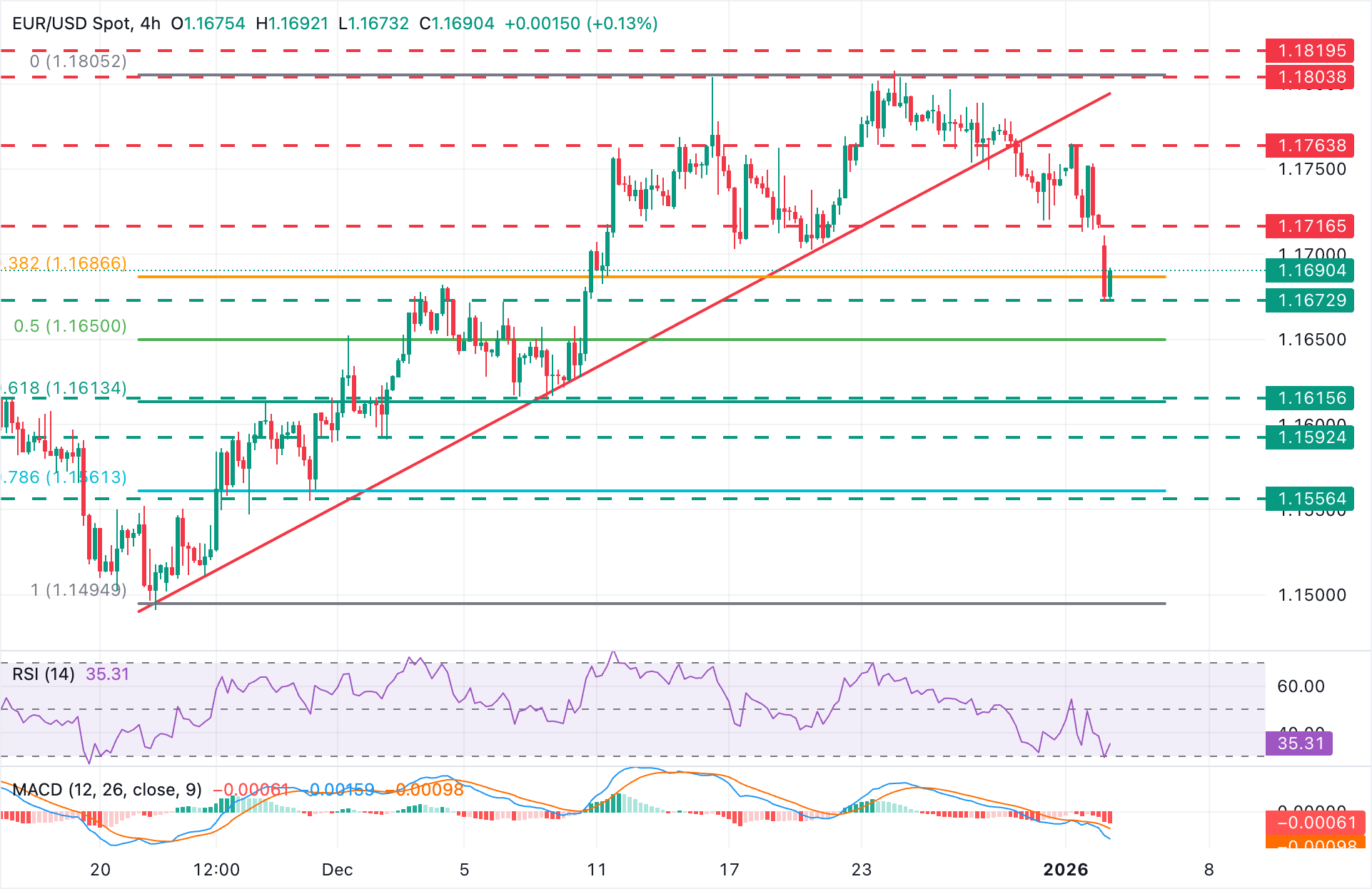
The EUR/USD has extended its correction from 1.1800 highs to four-week lows below 1.1700, and technical indicators point to further decline. The 4-hour Relative Strength Index (RSI) is near 35, and the Moving Average Convergence Divergence (MACD) is printing red bars, highlighting a strong bearish momentum.
The pair has found support near 1.1670, but so far, it seems unable to post any significant recovery. Further down, the 50% Fibonacci retracement of the November-December rally, at 1.1650, might provide support ahead of the 1.1615 area, where the December 8 and 9 lows meet the 61.8% Fibonacci retracement of the mentioned cycle.
A bullish reaction should breach previous support levels at the 1.1715-1.1720 area (December 31, January 2 lows) to ease negative pressure and aim for the January 2 high, at 1.1765.
Risk sentiment FAQs
In the world of financial jargon the two widely used terms “risk-on” and “risk off'' refer to the level of risk that investors are willing to stomach during the period referenced. In a “risk-on” market, investors are optimistic about the future and more willing to buy risky assets. In a “risk-off” market investors start to ‘play it safe’ because they are worried about the future, and therefore buy less risky assets that are more certain of bringing a return, even if it is relatively modest.
Typically, during periods of “risk-on”, stock markets will rise, most commodities – except Gold – will also gain in value, since they benefit from a positive growth outlook. The currencies of nations that are heavy commodity exporters strengthen because of increased demand, and Cryptocurrencies rise. In a “risk-off” market, Bonds go up – especially major government Bonds – Gold shines, and safe-haven currencies such as the Japanese Yen, Swiss Franc and US Dollar all benefit.
The Australian Dollar (AUD), the Canadian Dollar (CAD), the New Zealand Dollar (NZD) and minor FX like the Ruble (RUB) and the South African Rand (ZAR), all tend to rise in markets that are “risk-on”. This is because the economies of these currencies are heavily reliant on commodity exports for growth, and commodities tend to rise in price during risk-on periods. This is because investors foresee greater demand for raw materials in the future due to heightened economic activity.
The major currencies that tend to rise during periods of “risk-off” are the US Dollar (USD), the Japanese Yen (JPY) and the Swiss Franc (CHF). The US Dollar, because it is the world’s reserve currency, and because in times of crisis investors buy US government debt, which is seen as safe because the largest economy in the world is unlikely to default. The Yen, from increased demand for Japanese government bonds, because a high proportion are held by domestic investors who are unlikely to dump them – even in a crisis. The Swiss Franc, because strict Swiss banking laws offer investors enhanced capital protection.
추천 기사


