

USD/INR ticks up as FIIs continue to offload stake in Indian stock market
- The Indian Rupee edges down against the US Dollar as FIIs continue to pare stake in the Indian equity market.
- Indian Rupee’s forward premiums correct after the RBI announces 3-year $10 billion USD/INR buy-sell swap.
- The US Q3 GDP unexpectedly expanded at a robust pace of 4.3%.
The Indian Rupee (INR) ticks down against the US Dollar (USD) in the early trading session on Wednesday. The USD/INR pair edges higher to near 90.16, but is broadly in the corrective phase, following the Reserve Bank of India’s (RBI) intervention last week.
The RBI sold US Dollars in the spot and Non-Deliverable Forward (NDF) market in two trading days: Wednesday and Friday, last week to support the Indian Rupee against one-way depreciation.
However, investors refrain from relying on the Indian Rupee’s recovery as Foreign Institutional Investors (FIIs) continue to offload their stake in the Indian stock market. So far in December, FIIs have remained net sellers in 14 out of 17 trading days, and have sold shares worth Rs. 22,109.51 crore.
Market experts believe that overseas investors are unlikely to return to the Indian equity market until a bilateral deal between the United States (US) and India is announced.
Meanwhile, the USD/INR January month-end forward premium has eased to 41 paisa from a peak of 58 paisa seen on Tuesday after the Reserve Bank of India (RBI) announced on Tuesday that it would conduct a 3-year $10 billion USD/INR buy-sell swap next month, Reuters reported.
Daily Digest Market Movers: The Fed is expected to cut interest rates by at least 50 bps in 2026
- The Indian Rupee falls marginally against the US Dollar, even as the latter trades vulnerably due to firm expectations that the Federal Reserve (Fed) will deliver at least 50 basis points (bps) reduction in interest rates in 2026.
- In Asian trading hours, the US Dollar Index (DXY), which tracks the Greenback’s value against six major currencies, posts a fresh 11-week low at 97.75.
- The CME FedWatch tool shows the odds of the Fed reducing interest rates at least 50 bps in 2026 are 70.6%. Market speculation towards the scope of US interest rate cuts is higher than what the Fed signaled in its dot plot last week. The Fed’s dot plot showed that policymakers collectively see the Federal Funds Rate heading to 3.4% by the end of 2026, indicating that there won’t be more than one interest rate cut.
- Fed dovish expectations are intensified due to weak job market conditions and hopes that tariffs won’t de-anchor inflation expectations.
- Meanwhile, surprisingly upbeat US Q3 Gross Domestic Product (GDP) data has failed to deliver a material impact on Fed dovish speculation. The GDP report showed on Tuesday that the economy grew at an annualized pace of 4.3%, stronger than 3.8% in the second quarter. Economists expected the GDP growth to come in lower at 3.3%.
- Going forward, the US Dollar is expected to trade on the sidelines amid holidays in the FX market on account of Christmas and Boxing Day.
Technical Analysis: USD/INR struggles to return above 20-day EMA
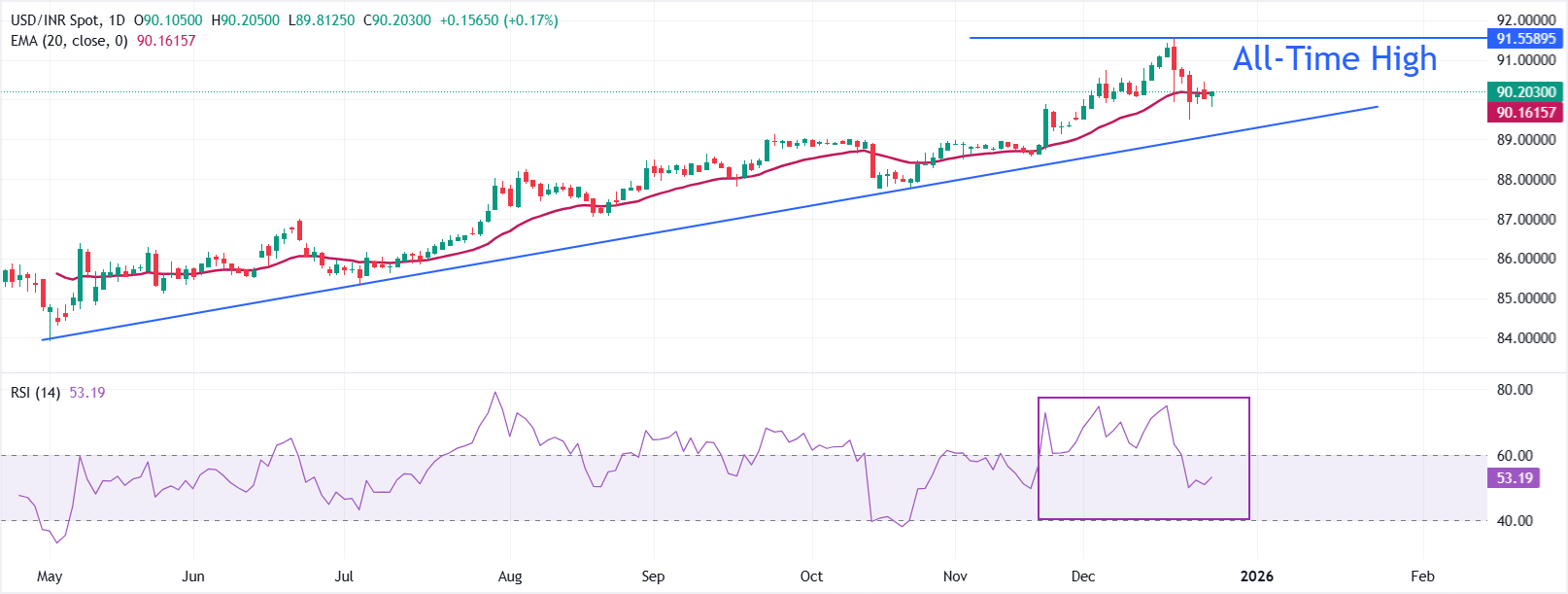
In the daily chart, USD/INR trades at 90.2085. It holds above the 20-day EMA at 90.1621, though the average has begun to flatten after a steady climb, preserving a mild bullish bias. RSI at 53 (neutral) reflects cooled momentum from prior overbought readings. The rising trend line from 83.9428 underpins the setup, with support aligning near 89.1667. Holding above the average keeps the bias positive, while a close below trend support would turn the tone lower.
Momentum has eased, yet the broader uptrend remains anchored by trend support. RSI near the midline lacks directional impulse; a push back into the 60s would reinforce bullish appetite. While the structure holds, pullbacks would attract buyers, and the pair could extend higher. A break of the supporting line would open the door to a deeper retracement.
(The technical analysis of this story was written with the help of an AI tool)
Indian Rupee FAQs
The Indian Rupee (INR) is one of the most sensitive currencies to external factors. The price of Crude Oil (the country is highly dependent on imported Oil), the value of the US Dollar – most trade is conducted in USD – and the level of foreign investment, are all influential. Direct intervention by the Reserve Bank of India (RBI) in FX markets to keep the exchange rate stable, as well as the level of interest rates set by the RBI, are further major influencing factors on the Rupee.
The Reserve Bank of India (RBI) actively intervenes in forex markets to maintain a stable exchange rate, to help facilitate trade. In addition, the RBI tries to maintain the inflation rate at its 4% target by adjusting interest rates. Higher interest rates usually strengthen the Rupee. This is due to the role of the ‘carry trade’ in which investors borrow in countries with lower interest rates so as to place their money in countries’ offering relatively higher interest rates and profit from the difference.
Macroeconomic factors that influence the value of the Rupee include inflation, interest rates, the economic growth rate (GDP), the balance of trade, and inflows from foreign investment. A higher growth rate can lead to more overseas investment, pushing up demand for the Rupee. A less negative balance of trade will eventually lead to a stronger Rupee. Higher interest rates, especially real rates (interest rates less inflation) are also positive for the Rupee. A risk-on environment can lead to greater inflows of Foreign Direct and Indirect Investment (FDI and FII), which also benefit the Rupee.
Higher inflation, particularly, if it is comparatively higher than India’s peers, is generally negative for the currency as it reflects devaluation through oversupply. Inflation also increases the cost of exports, leading to more Rupees being sold to purchase foreign imports, which is Rupee-negative. At the same time, higher inflation usually leads to the Reserve Bank of India (RBI) raising interest rates and this can be positive for the Rupee, due to increased demand from international investors. The opposite effect is true of lower inflation.
추천 기사


