


EUR/USD picks up with US employment, Fed monetary policy decision in focus
- The Euro shows minor gains but remains capped below 1.1650 against the US Dollar.
- The Dollar holds onto Monday's gains, buoyed by higher US Treasury yields.
- EUR/USD has broken below a near-term trendline support.
EUR/USD posts marginal gains on Tuesday, trading at 1.1650 at the time of writing, after bouncing from 1.1616 lows seen on Monday. From a wider perspective, however, the pair trades in a choppy manner, with investors wary of placing clear directional bets ahead of the Federal Reserve's monetary policy decision on Wednesday.
Futures markets are pricing a nearly 90% chance that the US central bank will cut rates by 25 basis points after their two-day meeting, according to the CME Group's Fedwatch Tool. The main attraction of the event will be the tone of the monetary policy statement, the potential changes in the interest rate projections (the dot plot), and Chairman Jerome Powell's press conference for a better assessment of what comes next.
Before that, the US weekly ADP Employment Change report and the JOLTS Job Openings will provide valuable insight into the health of the US labour market, which might be of particular relevance this time as November's Nonfarm Payrolls report will not be released until next week.
Euro Price Today
The table below shows the percentage change of Euro (EUR) against listed major currencies today. Euro was the strongest against the Japanese Yen.
| USD | EUR | GBP | JPY | CAD | AUD | NZD | CHF | |
|---|---|---|---|---|---|---|---|---|
| USD | -0.05% | -0.05% | 0.06% | -0.01% | -0.26% | -0.11% | -0.11% | |
| EUR | 0.05% | 0.00% | 0.07% | 0.04% | -0.21% | -0.02% | -0.07% | |
| GBP | 0.05% | -0.00% | 0.10% | 0.04% | -0.22% | -0.06% | -0.06% | |
| JPY | -0.06% | -0.07% | -0.10% | -0.06% | -0.30% | -0.16% | -0.16% | |
| CAD | 0.01% | -0.04% | -0.04% | 0.06% | -0.25% | -0.11% | -0.10% | |
| AUD | 0.26% | 0.21% | 0.22% | 0.30% | 0.25% | 0.15% | 0.17% | |
| NZD | 0.11% | 0.02% | 0.06% | 0.16% | 0.11% | -0.15% | -0.00% | |
| CHF | 0.11% | 0.07% | 0.06% | 0.16% | 0.10% | -0.17% | 0.00% |
The heat map shows percentage changes of major currencies against each other. The base currency is picked from the left column, while the quote currency is picked from the top row. For example, if you pick the Euro from the left column and move along the horizontal line to the US Dollar, the percentage change displayed in the box will represent EUR (base)/USD (quote).
Daily Digest Market Movers: The Dollar treads water ahead of the Fed
- The US Dollar (USD) broadly holds onto Monday's gains, which were buoyed by higher US Treasury yields and risk-aversion after news of an earthquake in Japan. Overall, the US Dollar Index (DXY) has remained moving sideways near six-week lows at the 98.75 area.
- Investors are looking from the sidelines, awaiting Wednesday's Fed meeting to provide further clues about the bank's path forward. Chairman Jerome Powell is expected to strike a hawkish note after the meeting, hinting at a pause over the coming months, but the wide division within the committee and speculation that the White House advisor Kevin Hassett will replace him in May, are likely to keep hopes of further monetary easing alive.
- A 7.5-magnitude earthquake hit the north of Japan on Monday, prompting authorities to evacuate thousands of residents and launching a tsunami warning that, later on, was downgraded to an advisory. The first official data from the Japanese government says that 13 people have been injured, but figures are still tentative.
- During the US session on Tuesday, the focus will be on the US JOLTS Job Openings data from both September and October, which are expected to have remained broadly steady, with 7.2 million openings in both months, following the 7.22 million seen in August.
- In the Eurozone, the only event worth noting on Tuesday will be a speech by Bundesbank President and ECB Council member, Joachim Nagel, who is likely to reiterate that the bank is in a good place and that monetary policy will remain unchanged for some time.
- Data released on Monday revealed that the Eurozone Sentix Investors Sentiment Index improved in December to -6.2 from -7.4 in November. The index measuring investors' sentiment about the current economic situation rose to -16.5 from -17.5 in the previous month, with the economic expectations showing the largest improvement, to 4.8, from 3.3 in November. The impact on the Euro, however, was marginal.
- ECB board member Isabel Schnabel affirmed earlier on Monday that she feels comfortable with investors' bets that the central bank's next move will be a rate hike, but the Latvian Central Bank Governour and ECB board member Martins Kazaks denied that the rate hike might come in December.
Technical Analysis: EUR/USD dropped above trendline support
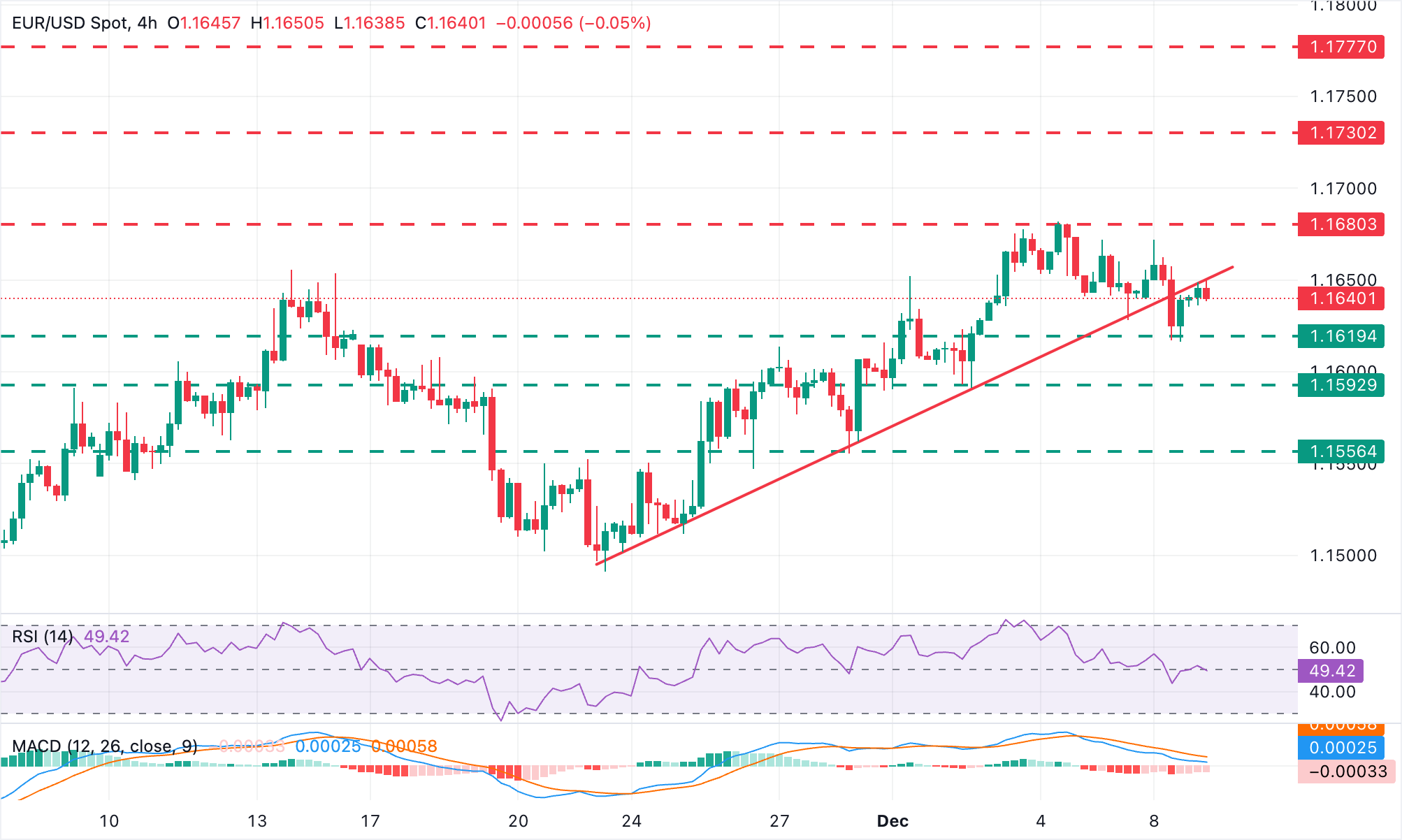
EUR/USD maintains its bullish trend from mid-November lows intact, but Monday's decline led prices to trade below the trendline support, which is a sign of weakness. Technical indicators are also turning lower: the 4-hour Relative Strength Index (RSI) has pulled back below the key 50 level, and the Moving Average Convergence Divergence (MACD) keeps trending lower underneath the signal line.
Failure to regain the mentioned trendline, now at 1.1650, is likely to increase pressure towards Monday's low at 1.1616 ahead of the December 1 and 2 lows around 1.1590 and the November 26 and 28 lows in the 1.1550-1.1555 area.
A bullish move above 1.1650, on the contrary, would bring the December 4 high at around 1.1680 into focus. Further up, the next target is the October 17 high, near 1.1730.
Fed FAQs
Monetary policy in the US is shaped by the Federal Reserve (Fed). The Fed has two mandates: to achieve price stability and foster full employment. Its primary tool to achieve these goals is by adjusting interest rates. When prices are rising too quickly and inflation is above the Fed’s 2% target, it raises interest rates, increasing borrowing costs throughout the economy. This results in a stronger US Dollar (USD) as it makes the US a more attractive place for international investors to park their money. When inflation falls below 2% or the Unemployment Rate is too high, the Fed may lower interest rates to encourage borrowing, which weighs on the Greenback.
The Federal Reserve (Fed) holds eight policy meetings a year, where the Federal Open Market Committee (FOMC) assesses economic conditions and makes monetary policy decisions. The FOMC is attended by twelve Fed officials – the seven members of the Board of Governors, the president of the Federal Reserve Bank of New York, and four of the remaining eleven regional Reserve Bank presidents, who serve one-year terms on a rotating basis.
In extreme situations, the Federal Reserve may resort to a policy named Quantitative Easing (QE). QE is the process by which the Fed substantially increases the flow of credit in a stuck financial system. It is a non-standard policy measure used during crises or when inflation is extremely low. It was the Fed’s weapon of choice during the Great Financial Crisis in 2008. It involves the Fed printing more Dollars and using them to buy high grade bonds from financial institutions. QE usually weakens the US Dollar.
Quantitative tightening (QT) is the reverse process of QE, whereby the Federal Reserve stops buying bonds from financial institutions and does not reinvest the principal from the bonds it holds maturing, to purchase new bonds. It is usually positive for the value of the US Dollar.
추천 기사


