

EUR/USD skyrockets as US jobs data triggers Fed rate cut bets
- EUR/USD rallies from 1.1391 to 1.1554, gaining over 1% on Friday.
- July Nonfarm Payrolls show just 73K jobs added; May–June revisions slash 258K jobs.
- Fed funds futures price in 62 bps of easing by December; 76% odds of a September rate cut.
- EU inflation data beats forecasts: HICP at 2.4% YoY, core HICP steady at 2.0%.
The EUR/USD surges more than 1% on Friday as the Greenback gets battered on a worse-than-expected jobs report in the United States (US), which triggered investors' reaction to price in two interest rate cuts by the Federal Reserve (Fed). Data across the pond was shrugged off by traders, which sent the pair from around lows of 1.1391 toward 1.1597.
Wall Street extended its losses amidst fears of an economic slowdown in the US. July Nonfarm Payroll (NFP) figures were expected to be weaker compared to June’s, but the downward revisions of the previous two months, alongside last month's print, drove the EUR/USD higher.
Alongside this, the Institute for Supply Management (ISM) revealed that manufacturing activity contracted. Meanwhile, the University of Michigan (UoM) Consumer Sentiment in June deteriorated, ending a bad day of economic reports for the US economy.
Following the NFP, traders immediately rushed to price in interest cuts by the Fed. Before the announcement, investors expected 34 bps of easing. At the time of writing, the CBOT December 2025 fed funds rate contract shows nearly 62 bps of easing towards the year’s end.
The odds for a 25 bps rate cut by the Fed at the September meeting are at 76%, according to Prime Market Terminal data.
Across the pond, the European Union’s July Harmonized Index of Consumer Prices (HICP) came in unchanged at 2.4% YoY, defying expectations for a slight dip to 2.3%. Core HICP remained steady at 2.0%, slightly above the 1.9% forecast, suggesting that underlying inflationary pressures remain firm.
Daily digest market movers: The Euro jumps on broad US Dollar weakness
- US Nonfarm Payrolls increased by just 73K in July, a sharp slowdown from June’s 147K and well below the 110K expected. The Unemployment Rate edged up to 4.2% from 4.1%, in line with forecasts. Meanwhile, Average Hourly Earnings rose 3.9% YoY, up from 3.7% in June and slightly above the expected 3.8%, indicating lingering wage pressure despite weaker hiring.
- Following the latest round of economic data, the Fed’s parade began. Cleveland Fed President Beth Hammack described the July Nonfarm Payrolls report as “disappointing,” but noted that the labor market remains broadly balanced. She added that she remains “confident in the decision made earlier this week” to hold rates steady.
- Meanwhile, Atlanta Fed President Raphael Bostic acknowledged that the labor market is slowing from previously strong levels. He emphasized that inflation risks remain more pressing than employment concerns and reiterated his support for just one rate cut, maintaining a broadly hawkish stance.
- The ISM Manufacturing PMI declined to 48.0 in July from 49.0, marking the fifth consecutive month of contraction after two brief months of expansion that followed a prolonged 26-month downturn. The reading missed expectations of 49.5. Notably, the Employment sub-index contracted further, while the Prices Paid component indicated easing cost pressures.
- Meanwhile, Consumer Sentiment improved for a second straight month, though slightly below the preliminary estimate—easing to 61.7 from 61.8. Inflation expectations were revised higher for the 1-year outlook to 4.5% (from 4.4%), while the 5-year outlook fell to 3.4% from 3.6%, suggesting households remain cautiously optimistic about long-term price stability.
- Other data in the EU revealed that the HCOB Manufacturing Flash PMI in the EU improved for the whole bloc, Spain, and Italy, with the latter remaining in contractionary territory. Contrarily, Germany and France sank further into negative territory.
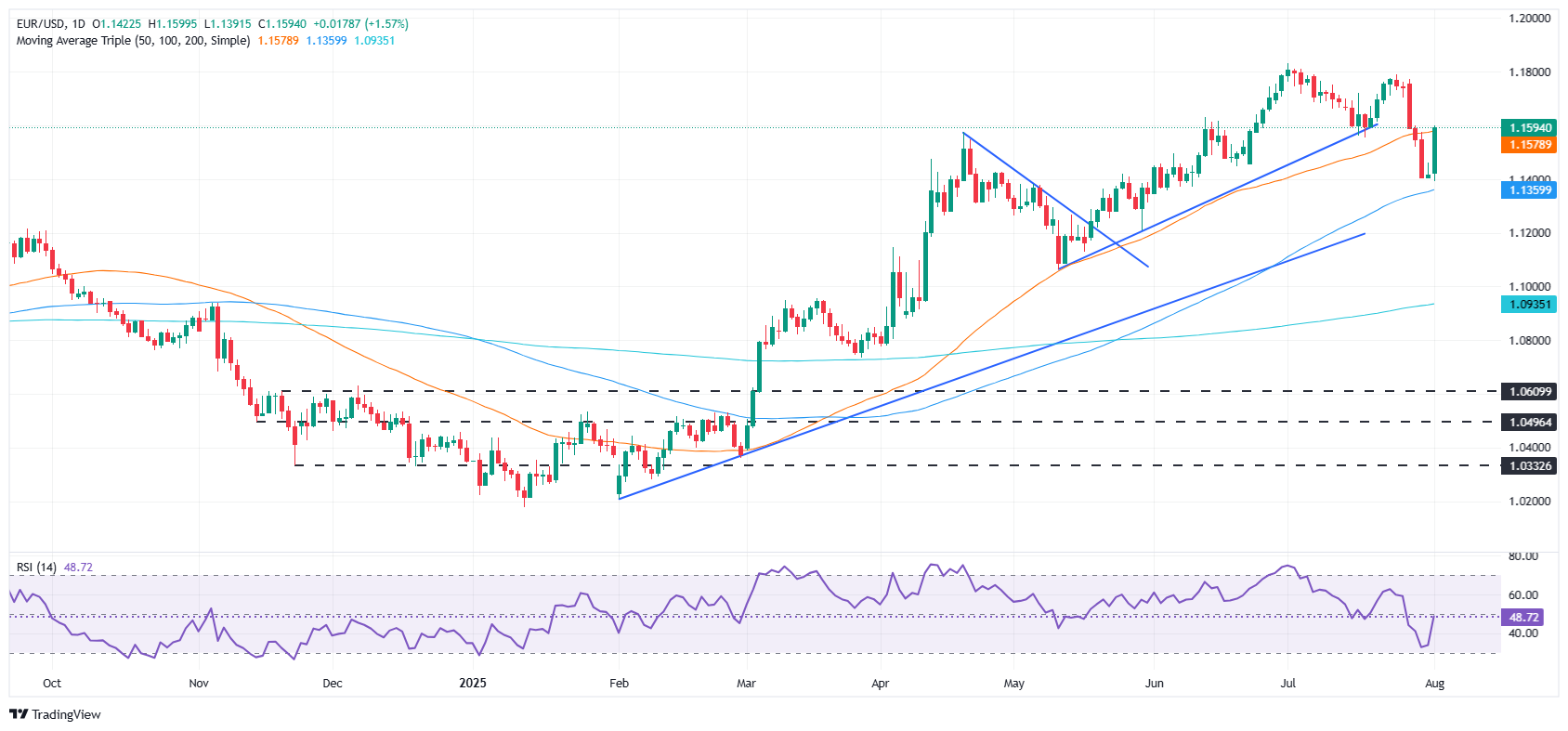
Technical outlook: EUR/USD upside clears above 1.1600, with bulls eyeing 1.1650
The formation of a ‘morning star’ candlestick chart pattern indicates that the EUR/USD might resume its uptrend, but it would face key resistance at 1.1600. The Relative Strength Index (RSI) bounced off nearly oversold territory, closing into its neutral line. That said, a cross above 50 would confirm that buyers are in charge.
If EUR/USD clears the 20-day Simple Moving Average (SMA) at 1.1645, a move to 1.1700 is on the cards. On further strength, the next key resistance will be 1.1800 and the year-to-date (YTD) high at 1.1830.
On the flipside, a drop below the 50-day SMA at 1.1576 clears the way to 1.1550, subsequently followed by the 1.1500 figure. The next area of interest would be August’s low of 1.1391.
Euro FAQs
The Euro is the currency for the 19 European Union countries that belong to the Eurozone. It is the second most heavily traded currency in the world behind the US Dollar. In 2022, it accounted for 31% of all foreign exchange transactions, with an average daily turnover of over $2.2 trillion a day. EUR/USD is the most heavily traded currency pair in the world, accounting for an estimated 30% off all transactions, followed by EUR/JPY (4%), EUR/GBP (3%) and EUR/AUD (2%).
The European Central Bank (ECB) in Frankfurt, Germany, is the reserve bank for the Eurozone. The ECB sets interest rates and manages monetary policy. The ECB’s primary mandate is to maintain price stability, which means either controlling inflation or stimulating growth. Its primary tool is the raising or lowering of interest rates. Relatively high interest rates – or the expectation of higher rates – will usually benefit the Euro and vice versa. The ECB Governing Council makes monetary policy decisions at meetings held eight times a year. Decisions are made by heads of the Eurozone national banks and six permanent members, including the President of the ECB, Christine Lagarde.
Eurozone inflation data, measured by the Harmonized Index of Consumer Prices (HICP), is an important econometric for the Euro. If inflation rises more than expected, especially if above the ECB’s 2% target, it obliges the ECB to raise interest rates to bring it back under control. Relatively high interest rates compared to its counterparts will usually benefit the Euro, as it makes the region more attractive as a place for global investors to park their money.
Data releases gauge the health of the economy and can impact on the Euro. Indicators such as GDP, Manufacturing and Services PMIs, employment, and consumer sentiment surveys can all influence the direction of the single currency. A strong economy is good for the Euro. Not only does it attract more foreign investment but it may encourage the ECB to put up interest rates, which will directly strengthen the Euro. Otherwise, if economic data is weak, the Euro is likely to fall. Economic data for the four largest economies in the euro area (Germany, France, Italy and Spain) are especially significant, as they account for 75% of the Eurozone’s economy.
Another significant data release for the Euro is the Trade Balance. This indicator measures the difference between what a country earns from its exports and what it spends on imports over a given period. If a country produces highly sought after exports then its currency will gain in value purely from the extra demand created from foreign buyers seeking to purchase these goods. Therefore, a positive net Trade Balance strengthens a currency and vice versa for a negative balance.
추천 기사


