


The S&P 500 Is Doing Something That Hasn't Been Seen in Nearly 100 Years. Here Are the 10 Most Important Stocks to Keep an Eye On.
An interesting psychological aspect of stock market dynamics is that investors often fall into the trap of viewing times of favorable or unfavorable conditions through a binary lens. What I mean by that is it's not uncommon for investors to follow the herd and recency bias when picking and choosing stocks.
Several eye-opening trends are fueling the movements across the S&P 500 (SNPINDEX: ^GSPC) right now. What's going on in the index can be tied to the phenomena above to help shed some light on what stocks investors should keep a close eye on as the market swings from one extreme to another.
Where to invest $1,000 right now? Our analyst team just revealed what they believe are the 10 best stocks to buy right now. Learn More »
What is going on with the S&P 500?
According to a research report published by investment bank Goldman Sachs, concentration levels within S&P 500 are hovering around their highest levels in 93 years.
According to Goldman, concentration levels of this magnitude have occurred eight times during the past century: 1932, 1939, 1964, 1973, 2000, 2009, 2020, and now. As the data in the report shows, the weight of the top 10 stocks in the S&P 500 is nominally higher than ever.

Image source: Getty Images.
What stocks should investors keep an eye on?
Goldman's analysis is pretty interesting, but as an investor my guess is you're wondering which stocks are actually having the most influence on the S&P 500's movements right now. As of April 24, the top 10 stocks in the S&P 500 weighted by market cap are:
- Apple: $3.1 trillion
- Microsoft: $2.9 trillion
- Nvidia: $2.6 trillion
- Amazon: $1.9 trillion
- Alphabet: $1.9 trillion
- Meta Platforms: $1.3 trillion
- Berkshire Hathaway: $1.1 trillion
- Broadcom: $880 billion
- Tesla: $826 billion
- Eli Lilly: $770 billion
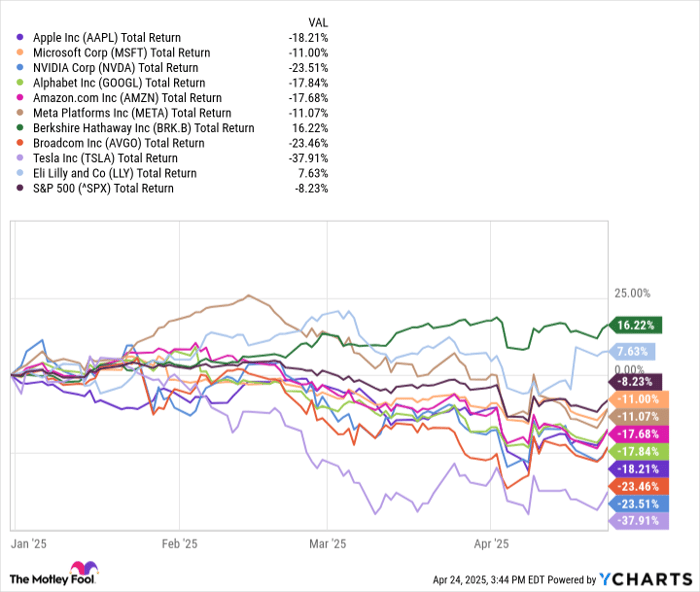
AAPL Total Return Level data by YCharts
With the exception of Berkshire and Lilly, each of the stocks cited above is underperforming the S&P 500 so far this year as of this writing.
What does all of this really mean?
There are a couple of different ideas I'd like to unpack given the data and these specific stocks.
First, it's not entirely surprising to see such a precipitous drop in high-growth technology stocks such as the "Magnificent Seven." Thanks to the bullish narratives fueling artificial intelligence (AI), investors have been flocking in droves (herd mentality) to invest in megacap tech stocks during the past couple of years. This has resulted in an unprecedented run for most of big tech. But during times of economic uncertainty (like now), it's not uncommon for investors to take some gains off the table and reallocate funds into consumer defensive stocks, index funds, commodities such as gold, or dividend stocks.
In other words, volatile growth stocks may not be seen as favorably at the moment, and so investors seek out what they think are safer opportunities. What's a little ironic is that the Magnificent Seven stocks have certainly experienced some episodes of volatility during the past two years, so why is now really any different in the grand scheme of things? Mark it down to recency bias.
The second point I'd like to make is that even though many of the growth stocks above are underperforming the market this year, their overall weight in the S&P 500 remains enormous. What this implies is that even though these stocks aren't performing well right now, there are a number of important factors to consider about their dominance.
To start, each of the top 10 stocks above are still being held by a number of influential institutional funds with long-term investment theses and strategies at their core. In addition, the Magnificent Seven, Berkshire, and Lilly all dominate their respective sectors in technology, financial services, and pharmaceuticals. Given these sectors are popular with both hedge funds and retail investors, it's likely that the recent sell-offs will be temporary and these companies will remain favorable in the long run.
At a high level, investing in any of the stocks above provides exposure to high-growth industries such as artificial intelligence (AI), cloud computing, cybersecurity, e-commerce, the red-hot weight-loss market in pharma, and more. In my eyes, each of the top 10 S&P 500 stocks could be seen as a good buy right now depending on your sector preference and risk tolerance.
Should you invest $1,000 in S&P 500 Index right now?
Before you buy stock in S&P 500 Index, consider this:
The Motley Fool Stock Advisor analyst team just identified what they believe are the 10 best stocks for investors to buy now… and S&P 500 Index wasn’t one of them. The 10 stocks that made the cut could produce monster returns in the coming years.
Consider when Netflix made this list on December 17, 2004... if you invested $1,000 at the time of our recommendation, you’d have $594,046!* Or when Nvidia made this list on April 15, 2005... if you invested $1,000 at the time of our recommendation, you’d have $680,390!*
Now, it’s worth noting Stock Advisor’s total average return is 872% — a market-crushing outperformance compared to 160% for the S&P 500. Don’t miss out on the latest top 10 list, available when you join Stock Advisor.
See the 10 stocks »
*Stock Advisor returns as of April 28, 2025
John Mackey, former CEO of Whole Foods Market, an Amazon subsidiary, is a member of The Motley Fool's board of directors. Suzanne Frey, an executive at Alphabet, is a member of The Motley Fool's board of directors. Randi Zuckerberg, a former director of market development and spokeswoman for Facebook and sister to Meta Platforms CEO Mark Zuckerberg, is a member of The Motley Fool's board of directors. Adam Spatacco has positions in Alphabet, Amazon, Apple, Eli Lilly, Meta Platforms, Microsoft, Nvidia, and Tesla. The Motley Fool has positions in and recommends Alphabet, Amazon, Apple, Berkshire Hathaway, Goldman Sachs Group, Meta Platforms, Microsoft, Nvidia, and Tesla. The Motley Fool recommends Broadcom and recommends the following options: long January 2026 $395 calls on Microsoft and short January 2026 $405 calls on Microsoft. The Motley Fool has a disclosure policy.
Recommended Articles


