


Does Stanley Druckenmiller Know Something Wall Street Doesn't? The Billionaire Investor Is Worried About a Repeat of 1970s Market-Crushing Inflation.
Few have mastered the art of consistency better than Stanley Druckenmiller. The George Soros protege never had a losing year while running Duquesne Capital Management for three decades and generated average annual returns of 30%. Druckenmiller is an astute observe of macroeconomics and keeps a close eye on the economy and the bond market, which is likely a big reason for his success. While the market has cheered the Federal Reserve's recent decisions to lower interest rates, Druckenmiller in several interviews now has been skeptical.
Does the billionaire investor know something that Wall Street doesn't? Let's take a look.
Did the Fed move too early?
A few weeks ago, reports from an industry conference revealed that Druckenmiller has bets against U.S. Treasury bonds that account for 15% to 20% of his portfolio. Many were surprised by the move because the Fed has begun lowering interest rates. Bond yields normally follow the Fed to some degree and have an inverse relationship with bond values, so if yields are going to move lower shouldn't bonds move higher?
At the conference, Druckenmiller reportedly mentioned concerns about fiscal recklessness, hinting he might be concerned about yields moving higher due to worries about the U.S. Government's growing debt load.
On a recent podcast called In Good Company, Druckenmiller confirmed that he is concerned about the federal deficit and believes there will eventually be a reckoning. Investors are tolerating the government's financial situation because the U.S. dollar is the world's reserve currency. Things could start to get murky later next year or in early 2026, he said.
Druckenmiller is also concerned that the Fed hasn't beat back inflation:
I'm a little worried that the Fed has declared victory too early... I don't have conviction like I had in 2021 that inflation was going to go up, that's when the money supply was growing 40% and all sorts of things were happening, but I also don't have conviction that they've snuffed this thing out and won the battle.
Druckenmiller said that the Fed cutting while credit spreads are narrow, Gold and stocks surging, and real evidence of a weak economy "makes me nervous that this thing could turn up again." Druckenmiller also seems to be worried about a repeat of the high inflation seen in the 1970s because, he said, if this scenario is to repeat itself, then inflation would have ideally bottomed now.
In the 1970s, inflation catapulted to nearly 9% before hitting 12% later in the decade and peaking at 14% by 1980. Part of the problem started in the early 1970s when the Fed grew the money supply. Sound familiar? High inflation and high oil prices put a dent in market returns in the 1970s. The market grew but only generated average annual returns of about 4%, well below the market's lifetime average annual returns.
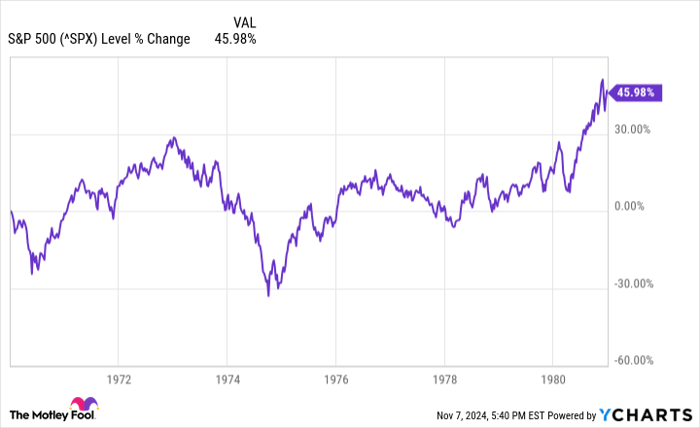
^SPX data by YCharts
Debt issues may force the Fed's hand
The Federal Open Market Committee (FOMC) recently trimmed interest rates by another quarter point. Interestingly, the FOMC's statement removed a line from the last meeting that said, "The Committee has gained greater confidence that inflation is moving sustainably toward 2 percent..." Instead, it noted that the risks of achieving employment and inflation goals are "roughly in balance."
Druckenmiller's concerns about reckless fiscal spending and the Fed moving too early may collide and create a situation where inflation is inevitable.
The billionaire hedge fund investor Paul Tudor Jones recently raised this point on CNBC ,saying, "All roads lead to inflation." Jones is worried the Fed will have no choice but to keep interest rates low because of the U.S. national debt. Low rates could reignite inflation, especially if the Fed moved too early. A lot remains to be seen, and Druckenmiller seems to be pointing out a repeat of the 1970s as more of a risk. However, his portfolio also indicates that this could occur with his bets against Treasury bonds, so investors should be mindful. Druckenmiller may indeed be onto something that Wall Street hasn't yet spotted.
Where to invest $1,000 right now
When our analyst team has a stock tip, it can pay to listen. After all, Stock Advisor’s total average return is 873% — a market-crushing outperformance compared to 176% for the S&P 500.*
They just revealed what they believe are the 10 best stocks for investors to buy right now…
See the 10 stocks »
*Stock Advisor returns as of November 4, 2024
The Motley Fool has a disclosure policy.
Recommended Articles


