


VIG vs NOBL: Which Dividend ETF Should You Buy Now?
Key Points
VIG costs less to own and has outperformed NOBL over the past year and five years.
NOBL offers higher dividend yield and invests in companies with a strong track record of dividend raises.
VIG offers lower costs and a unique feature that filters out stocks high-yield stocks.
- 10 stocks we like better than ProShares S&P 500 Dividend Aristocrats ETF ›
Both the Vanguard Dividend Appreciation ETF (NYSEMKT:VIG) VIG and the ProShares S&P 500 Dividend Aristocrats ETF (NYSEMKT:NOBL) target companies with a proven record of growing dividends. Their approaches, however, diverge.
VIG tracks a broader swath of large-cap U.S. stocks with a dividend-growth tilt, while NOBL zeroes in on S&P 500 firms with the longest dividend growth streaks and applies equal weighting. VIG also stands out for its significantly lower cost and stronger historical returns, while NOBL offers a higher yield and a more focused, equally weighted approach to dividend growth stocks.
This comparison unpacks how those differences show up in cost, performance, risk, and portfolio composition, helping investors make informed decisions.
Snapshot (cost & size)
| Metric | VIG | NOBL |
|---|---|---|
| Issuer | Vanguard | ProShares |
| Expense ratio | 0.04% | 0.35% |
| 1-yr total return (as of 2026-03-21) | 11.8% | 5.7% |
| Dividend yield | 1.6% | 2% |
| Beta | 0.81 | 0.76 |
| AUM | $123.8 billion | $10.9 billion |
Beta measures price volatility relative to the S&P 500; beta is calculated from five-year monthly returns. The 1-yr return represents total return over the trailing 12 months.
VIG is considerably more affordable, charging just 0.04% in annual fees versus NOBL's 0.35%, and it is also much larger in terms of assets under management. NOBL offers a higher dividend yield by 0.4 percentage points, appealing to those who prioritize current income.
Performance & risk comparison
| Metric | VIG | NOBL |
|---|---|---|
| Max drawdown (5 y) | -20.4% | -17.91% |
| Growth of $1,000 over 5 years | $1,478 | $1,229 |
What's inside
NOBL holds nearly 70 stocks, with a portfolio that is equally weighted and sector exposure capped at 30%. As of its most recent data, the largest sector weights are industrials (22.5%), consumer defensive (22.09%), and financial services (13.08%). Its top holdings as of March 20 include Chevron (NYSE:CVX), ExxonMobil (NYSE:XOM), and Linde (NASDAQ:LIN), each making up just over 1.7% of assets. The fund has been around for 12.4 years, offering a focused yet diversified approach to U.S. dividend growth leaders.
VIG, by contrast, casts a wider net with 338 holdings and a tilt toward technology (24.5%), financial services (20.6%), and healthcare (16.8%). Its largest positions as of Feb. 28 were Broadcom(NASDAQ:AVGO), Apple (NASDAQ:AAPL), and Eli Lilly (NYSE:LLY), each making up between 3.7% and 5.9% of total assets.
For more guidance on ETF investing, check out the full guide at this link.
What this means for investors
For investors seeking a steady stream of passive income, dividend ETFs offer a blend of regular income with instant diversification by holding a basket of stocks. The Vanguard Dividend Appreciation ETF and the ProShares S&P 500 Dividend Aristocrats ETF are both quality dividend ETFs focused on dividend growth.
NOBL invests exclusively in Dividend Aristocrats®. The term Dividend Aristocrats® is a registered trademark of Standard & Poor’s Financial Services LLC, a subsidiary of the S&P 500 Global (NYSE:SPGI). It is an elite group of S&P 500 stocks that have increased their dividends for at least 25 consecutive years. The focus, therefore, is on companies that exhibit strong fundamentals, with earnings and cash flow growth that can support larger dividend payouts year after year.
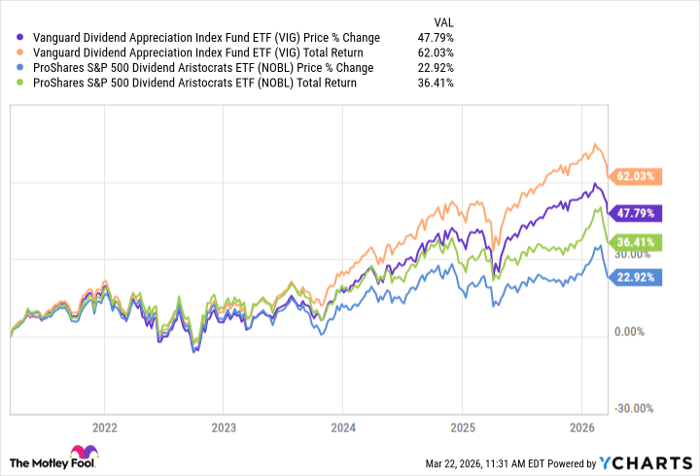
VIG data by YCharts
VIG also focuses on dividend growth stocks, but it has a lower benchmark for dividend raises than NOBL. That’s because VIG tracks the S&P U.S. Dividend Growers Index, which includes companies that have increased dividends for at least ten consecutive years. One quirk is that the index excludes the 25% highest-yielding companies, possibly to remove high yields that may be unsustainable. This provides a strong safety net for investors and is one of the biggest reasons VIG has outperformed NOBL by such a wide margin over the years.
While past performance does not guarantee future returns, VIG appears to be a less risky bet with significantly lower costs as well.
Should you buy stock in ProShares S&P 500 Dividend Aristocrats ETF right now?
Before you buy stock in ProShares S&P 500 Dividend Aristocrats ETF, consider this:
The Motley Fool Stock Advisor analyst team just identified what they believe are the 10 best stocks for investors to buy now… and ProShares S&P 500 Dividend Aristocrats ETF wasn’t one of them. The 10 stocks that made the cut could produce monster returns in the coming years.
Consider when Netflix made this list on December 17, 2004... if you invested $1,000 at the time of our recommendation, you’d have $495,179!* Or when Nvidia made this list on April 15, 2005... if you invested $1,000 at the time of our recommendation, you’d have $1,058,743!*
Now, it’s worth noting Stock Advisor’s total average return is 898% — a market-crushing outperformance compared to 183% for the S&P 500. Don't miss the latest top 10 list, available with Stock Advisor, and join an investing community built by individual investors for individual investors.
See the 10 stocks »
*Stock Advisor returns as of March 22, 2026.
Neha Chamaria has no position in any of the stocks mentioned. The Motley Fool has positions in and recommends Apple, Chevron, ProShares S&P 500 Dividend Aristocrats ETF, S&P Global, and Vanguard Dividend Appreciation ETF and is short shares of Apple. The Motley Fool recommends Broadcom and Linde. The Motley Fool has a disclosure policy.
Recommended Articles


